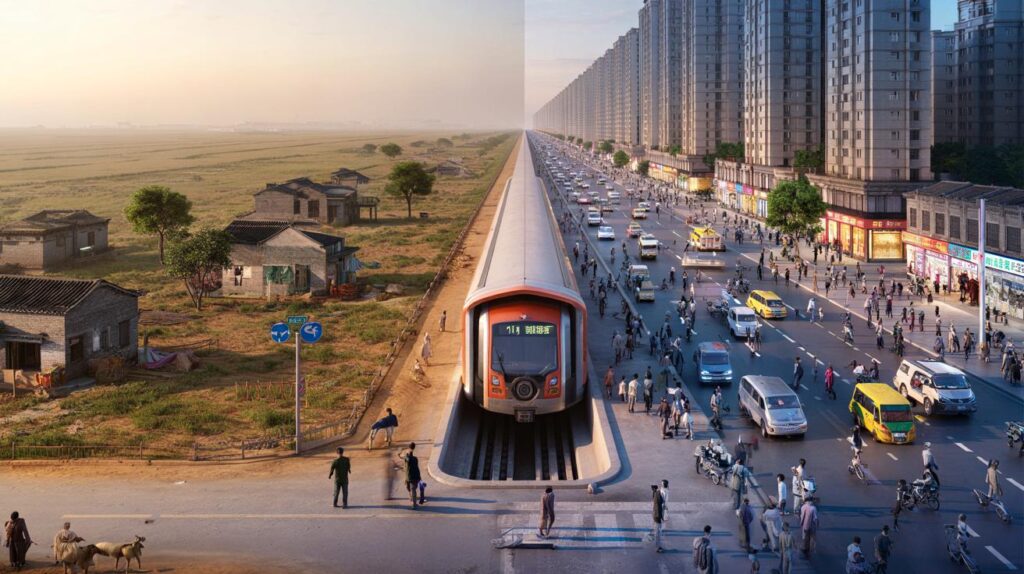
The first time I saw one of those “ghost” subway stations in China was from the window of a cheap long-distance bus in 2008. Outside, the road was flanked by fields, dusty brick houses, a lone billboard half torn by the wind. Then suddenly, out of nowhere, a glossy concrete structure appeared, glass panels shining, a bold blue “Metro” sign pointing to a staircase that seemed to sink into the ground. No towers, no malls, no crowds. Just a station standing in an empty landscape like a prop from a science-fiction movie.
The driver snorted and muttered something that made the whole bus chuckle.
A subway to nowhere. That was the joke.
 I’ve spent hundreds of hours on long Amtrak rides. Here are my 10 best tips for first-time riders.
We didn’t know the punchline yet.
From “stations in the fields” to city centers in waiting
Around the time of the Beijing Olympics, these scenes popped up across China. Sleek subway entrances rose next to corn patches, muddy lanes and two-story farmhouses with laundry flapping in the wind. For many foreign visitors, it felt surreal. You’d step out of a spotless, air-conditioned metro car… and be greeted by a goat tied to a pole and an old man selling sunflower seeds.
The question hung in the air, unspoken: who on earth is going to use this?
Urban planners in China had a term for this strategy: “stations in the fields.” Lines like Beijing’s Line 4 and Line 13, parts of Shanghai’s sprawling network, parts of Shenzhen’s early extensions, pushed deep into areas that, at the time, barely qualified as suburbs. Some stations serviced more construction cranes than commuters.
There were photos on early social media of empty platforms, silent escalators, and lonely ticket machines. People shared them as proof of excess, calling these places “ghost subways,” a cousin to the famous “ghost cities” story that Western media loved. It fit a simple narrative: China was overbuilding.
What we missed was that those fields weren’t meant to stay fields. Local governments had already drawn future skylines on planning maps. The subway wasn’t an accessory to that growth; it was the trigger. Once a station was confirmed, land prices nudged up. Developers arrived with glossy brochures promising “metro lifestyle.” Families stretched their budgets to buy apartments precisely because there was a line nearby, even if it looked absurdly premature in 2008.
The “waste” we laughed at was, in many places, a down payment on a future city.
Fast-forward to 2025: who’s laughing now?
Take the case of Beijing’s Tiantongyuan, once mocked as a remote bedroom community at the northern end of the line. In the late 2000s, people complained about moving there the way people elsewhere complain about being exiled to the edge of the world. The metro station was there early, serving sparse traffic and endless speculation.
Visit at 8:30 a.m. in 2025 and you’ll be swept by a river of bodies, shoulder-to-shoulder, every square meter of platform claimed.
Or go to Shanghai’s Pudong, where, in the early 2000s, entire stretches of new lines ran past half-empty plots and lonely high-rises. At the time, a lot of foreign analysts pointed to aerial photos and said, “Look, no one lives there.” Today, those same stops are anchored by malls, office parks, schools, and residential blocks whose windows all glow at night.
What used to be a punchline about “subways built for ghosts” has turned into a daily reality of **record-breaking ridership**, smashed rush-hour capacities and packed trains where you sometimes need two or three passes to squeeze in. Cities that felt oversized on paper are now wrestling with how to expand platforms or add trains just to cope.
From a distance, it’s easy to call this luck or brute-force spending. On the ground, the pattern is more deliberate. China built transport first, density second. That flips the script used in many Western cities, where debates drag on for years until population pressure becomes unbearable, land prices soar, and only then does a transit line limp into existence. By 2025, you can see the difference in commuting habits, car ownership, and even where young people choose to live.
Let’s be honest: nobody really does this every single day, but try spending a week in a Chinese mega-city without touching the metro and you’ll feel how central those early, “naive” investments have become.

What this long-game thinking can teach the rest of us
There’s a simple, almost boring method behind the spectacle: align transport with where you want people to live and work, not where they already are. Chinese planners plotted out future residential clusters, university campuses, industrial parks. Then they punched rail lines straight to those future hubs, long before the coffee shops and daycare centers appeared.
It’s like laying the veins before the body finishes growing. The shape that follows becomes less random, more connected.
Many cities elsewhere do the opposite. They wait until congestion is unbearable, then extend a line timidly by a couple of stations. By that point, land near the center is unaffordable, car culture is entrenched, and every new project sparks years of protest, lawsuits and budget fights. When people saw China’s empty stations in 2008, they judged them with this short-term mindset.
We’ve all been there, that moment when you look at a half-empty new tram line or bike lane and think, “Nobody’s using this, what a waste.” Yet adoption often lags behind infrastructure. *Usage grows into space that exists; it rarely materializes out of thin air.*
There’s a plain-truth sentence hidden in the Chinese case: **cities get the transport they’re brave enough to build early**. A former planner in Chengdu summed it up to me one evening over instant noodles in a station canteen:
“People said we were crazy to run trains to fields,” he said. “Now those fields are gone. The only thing people complain about is that the trains are too full.”
Beside his quote, three rough lessons stand out, the kind of thing any city, rich or poor, can adapt:
- Plan rail with a 20–30 year horizon, not a 5-year election cycle.
- Put stations where you want future density, not just current demand.
- Accept a few quiet years now to avoid crisis-level overload later.
These aren’t glamorous, and they don’t make viral images as easily as “ghost stations,” yet they quietly shape how millions move every day.
Naivety, hindsight and the cost of short vision
By 2025, walking through those once-lonely stations, you feel a strange mix of déjà vu and mild embarrassment. The platforms that foreign headlines once framed as absurd overreach are now routine backdrops to teenagers scrolling short videos, grandparents hauling groceries, office workers power-walking between connections. The emptiness that made such good photos has been crowded out by lived reality.
The joke aged badly. The concrete did not.
This doesn’t mean every Chinese metro project was perfect. Some lines still feel overbuilt, some stations are quieter than planners hoped, and funding models carry their own risks. Yet the broad picture remains: a willingness to bet big on future ridership, to accept years of underuse as the price of long-term coherence. That’s the part that stings when other countries look back at their own choices.
How many cities, stuck in traffic purgatory in 2025, would trade a decade of “too empty” trains for the next twenty years of reliable, car-free mobility?
So the story of those 2008 stations in the middle of nowhere is less about China alone and more about how we perceive time. We call things naive when we measure them against today’s demand instead of tomorrow’s needs. We swipe through images of empty infrastructure and confuse quiet with failure. Then, one day, we step off a train into a bustling district that used to be farmland and realize the punchline was on us.
The real question isn’t whether China overbuilt. It’s whether the rest of us under-dreamed.
| Key point | Detail | Value for the reader |
|---|---|---|
| Build transit before density | Chinese metros reached “fields” years before towers and malls arrived | Offers a mental model for long-term infrastructure in your own city |
| Expect a quiet phase | Early “ghost” years gave way to packed trains and mature neighborhoods | Helps you read “empty” projects as seeds, not mistakes |
| Think beyond election cycles | Lines were planned on 20–30 year horizons, weathering early criticism | Encourages patience and support for ambitious, future-focused projects |
FAQ:
- Question 1Were those Chinese “ghost” subway stations really empty in 2008?
- Answer 1Many had very low ridership at first, especially terminal stations near farmland or construction sites, but they were built with expected future growth in mind.
- Question 2Did all of those early metro extensions eventually fill up?
- Answer 2Most urban lines in major cities like Beijing, Shanghai, Shenzhen and Chengdu are now heavily used, though a few edge stations and smaller-city projects still feel underutilized.
- Question 3Was this just a political showcase, or real planning?
- Answer 3There was politics and prestige, but also detailed land-use planning that tied new residential zones, business parks and universities directly to future transit lines.
- Question 4Could Western or developing cities copy this “build first” strategy?
- Answer 4Not at the same speed or scale, yet the core idea—aligning long-term housing and jobs with early transit—can absolutely be adapted with smaller, phased projects.
- Question 5What’s the personal takeaway for someone stuck in traffic today?
- Answer 5When new transit or bike lanes seem “too empty,” remember China’s 2008 stations: supporting them early is how you get a livable city later.