Along Panama’s Pacific coast, a normally reliable ocean engine stalled in early 2025, leaving researchers, fishers and coastal communities facing an unprecedented disruption to marine life and local climate conditions.
The ocean engine that suddenly stopped
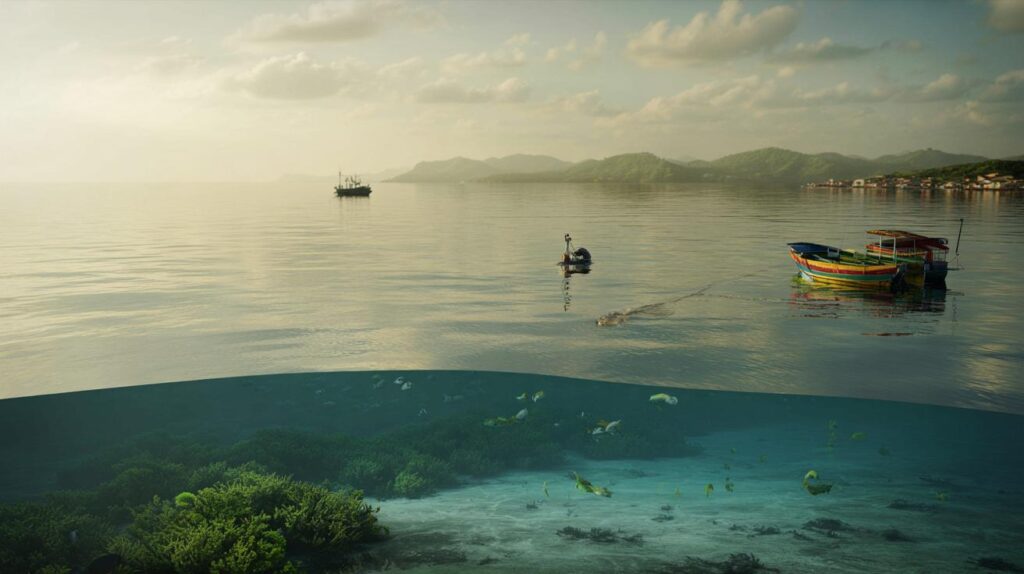
Every dry season, from December to April, the Gulf of Panama usually runs on a powerful but invisible mechanism: coastal upwelling. Trade winds push warm surface waters away, allowing colder, nutrient-rich deep waters to rise. That surge of nutrients feeds microscopic algae, supports busy fisheries and keeps coral reefs a few crucial degrees cooler.
In 2025, that system failed. Satellite images showed almost no chlorophyll signal in February — a clear sign that phytoplankton, the base of the marine food web, had not responded as it normally does. At the same time, ocean buoys and shipboard sensors detected no drop in surface temperatures and no spike in nutrients in the upper layers.

The Gulf of Panama went through its dry season without its usual pulse of cold, fertile water — a first in at least four decades.
An international team led by the Smithsonian Tropical Research Institute, working with Germany’s Max Planck Institute, pieced together the anomaly using satellite data, ship measurements and atmospheric simulations. Their work, published in the journal PNAS, describes a rare but highly revealing breakdown of a tropical upwelling system.
Why Panama’s upwelling usually matters so much
Panama’s coastal upwelling is smaller than the famous Humboldt or California systems, but it plays an outsized role locally. When deep waters rise, three things happen at once:
- Phytoplankton bloom, driving rich food webs and coastal fisheries.
- Surface waters cool, slightly moderating the local climate and sea-breeze temperatures.
- Coral reefs gain a thermal buffer during some of the year’s hottest weeks.
For at least 40 years, instruments have recorded a repeatable pattern: a marked drop in sea surface temperature and a sharp rise in chlorophyll concentrations each dry season. That regularity allowed researchers to treat the Gulf of Panama as a relatively stable tropical system, even as global warming intensified.
With the 2025 breakdown, that assumption of stability has vanished, and with it a degree of comfort for coastal communities that depend on predictable seas.
Weakening winds and a broken pattern
At the heart of the 2025 event lies a shift in the trade winds. Data from the research vessel S/Y Eugen Seibold showed that the usually steady northerly winds became unusually weak and erratic during the critical early months of the year.
Without strong trades to push surface waters offshore, the pressure difference that normally drags deep water upward simply never formed.
Atmospheric models found that this wind collapse lined up with broader pressure anomalies over the eastern tropical Pacific. Researchers point to two overlapping suspects:
| Potential driver | Role in the 2025 event |
|---|---|
| Natural decadal variability | Patterns such as the Pacific Decadal Oscillation can shift wind belts and atmospheric pressure over many years. |
| Human-driven climate change | Warming oceans and altered temperature gradients can weaken or redirect the tropical trade winds. |
The study does not pin the event on a single cause. Instead, it suggests that long‑term warming and natural variability likely interacted, nudging the regional climate beyond the threshold needed to sustain the usual upwelling.
Fishers, corals and microbes feel the shock first
The physical shift in winds and water movement rapidly translated into biological and economic shocks.
Fewer nutrients, fewer fish
With no deep, nutrient-rich water reaching the surface, phytoplankton growth remained unusually low. That meant less food for zooplankton, small fish and, eventually, commercially important species.
Artisanal fleets targeting mackerel, sardines and certain squid species reported steep drops in catch. For many coastal households, where fishing income pays for food, school fees and fuel, that sudden downturn added pressure on already thin margins.
A single season without upwelling translated into empty nets and tighter budgets across multiple Panamanian fishing villages.
Local authorities now face difficult questions: was 2025 a one-off shock, or the start of a more erratic pattern that will complicate fisheries management and food security planning?
Coral reefs without their seasonal shield
Coral reefs in the region rely on upwelled waters for another reason. Those colder pulses typically shave a few degrees off sea temperatures during the dry season, just when solar radiation is intense and heat stress peaks.

Without that relief in 2025, coral colonies were exposed to unusually long stretches of warm water. That raised the risk of bleaching, a stress response in which corals expel the algae that feed them and give them colour. Repeated or prolonged bleaching can kill large sections of a reef.
Warmer, more stagnant water also tends to carry less oxygen and allows some pathogens to spread more easily. Researchers warn that sensitive bottom-dwelling organisms and reef-associated species could suffer lasting damage if such warm anomalies recur.
A climate blind spot in the tropics
One of the most unsettling aspects of the 2025 event is how close it came to going unnoticed. Tropical upwelling zones like Panama’s are poorly monitored compared with better‑known regions off California, Peru or northwest Africa.
The Panama anomaly was captured only because a dedicated research campaign happened to be underway, with ship-based sensors and satellite analysis already planned. In many similar regions, there are no such continuous records.
Large stretches of the tropical ocean still function as a climate blind spot, where major shifts can unfold with almost no real-time scientific oversight.
Researchers argue that this gap directly limits the reliability of climate models and seasonal forecasts. Without sustained data — from satellites, drifting buoys, moorings and research cruises — models struggle to represent sudden breakdowns in processes like upwelling, or to project how often they might occur in a warmer world.
Why better monitoring changes real-world decisions
For governments and local communities, better ocean monitoring is more than a scientific luxury. It can support:
- Fisheries quotas that respond quickly to drops in productivity.
- Early warnings for heat stress on coral reefs, giving managers time to restrict tourism or local impacts.
- Food security planning when coastal catches fall short.
- Insurance and risk assessments for sectors tied to marine conditions, such as tourism and aquaculture.
International teams are now pushing for expanded observation networks across tropical basins, combining low-cost sensors, satellite data and coastal stations. The 2025 Panama event is being used as a case study to argue for that investment.
What “upwelling failure” really means for the climate
To non-specialists, an “upwelling failure” might sound like a technical detail. In climate terms, it signals a deeper shift. Upwelling zones help lock carbon and nutrients into predictable seasonal cycles. When those cycles wobble, several feedbacks can change at once.
For instance, if nutrient delivery remains weak for several years, some fish populations may relocate or shrink. That can alter where and how carbon and nitrogen move through the ecosystem. Surface waters without productive plankton can also absorb heat differently, potentially feeding back into local weather patterns.
Scientists are now running new simulations to test several scenarios:
- Rare, isolated upwelling failures that ecosystems can recover from within a few years.
- Frequent weak seasons, gradually lowering average fish productivity.
- Permanent shifts in wind patterns that move or sharply reduce upwelling zones.
Each pathway carries different implications for coastal economies and regional climate, from fisheries re‑zoning to changes in rainfall patterns on nearby land.
Key terms and what they mean in practice
Two scientific concepts underpin this story.
Phytoplankton are microscopic algae that float near the ocean surface. They photosynthesise like plants on land, taking up carbon dioxide and releasing oxygen. Large blooms feed zooplankton, small fish and, ultimately, top predators. When upwelling falters, these blooms shrink, and the entire food web feels the pinch.
Pacific Decadal Oscillation (PDO) is a long-term fluctuation in Pacific Ocean temperatures, typically cycling over 20–30 years. Different phases of the PDO shift where warm and cool waters sit, which in turn reshapes wind patterns. During certain phases, coastal regions such as Panama may be more exposed to weak trades and, therefore, to failed or reduced upwelling seasons.
For residents along the Gulf of Panama, these terms are starting to move from academic jargon to lived experience. The stalled upwelling of 2025 shows how a change in winds far offshore can reach all the way into kitchen budgets, reef health and the feel of the water at the beach.