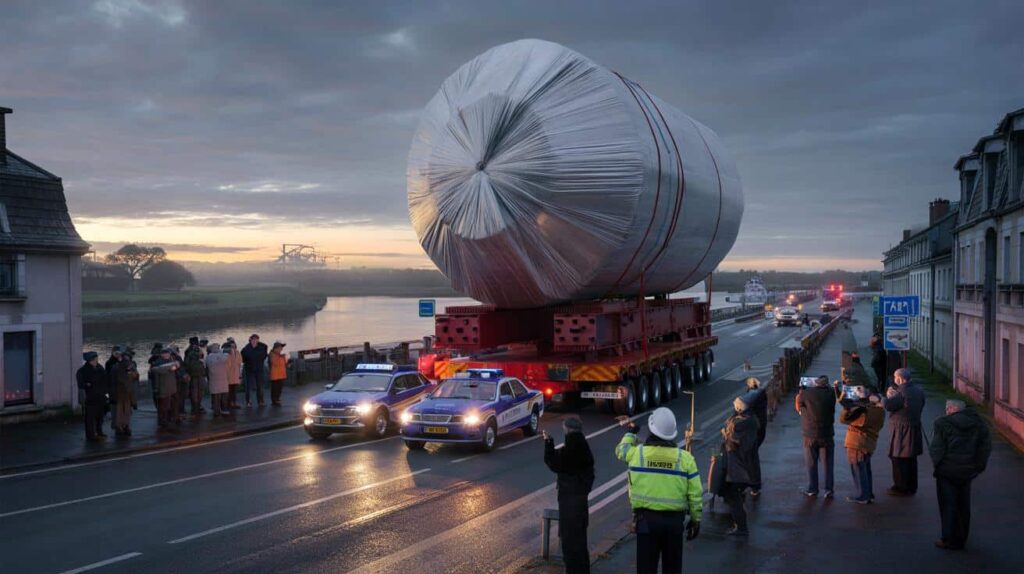
Just before dawn, on a gray Norman morning, a convoy rolled out of a French industrial yard carrying something that looked like a fallen piece of a spaceship. Wrapped in tarps, strapped to a multi-axle transporter that crawled more than it drove, the 500-tonne steel ring started its slow journey toward the sea. Workers in orange jackets watched in silence, phones raised, as the giant passed by with the gravity of a moving monument.
Hours later, cranes in the port of Dunkirk hoisted the load toward a waiting vessel bound for Britain. On board, you could already see the story headlines forming: France delivering the beating steel heart of the UK’s new nuclear age.
Some cargo doesn’t just cross borders. It crosses eras.

A 500-tonne symbol on the road and at sea
Seen up close, the component almost doesn’t look real. The 500-tonne steel unit, part of the reactor pressure vessel for Hinkley Point C, sits like a colossal bracelet, taller than a house and wider than a road. It was forged in France, in one of the few factories on the planet capable of handling such dense, precise metalwork.
Escorted by pilot cars, police, and a cloud of logistics staff, it rolled slowly through French roads before being loaded onto a heavy-lift ship heading across the Channel. A literal **piece of France** heading straight for the heart of the UK’s future power grid.
The story really started years ago in the furnaces of Burgundy. In the workshops of Framatome and the historic Le Creusot forge, teams worked with obscene temperatures and pressures to shape ultra-thick steel worthy of a nuclear core. One worker described the daily rhythm as “listening to metal breathe”.
Once machined, inspected, and certified under layers of regulations, the piece was transported by barge and custom-built trailers, often at walking speed. Locals gathered on bridges to film it, kids pointing at the strange, crawling convoy. For a few minutes, a very technical story became a village event.
What looks like a simple steel ring is in fact a concentrated dose of engineering, politics, and energy anxiety. This single component will sit near the core of one of Hinkley Point C’s two EPR reactors, designed by the French company EDF and its partners. The UK is paying tens of billions for the project, counting on it to supply around 7% of the country’s electricity when fully running.
Behind the impressive images of the convoy lies a blunt reality: Europe is grappling with how to keep the lights on without cooking the planet. Nuclear, with its promises and its fears, is back in the game.
How you move a steel giant and why it matters
There’s a very simple method behind this epic delivery: you break the journey into dozens of tiny, controlled steps. First, the steel piece is forged and machined in France. Then, engineers study each road, each bridge, each bend, and each tide at the port.
Transport teams rehearse the route, checking clearances sometimes down to a few centimeters. At sea, the ship’s captain waits for perfect weather windows to cross the Channel. On the British side, the choreography starts again, until cranes at Hinkley Point C finally lift the steel into place like a puzzle piece in a gigantic concrete ring.
 “We’ve misunderstood this for years”: the animal behavior change linked to extreme weather
From the outside, it’s easy to shrug and think, “Just another big thing on a truck.” Many of us scroll past these photos on social media between two cat videos. Yet behind this kind of project there’s a hidden web of risks and potential mistakes.
A miscalculated weight on a bridge, a forgotten local permit, a wind gust at the wrong moment during lifting operations, and months of work can be delayed, or worse. Let’s be honest: nobody really reads a 300-page transport safety plan every single day. Which is why teams obsess over procedures, checklists, and backup options so that people barely notice anything at all.
“People see a big ring of steel,” says a French logistics manager, “but what they’re really looking at is thousands of hours of paperwork, sleepless nights, and arguments about the best turn to take on a country road.”
- Scale – 500 tonnes of high-grade steel, one of the heaviest single pieces ever sent for a UK reactor.
- Route – Factory in France → road convoy → port loading → Channel crossing → British port → Hinkley Point C.
- Timeframe – A journey planned years ahead, executed over days, and designed to last for decades once installed.
- Impact – Key element for a plant meant to power around 6 million homes when both reactors are online.
- Message – France and the UK are tightly bound by concrete, steel, and electrons, even when politics wobble.
A new chapter for nuclear – and for Franco-British ties
For London and Paris, this 500-tonne delivery is more than industrial pride. It’s a handshake made of steel at a time when both countries are under pressure to clean up their energy mixes. The UK has shut down coal plants, faces aging gas infrastructure, and is haunted by memories of energy price spikes. France, rich in nuclear experience but scarred by delays and budget overruns at other EPR projects, wants to prove it can still deliver.
Each successful milestone at Hinkley Point C is a small victory for an entire industry trying to reinvent its reputation.
Across Europe, governments are recalculating their bets. Wind and solar are growing fast, yet they remain vulnerable to weather and storage limits. German factories worry about power prices, British households dread winter bills, French cities brace for heatwaves and grid stress. Nuclear is stepping back into the spotlight not as a silver bullet, but as a stabilizing backbone.
France’s role is central. With its fleet of 56 reactors (many of them aging), it has both the know-how and the urgent need to modernize. Exporting components to the UK is also exporting a model, an industrial ecosystem, and a certain idea of energy sovereignty.
The steel ring shipped to Hinkley Point C also carries a quiet emotional charge. We’ve all been there, that moment when you realize the things you took for granted – the light switch, the hot shower, the phone charger – depend on enormous and invisible systems.
*This is what that system looks like when it suddenly becomes visible, perched on a trailer or hanging from a crane over the Bristol Channel.* For some, it inspires awe. For others, unease. For many, it raises a simple, nagging question: who do we trust to run the machines that run our lives?
| Key point | Detail | Value for the reader |
|---|---|---|
| France’s 500-tonne delivery | Massive steel component for Hinkley Point C’s EPR reactor shipped from French forges to the UK site | Grasp the scale and ambition behind Europe’s new nuclear build |
| Strategic energy stakes | Hinkley Point C could supply about 7% of UK electricity once fully operational | Understand how one project can influence national bills and energy security |
| Franco-British cooperation | EDF, French supply chains, and UK funding tied together around a single nuclear plant | See how geopolitical relationships play out through steel, contracts, and electrons |
FAQ:
- What exactly is the 500-tonne steel component?It’s a massive forged steel section that will form part of the reactor pressure vessel system, the thick-walled structure that contains the nuclear core at Hinkley Point C.
- Why was it made in France and not in the UK?Only a handful of sites worldwide can forge and machine steel of this size and quality; France still has this heavy nuclear industrial capability through groups like Framatome and historical forges such as Le Creusot.
- How will Hinkley Point C affect UK electricity bills?In the short term, the project is expensive, but once operational it should provide large volumes of low-carbon baseload power, helping stabilize prices and reduce exposure to gas market spikes.
- Is nuclear power really low carbon?Over its full lifecycle (construction, fuel, operation, dismantling), nuclear emits far less CO₂ per kilowatt-hour than coal or gas, and is comparable to wind and solar, according to major scientific assessments.
- When is Hinkley Point C expected to start generating electricity?The project has faced delays and cost increases; the latest public timelines from EDF point to the late 2020s for the first reactor to start producing power, with the second following afterward.