The desert air in Jeddah hangs heavy and warm, even late at night. From the Corniche, people watch cranes blinking red against the sky, their booms tracing slow arcs above half-built towers. Kids lick melted ice cream; men in white thobes scroll through their phones, watching slick videos of something that doesn’t yet exist. A kilometer-high mirage of glass and steel, promised just beyond the horizon.
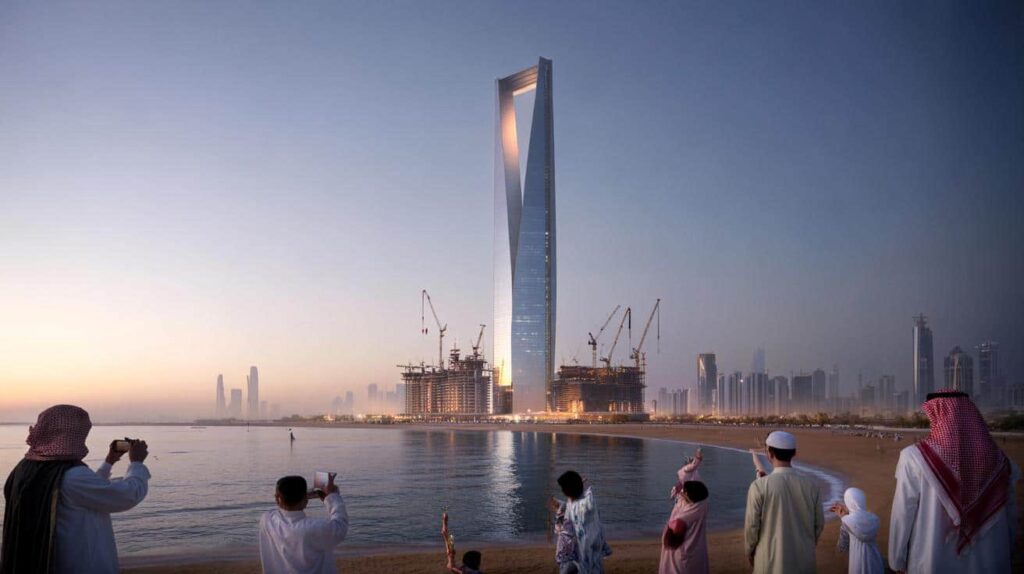
Someone points toward the dark inland and says quietly: “That’s where the new one will go. Taller than all of them.” No one laughs.
Forget Burj Khalifa. Forget Shanghai Tower. Saudi Arabia is quietly, stubbornly preparing to pull the sky a little closer.

The crazy part? This time, the race to the clouds isn’t just about bragging rights.
Saudi Arabia’s new obsession: touching the sky at 1,000 meters
On the dusty outskirts of Jeddah, the skeleton of a dream already sticks out of the ground. Concrete cores, rusted rebar, wind-whipped scaffolding: the early remains of what was once called Jeddah Tower, planned as the world’s first 1 km-high skyscraper. The site looks like a giant pressed pause halfway through the movie. Workers walked away years ago, leaving behind a strange monument to ambition and uncertainty.
Now the story is starting again. New tenders, fresh negotiations, and a simple, audacious goal: push past the Burj Khalifa’s 828 meters and build up to 1,000. In a world hooked on records and headlines, **Saudi Arabia wants the ultimate thumbnail image**.
The numbers alone are dizzying. A tower rising 1,000 meters would be roughly three Eiffel Towers stacked on top of one another. Engineers talk about elevators that travel faster than some trains, façades that withstand brutal Red Sea winds, and foundations bored deep into salty, unstable ground. At peak construction, thousands of workers could be on site, moving in a logistical dance where a single delayed concrete pour can derail a whole week.
On social media, renders of the proposed tower circulate like fan art for a future city: mirrored glass, sleek spires, elegant sky decks. Yet if you drive past the actual plot today, you mostly see construction fences and silence. That gap between glossy vision and stubborn reality is where this story is being rewritten.
Why does Saudi Arabia want this so badly? Because skyscrapers send a message that travels faster than any press release. A 1 km tower says: “We are here, we are serious, and we have the money to prove it.” The country is racing to diversify away from oil, to turn tourism, finance and tech into a second economic engine. A record-breaking tower becomes a lighthouse for that shift, pulling in foreign investors, luxury brands, and curious travelers.
Let’s be honest: nobody really flies to Dubai for the weather anymore. They come for the feeling of standing in front of something the rest of the world doesn’t have. Saudi Arabia is chasing that very specific emotional high.
From fantasy render to real building: how you even start a 1 km tower
On paper, a 1 km skyscraper starts with a simple gesture: push the foundation deeper than your fears. Engineers first study the soil, then redesign the structure, then study the soil again because the numbers still don’t feel safe enough. For Jeddah’s project, early plans called for a massive concrete mat and piles driven dozens of meters down, forming a sort of artificial bedrock. The base has to be wide, heavy, and incredibly dense, like an anchor holding down a vertical city.
From there, the building tapers. Each higher floor carries less weight but faces stronger wind. That’s why supertall towers often look like needles, broken into stacked “wings” or “petals” that cut the gusts instead of fighting them head-on.

The biggest mistake many people make when they look at those renderings is to think: “They’ll just copy the Burj Khalifa, right?” Skyscrapers don’t work like smartphone models. Every site, every climate, every political climate even, shapes the design. Saudi Arabia’s Red Sea humidity, heat, and occasional sandstorms demand different façades, different air systems, different materials.
And there’s the human side. We’ve all been there, that moment when a grand plan meets a brutal budget spreadsheet. A kilometer-high dream has to survive elections, oil price swings, global pandemics, and skeptical bankers in London and New York asking: “Who is actually going to pay the rent on the 180th floor?”
In a recent panel, a Gulf-based architect summed it up bluntly: “Building 1,000 meters is not a question of whether we can. It’s a question of why, and of who keeps signing the checks ten years in.” His point landed hard because everyone in the room had seen mega-projects stall mid-desert.
- Cost inflation: steel, concrete, and labor prices rarely stay still across a decade.
- Technology drift: elevator systems or glass façades planned today may feel outdated by opening day.
- Shifting politics: new leaders, new priorities, suddenly the tallest tower may not be the hottest idea.
- Climate pressure: a record-breaking carbon footprint is a PR nightmare without real green innovations.
- Public mood: citizens might ask why billions go up into the sky instead of down into schools and hospitals.
What a 1 km tower really means for you, me, and the future of cities
There’s a quiet truth behind all this steel and spectacle: a skyscraper this tall is less about square meters and more about storytelling. Saudi Arabia wants to rewrite its own narrative, from oil wells and closed borders to futuristic skylines and open visas. For a traveler, that might mean one day sipping coffee in a sky lobby above the clouds, then stepping out at ground level into a city that barely existed on the tourist map a decade earlier.
For locals, it could mean new jobs, new careers in engineering, hospitality, design. Or longer commutes, higher rents, and a sense that the city is growing for the world first, and for them second. The emotional balance is fragile.
Urban planners and climate activists watch these mega-towers with mixed feelings. On one hand, vertical density can be more efficient than endless sprawl. You need fewer roads, fewer pipes, fewer cables. On the other, cooling a glass giant in 40°C heat takes extraordinary energy unless the building is designed like a living machine: smart shading, advanced insulation, recycled water, integrated solar. *A 1 km skyscraper in 2035 cannot behave like a 300 m tower from 1995.*
The question quietly forming in the background is unsettling: is this the peak of our vertical obsession, or just a step toward 1.2 km, 1.5 km, even higher?
Look at the bigger picture. Alongside the Jeddah project, Saudi Arabia is pushing NEOM, The Line, and a supermarket of mega-concepts that feel almost sci‑fi. The coming tower is just one more piece in a mosaic of spectacle. Some will call it a vanity project. Others will see a country using bold architecture to fast‑forward its place in the global imagination.
What cannot be denied is the magnet effect. A 1 km tower will flood your feed, show up in travel videos, dominate news cycles, and inspire kids who draw cities taller than their notebooks. **The world’s tallest building doesn’t just change a skyline; it changes what people think is possible.** Whether that’s genius, madness, or both is still an open question.
| Key point | Detail | Value for the reader |
|---|---|---|
| Saudi Arabia targets 1 km | Reviving and retooling the Jeddah Tower plan to surpass Burj Khalifa | Understand where the next global “must‑see” skyline may emerge |
| Engineering and finance hurdles | Extreme foundations, wind, climate, and decade-long funding needs | See why such projects stall, and what it really takes to complete them |
| Symbolic and economic stakes | Tower as a “lighthouse” for investment, tourism, and national branding | Decode the real motives behind record-breaking skyscrapers |
FAQ:
- Will the Saudi 1 km tower actually be taller than Burj Khalifa?Yes, the project is designed to pass the Burj Khalifa’s 828 meters and reach roughly 1,000 meters, which would make it the tallest building on the planet if completed as planned.
- When could the 1 km tower realistically open?Timelines are fluid, but for a project of this scale, even with aggressive construction, you’re looking at close to a decade from a full restart to final opening.
- Is the Jeddah Tower project definitely back on?Saudi authorities have restarted tender processes and signaled renewed intent, yet final contracts, funding structures, and updated designs are still evolving behind closed doors.
- Can such a tall building be environmentally responsible?It can be significantly better than past supertalls if it uses advanced façades, renewable energy, and efficient cooling systems, though the sheer amount of materials and construction still carries a heavy footprint.
- Why do countries keep chasing “world’s tallest” titles?Because these towers act as instant global marketing—drawing attention, tourists, investors, and a sense of national pride that no billboard or slogan can match.