The first alert popped up in a quiet mission control room in Colorado. A tracking technician looked at his screen, frowned, then called a supervisor. A Chinese satellite had tweaked its orbit in a way no one fully expected, gliding a little too close to an American military communications bird already under stress from solar activity.
Nobody shouted. Nobody slammed a red button. People just leaned forward, shoulders tightening, voices dropping, the way they do when a small problem suddenly feels like the edge of something much bigger.
On another continent, in another control room, Chinese engineers were staring at near‑identical graphs, near‑identical warnings, near‑identical question marks.

This quiet moment in space came within a whisper of turning into something we’d rather not imagine.
When “peaceful space” almost snapped
From the outside, Earth orbit still looks like the future we were promised: bright rockets, smiling astronauts, and flags gently floating inside the ISS. From the inside, among the people who actually track each object spinning above our heads, the mood has changed. The word they use more and more is not “cooperation”, but **confrontation**.
Everyone saw the trend. Few wanted to admit how close it was getting to a breaking point. The Chinese flag on one screen, the American flag on another, and between them a thin line of code, course corrections and political nerves.
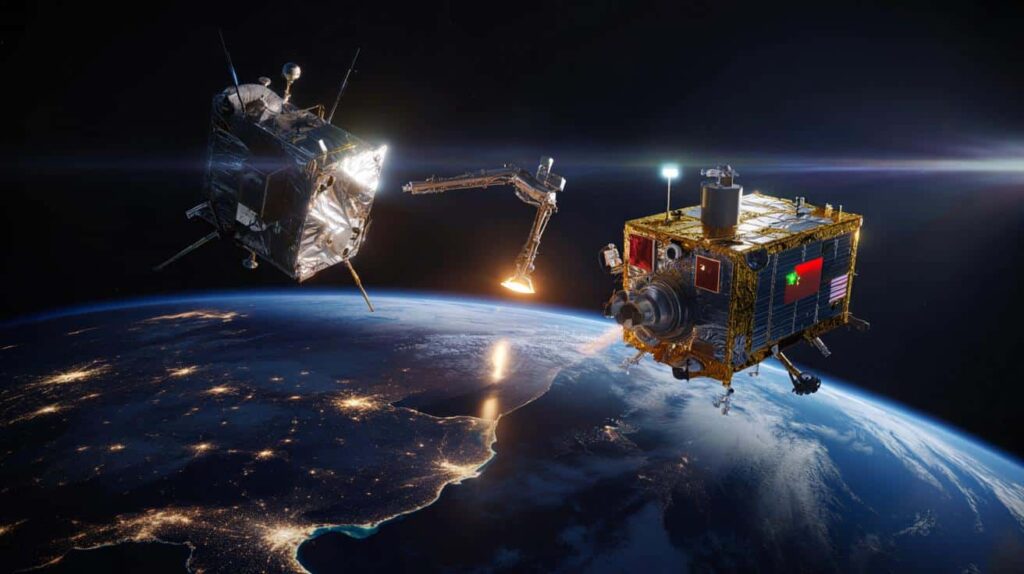
One U.S. analyst, speaking off the record, described a recent episode like this: “We had a Chinese ‘inspector’ satellite creeping toward one of ours. Too slow to call it an accident. Too deliberate to ignore.” The satellite in question could grab, nudge or cripple another spacecraft with a robotic arm. Officially, it was for debris cleanup and satellite servicing. Unofficially, Pentagon planners saw it as a potential orbital gun pressed to the temple of an American asset.
On Chinese state TV, commentators framed similar U.S. maneuvers near their satellites as “provocations in the heavens”. Each side kept the public story calm and technical. Behind closed doors, the tone was much sharper.
What made this standoff historic was not a single dramatic move, but the timing. China was racing to complete its Tiangong space station and lay the groundwork for crewed lunar missions. The United States, through NASA and SpaceX, was pushing its Artemis program and talking openly about a “sustained presence” on the Moon, with “commercial and allied partners”.
Strip away the legalese and you get something very old: who gets to plant hardware first, who writes the rules on the ground, who controls the high orbits that watch every battlefield on Earth. The peace rhetoric never vanished, it just floated on top of a much colder calculation.
The hidden rulebook above our heads
If there was one practical thing this near‑crisis exposed, it’s how flimsy the rules of the space game really are. The Outer Space Treaty from 1967 sounds noble: no nuclear weapons in orbit, space for peaceful purposes, exploration for all humankind. It was written before anyone imagined commercial mega‑constellations, reusable rockets, or anti‑satellite missiles that can shatter a spacecraft into a lethal cloud.
On the ground, you’d never let tanks from rival armies roam the same unmarked street with no traffic lights, no police and no agreed‑upon right of way. That’s almost exactly what we’re doing in orbit.
The last decade is a case study in how fast things can drift. In 2007, China tested an anti‑satellite weapon on one of its own weather satellites, creating thousands of fragments still zipping around the planet. Years later, the U.S., India and Russia all carried out their own versions of the same test. Each country wrapped the move in dry technical language, but space debris trackers still talk about those events like trauma.
We’ve all been there, that moment when everyone at a table knows things are getting tense, but nobody wants to be the first to say it out loud. Space diplomacy feels stuck exactly there.
The plain truth is: **most of the work to keep space “peaceful” now happens through improvised phone calls, hurried emails and private channels between agencies that barely trust each other**. When a satellite shifts course unexpectedly, analysts scramble to guess intent. Is it a test? A glitch? A warning? They have hours, sometimes minutes, to interpret a move that might have taken months to plan.
 Meteorologists warn early February may bring an Arctic disruption outside historical norms
*The reassuring speeches about humanity’s shared destiny among the stars start to sound thin when the people with the radar screens are whispering words like “jamming”, “blinding” and “pre‑positioned”.*
How to read the next space “incident” like an insider
There is a simple mental checklist that space analysts use, and once you know it, headlines about U.S.–China space tensions start to look different. First, they watch proximity: how close does one satellite come to another, and is that distance shrinking over time? Second, they look at capability: does the approaching craft have arms, lasers, jammers or the ability to grab and tow? Third, they note timing: does this maneuver line up with a summit, a crisis on Earth, or a key vote at the U.N.?
You can apply the same lens the next time you see a vague statement about “unprofessional behavior in orbit”.
Many of us instinctively hope each incident is just a misunderstanding. We want to believe mission control teams are always in sync, constantly calling each other, like drivers flashing their lights before a risky overtake. Let’s be honest: nobody really does this every single day. Notifications get lost. Diplomatic hotlines feel awkward. People fear that calling too often will make them look weak.
When the U.S. or China issues a bland line about “space safety concerns”, read it as a sign that some tense back‑and‑forth has probably already happened behind the scenes.
“Space is not a vacuum for politics,” a European space diplomat told me quietly. “We project our fears and ambitions up there just as easily as we launch rockets. The myth is that space will somehow stay above our rivalries. It won’t. Not by itself.”
- Watch the verbs in official statements: “approached”, “illuminated”, “tested”, “demonstrated” often hide sharp moves.
- Look at who speaks: defense ministries, not space agencies, usually mean the stakes are higher.
- Notice the orbit mentioned: low Earth orbit hints at comms and imaging; higher orbits often mean strategic command and control.
- Track repetition: a “one‑off” incident repeated three times starts to look like a message.
- Compare coverage: Chinese and U.S. media will frame the same event in completely different emotional tones. That contrast is part of the story.
What this near‑standoff really says about us
The almost‑confrontation between China and the United States in space didn’t end with a cinematic collision or a dramatic press conference. It fizzled out in spreadsheets, orbital plots and a set of quiet course corrections that most people never heard about. That’s precisely why it matters. The most consequential shifts in our relationship with space are happening offstage, in legal working groups, defense budgets and the whispered calculations of risk that guide each new mission.
If you strip the story down to its bones, you get a blunt question: do we want the sky above us to become just another contested border, or can we imagine something less tribal?
When schoolkids draw rockets, they rarely sketch jamming antennas or robotic grappling arms. They draw windows, stars, sometimes a cat floating in zero‑G. The fantasy of peaceful exploration is not just propaganda; it’s a genuine human impulse. Yet the past years have shown that leaving space to idealism alone is dangerous. Without tougher rules, more transparency and a basic willingness to talk honestly about worst‑case scenarios, the next close call might not stay quiet.
Some readers will shrug and think, “Space is for superpowers and billionaires, not for me.” Still, the GPS in your phone, the weather forecasts you trust, the live streams you scroll past at 2 a.m. all depend on that fragile orbital truce.
The standoff that almost was, between two satellites maneuvering in the dark, is a preview. As China’s lunar plans accelerate and the U.S. doubles down on its own Moon and Mars ambitions, overlaps will multiply. Who owns the ice in a shaded crater? Who decides a “safety zone” around a base? Who gets to turn off whose satellite if war breaks out on Earth? None of this has clear answers, yet hardware is already en route.
The illusion of guaranteed peace in space has cracked. What replaces it depends on whether we treat these near‑misses as forgettable technical hiccups or early warnings of a new, very high frontier dispute.
| Key point | Detail | Value for the reader |
|---|---|---|
| Fragile “peace” in orbit | U.S. and Chinese satellites already operate dangerously close, with dual‑use technologies | Helps you read beyond feel‑good space narratives and spot real tensions |
| Weak, outdated rules | Core treaties pre‑date modern space warfare tools and mega‑constellations | Shows why near‑crises keep happening and why debris and security risks are rising |
| How to decode incidents | Simple lenses: proximity, capability, timing, language and media framing | Gives you a quick method to interpret the next “space safety” headline like an insider |
FAQ:
- Question 1Did the U.S. and China really come close to a direct clash in space?Not in the Hollywood sense of exploding satellites, but there have been several episodes where both sides interpreted the other’s orbital maneuvers as deliberate pressure. Those moments triggered high‑level talks and contingency planning, which is as close to a standoff as you get without open conflict.
- Question 2Are “inspector” or “servicing” satellites actually weapons?They can be both. A robotic arm that can fix or refuel a satellite can also shove, spin or disable one. That dual‑use nature is what makes them so politically sensitive and hard to regulate.
- Question 3Does international law ban weapons in space?It bans weapons of mass destruction in orbit, not all weapons. Jammers, cyberattacks on satellites, blinding lasers or physical grappling devices live in a gray zone that current treaties barely touch.
- Question 4Could a space incident trigger a war on Earth?Yes. Many satellites are deeply woven into nuclear command, early‑warning and communications systems. If one side believes those assets are under attack, it can misread the move as preparation for a much larger strike.
- Question 5What would make space genuinely safer?More routine transparency about maneuvers, shared “rules of the road” for close approaches, bans on debris‑creating tests, and clear red lines around certain orbits and functions. None of this is easy, but each piece lowers the odds that a quiet blip on a radar screen becomes the starting gun for a crisis.