The room was still hot at 10 p.m., the kind of sticky warmth that clings to your skin even with the window open. On the TV, a weather presenter laughed as she pointed at a bright red map, joking about “another tropical night” as the comments on social media filled with memes about sleeping in the fridge. Someone typed “lol, global boiling” under the livestream. Another replied with the classic: “Remember when summers used to be fun?”
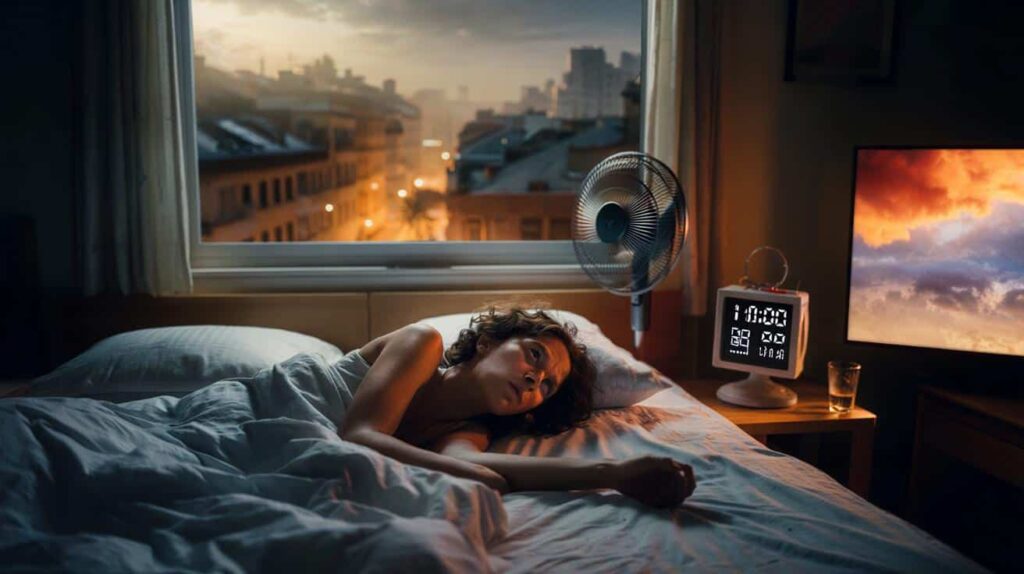
We’ve all been there, that moment when the forecast feels like background noise, more entertainment than warning. A passing joke, a quick scroll, and life goes on.
Except, scientists are starting to say: this particular signal we joke about isn’t a punchline anymore.

The joke we all share… that scientists are quietly tracking
Ask around at the office coffee machine or in a group chat: “Can you believe how warm the night was?” Someone will answer with a joke. “Didn’t even need a blanket.” “I slept like a rotisserie chicken.” We talk about hot nights like we talk about bad Wi-Fi, mildly annoyed but ultimately amused.
Yet climate researchers have a different name for these sweaty, restless nights. They call them **tropical nights** or “warm nights” – when temperatures don’t drop below around 20°C (68°F). It sounds almost pleasant. A vacation word.
On paper, it’s just one more weather line on an app. In reality, that line is starting to climb.
In Spain, Italy, Japan, southern US cities, the trend is being logged quietly in spreadsheets. Not just how hot the days are, but how little relief arrives after sunset. In Tokyo, for example, the number of tropical nights has exploded compared with the 1980s. The same curve appears in cities like Paris and New York, just starting from lower numbers.
Meteorologists in France now issue special alerts when a heatwave includes a streak of hot nights, because hospitals know what that means: more people struggling to recover, more calls to emergency services, more fragile bodies pushed over an invisible edge.
The story always looks the same: the first heatwave feels like news. By the third, it feels like a bad habit no one quite knows how to break.
So why are these nights no longer seen as benign background noise? Because our bodies, buildings, and cities are designed to cool down when the sun goes down. Nighttime is when we reset. Muscles repair, hearts rest, streets radiate away the day’s heat.
When the mercury refuses to fall, the whole system jams. Sleep gets lighter and shorter. Heart rates stay higher. The urban heat island effect – concrete trapping warmth – turns neighborhoods into slow cookers until dawn.
Climate scientists now treat rising **minimum night temperatures** as one of the clearest fingerprints of a warming planet. And the twist is cruel: it’s the part of the warming that many people still laugh about.
What warm nights really do to us (and what we can actually do back)
The first signal doesn’t show up in headlines. It shows up in your bedroom. You take longer to fall asleep, you toss more, you wake feeling like you barely rested. This isn’t just discomfort. Studies link hot nights with spikes in cardiovascular stress and higher mortality during heatwaves, even when daytime temperatures are the same.
Our bodies rely on a tiny drop in core temperature to fall into deep sleep. When the air around you stays above 24–25°C (75–77°F), that drop is harder to reach. That’s why even with a fan blasting, you wake feeling strangely wired and drained.
*The joke about “sweating through the sheets again” hides a real physiological cost.*
Let’s be honest: nobody really does this every single day. But small, consistent changes matter more than one dramatic purchase. Researchers and doctors often repeat the same advice, and it’s far less glamorous than buying a new air conditioner.
Cool the person, not just the room. Lukewarm showers before bed, damp cloth on pulse points, light cotton or linen sheets instead of thick synthetics. Keep curtains or shutters closed during the day so the room doesn’t turn into an oven by 6 p.m. Hydrate early, not just at night when you already feel parched.

The other trap? Pretending you’re “fine” because you’re young or “used to it”, while older neighbors or relatives are silently struggling through the same night.
Some researchers are blunt now when they talk about overnight heat.
“People joke about it because they survive one bad night,” says a climatologist from Barcelona. “But the signal we watch on our graphs isn’t one night. It’s the trend. And that trend is shouting.”
On a practical level, their advice can be surprisingly simple:
- Track night temperatures, not just daytime highs, during heatwaves.
- Check on anyone who is over 65, has heart or breathing issues, or lives alone.
- Arrange your bedroom so your bed is away from direct sun-heated walls.
- Use cross-ventilation when outside air is finally cooler than indoors.
- Create a “cool zone” at home: one room with a fan, shade, and plenty of water.
These aren’t miracle fixes. They’re small ways of treating hot nights as a real risk, not a meme.
From private discomfort to public warning sign
There’s a subtle mental shift that’s already happening in some cities. Weather services no longer speak only of “maximum temperatures”. They show nighttime minima as a headline detail during heatwaves, marking them in orange or red. Health agencies design warning plans around that number.
Urban planners now talk about trees, shade, fountains, even reflective roofs as tools not just for shade at noon, but for cooling the city enough so nights can breathe again. When asphalt and concrete are 5–10 degrees hotter at sunset, the night never really recovers.
This doesn’t feel like climate change in an abstract sense. It feels like opening your window at 1 a.m. and realizing the air outside is just as heavy as inside.
There’s also a social dimension that weather graphs don’t show. Who has an air-conditioned bedroom? Who can afford to let it run all night? Who lives on the shady side of the street, and who lives under a black tar roof that soaks up every ray of sun?
Researchers looking at mortality during European and US heatwaves noticed a cruel pattern. The same neighborhoods hit hard by pollution, noise, and lack of green space are also the ones where hot nights do the most damage. Warm nights quietly widen existing inequalities, one sleepless summer at a time.
That’s why some cities have started opening “night cooling centers” – not just daytime safe spaces – for people who literally cannot cool down at home.
So where does that leave our jokes? Maybe not in the trash, because humor is how many of us cope with anxiety. But behind every “lol, slept in a sauna again” comment lies a signal researchers are watching like a heartbeat monitor.
They see a future where what used to be rare – a week of tropical nights – becomes the default summer setting in many regions. They’re not trying to steal anyone’s fun. They’re trying to prepare us for what’s coming, one graph and one public warning at a time.
The shift is subtle: from laughing at the forecast to listening to what the nights are trying to tell us.
| Key point | Detail | Value for the reader |
|---|---|---|
| Rising warm nights are a climate signal | Nighttime minimum temperatures are increasing in many regions, reducing natural cooling | Helps you read forecasts differently and spot real risk beyond daytime highs |
| Health impact goes beyond discomfort | Hot nights hinder sleep, strain the heart, and are linked to higher mortality during heatwaves | Encourages you to take night heat seriously, especially for vulnerable people |
| Simple adaptations can reduce the risk | Shading, hydration, cooling routines, and checking on others all limit the damage | Gives you concrete actions to feel less helpless when the nights stay hot |
FAQ:
- What exactly counts as a “tropical night”?Different countries use slightly different thresholds, but it usually means the temperature doesn’t drop below around 20°C (68°F) during the night. In some studies, 25°C (77°F) is used as a more severe benchmark.
- Why are scientists more worried about nights than days?Because nights are when bodies and cities are supposed to recover. If recovery time disappears, health risks and infrastructure strain grow sharply, even if daytime highs don’t change much.
- Is this only a problem in very hot countries?No. Places that were historically cooler can be hit hard, because homes, habits, and infrastructure weren’t designed for persistent warm nights, and people are less adapted to sleeping in high heat.
- Do air conditioners solve the problem?They help individuals, but they use energy and can dump heat outside, raising city temperatures. They’re one tool, not a magic fix, especially where people can’t afford to run them through the night.
- What’s the simplest thing I can do this summer?Pay attention to night temperatures during heatwaves, cool your sleeping space as much as you reasonably can, and check in on at least one person who might be vulnerable when the forecast shows several hot nights in a row.