The other day I watched a guy in a café wrestling with his phone and a cable that clearly didn’t want to cooperate. He twisted it, flipped it, pushed harder. The little USB‑C plug wobbled in a port full of pocket dust and crumbs. At the next table, someone just dropped their phone on a coaster-shaped pad and walked away, no plugging, no fuss. The difference looked almost generational, like watching someone load a VHS tape next to a Netflix home screen.
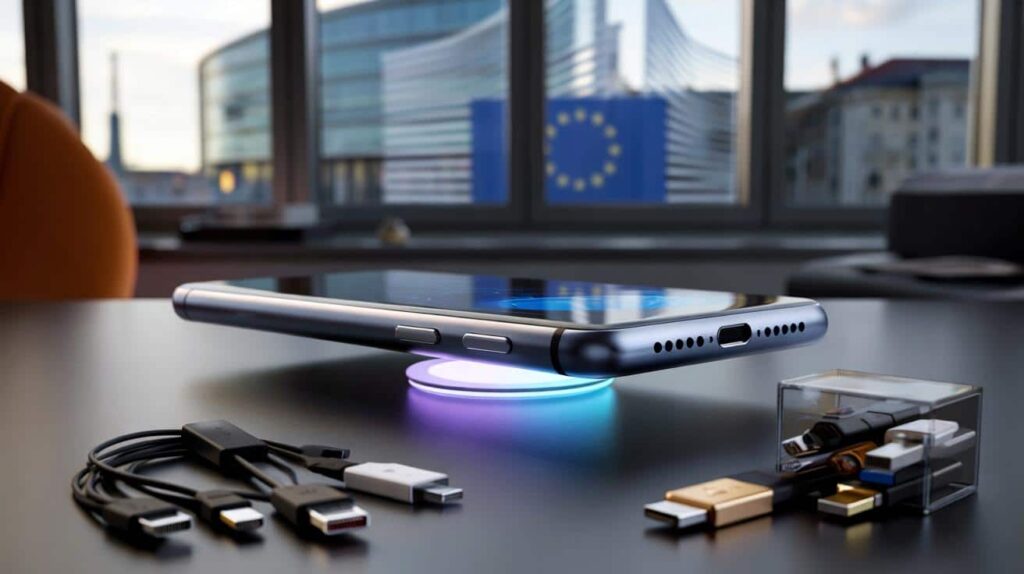
Now the EU is quietly preparing the next step: once USB‑C is standard everywhere, there’s a real chance we simply move past ports altogether. Wireless charging. Wireless data. Wireless everything.
The cable phase might be shorter than we think.

The EU just made USB‑C king… and accidentally wrote its obituary
Across Europe, a clock is ticking for every gadget that still clings to its old charging plug. The EU’s new rules push phones and small electronics towards USB‑C, the reversible connector that finally ended the “is it upside down?” dance. Most big brands have already complied, from Android veterans to Apple’s latest iPhones. On paper, it’s a victory for consumers fed up with drawers of orphaned chargers.
But buried inside this win is a strange consequence. Once every device speaks USB‑C, the next frontier becomes simpler. Kill the port completely. When everyone is aligned on one last physical standard, it becomes much easier to imagine a world where the standard… disappears.
We’ve all been there, that moment when your phone is at 3% and your friend hands you a cable that doesn’t fit. That scene is exactly what the EU wanted to erase. Lawmakers framed USB‑C as a way to reduce e‑waste and frustration: one cable for everything, from headphones to tablets, even handheld consoles. The numbers are heavy: the European Commission estimates around 11,000 tonnes of charger waste every year across the continent.
Now imagine replacing all those cables with nothing physical at all. No more drawer full of tangled wires, just a few wireless pads in strategic spots: office, sofa, nightstand, car. Less stuff, less plastic, fewer ports to break. Once the headache of “which plug?” disappears, the question naturally drifts to “do we even need a plug?”.
For phone makers, a portless future isn’t just about aesthetics, even if the marketing photos of smooth, uninterrupted edges practically write themselves. Removing ports means fewer entry points for water, dust, and corrosion. That unlocks better waterproofing and potentially slimmer internal designs. It also hands companies more control over how you connect and charge. Wireless standards like Qi2 are getting faster and smarter, while Wi‑Fi 7 and 5G handle more of the data we used to move via cable.
The EU didn’t explicitly ask for a portless world, but by imposing USB‑C as a universal baseline, it has quietly closed the chapter on connector chaos. The sequel could be a world where the best connector is no connector at all.
From cables to invisible connections: how we actually get there
The shift won’t happen overnight. The first real signs will come from “hero” devices: ultra-premium phones marketed as futuristic, sealed, and minimal. No SIM tray. No headphone jack. Then, no charging port. Instead, you’ll get a magnetic wireless ring on the back, or a precise sweet spot that pairs instantly with a dock on your desk. You’ll drop the phone and it’ll latch on, like it’s snapping into its natural habitat.
 France delivers a 500-tonne steel giant to power the UK’s new Hinkley Point C nuclear reactor
File transfers will quietly move to Wi‑Fi Direct, ultra-fast local syncing, or simple cloud links. Your next laptop could see your phone pop up instantly via UWB or Bluetooth LE, ready for drag‑and‑drop with zero cable in sight. The missing port starts feeling less like a loss and more like something you forgot you ever needed.
For everyday users, the transition will feel messy before it feels magical. Early wireless chargers can be finicky: misaligned coils, slow speeds, hot backs. People complain, brands patch, standards evolve. Some will cling to their trusty USB‑C phones the way others clung to headphone jacks. There will be that one person who travels with a tiny “USB‑C survival kit” and gently mocks the friend whose portless phone is pleading for a compatible pad.
Let’s be honest: nobody really does this every single day, meticulously organizing chargers for every possible scenario. Most of us only think about power when the battery icon turns red. A truly portless era will only work when charging is so ambient and widespread that you almost never hit that panic moment in the first place.
The technical story is already written in draft form. Wireless charging speeds are climbing toward wired numbers, especially with **MagSafe‑style magnetic systems** and the Qi2 standard. Data transfer can lean on ultra-wideband, superfast Wi‑Fi, or secure peer‑to‑peer standards that barely existed when micro‑USB ruled the world. The EU’s demand for USB‑C doesn’t stop any of this; it just defines the last generation of phones that will still need a hole in the frame.
Smartphone analyst Marta Rodríguez puts it bluntly: “The EU has solved the cable mess so manufacturers can focus on the post‑cable age. USB‑C is the bridge, not the destination.”
- Portless phones reduce mechanical failure points, extending device lifespan.
- Wireless-only models can be fully sealed, boosting water and dust resistance.
- Regulators can still push e‑waste reduction by targeting chargers, not ports.
- Accessory makers will pivot from cables to docks, stands, and mats.
- Consumers gain convenience, but lose some repair flexibility and control.
What this means for you, your next phone, and the way you charge everything
Once you view USB‑C as a stepping stone instead of a final destination, the next few years of tech launches look different. That shiny new “EU‑compliant” USB‑C phone in your hand might be one of the last models that still relies heavily on a port. Your next upgrade could be the first time you buy a phone that expects you to live in a mostly wireless home. Charging pads on the coffee table. A car that recharges your device without a thought. Office desks with built‑in coils under the surface, barely visible but always there.
*The real mental shift is accepting that connection doesn’t need a visible plug to feel secure.* We trust cloud backups for our photos already, we tap cards for payments, we beam music to wireless earbuds. Losing the charging port is just the next part of that same invisible handshake between device and environment.
| Key point | Detail | Value for the reader |
|---|---|---|
| USB‑C as a bridge | The EU has locked in USB‑C as the common standard, which simplifies the move to fewer or no ports later. | Helps you understand why brands might drop ports sooner than expected. |
| Rise of wireless everything | Charging, syncing, and backups are shifting to Qi2, Wi‑Fi, 5G, and cloud services. | Lets you prepare your habits and accessories for a cable‑light lifestyle. |
| Practical impact on daily life | More pads, fewer cables, sealed devices that are harder to repair but easier to live with. | Guides your next phone purchase and how you set up your home and workspace. |
FAQ:
- Will the EU actually force phones to remove USB‑C ports?The EU isn’t pushing for portless phones yet. The current rules only require a common wired standard (USB‑C). Portless designs will come from manufacturers themselves, not direct EU pressure.
- When could fully portless smartphones become mainstream?High-end models could go portless within 2–4 years, used as “concept made real” devices. Mass-market adoption would likely trail a few years behind, once wireless charging and data feel reliably painless.
- Can wireless charging really match USB‑C speeds?On paper, yes: Qi2 and proprietary magnetic systems can get close to wired speeds, especially for short bursts. Real‑world performance will depend on heat management, coil design, and how close manufacturers are willing to push batteries.
- What about people who rely on cables for debugging, pro video, or backups?They’ll be the loudest critics at first. Brands may answer with special docks, pogo‑pin connectors, or pro‑only variants. Some niche or industrial devices might keep ports long after consumer phones move past them.
- Should I still buy USB‑C accessories today, or wait?USB‑C cables and chargers will stay useful for years, powering laptops, tablets, headphones, and older phones. Even if your next phone goes portless, those bricks can often be reused to feed wireless pads and multi‑device hubs.