The pain always shows up at the same time.
You stand up from your desk after a long call, go to grab a coffee, and your hips feel like rusty hinges. Your lower back complains, one side of your pelvis feels higher than the other, and for a few seconds you walk like someone twice your age. Then the stiffness fades a bit, you shrug it off, and you sit down again.
Hours pass. Days pass. Weeks. Nothing “bad” enough to call a doctor, but you can feel something slowly locking up. Deep, hidden, right at the front of your hips.
That’s the quiet grip of tight hip flexors from sitting.
And once you notice it, you can’t un-notice it.

The hidden damage of sitting on your hip flexors
Spend one full day paying attention to how much you actually sit.
Not what you think you do. What you really do. Laptop at the table, slumped on the couch, perched awkwardly on a kitchen stool, scrolling your phone in bed. Your hips stay in that same 90-degree bend for hours, like someone pressed pause on your body.
Your brain is still racing from meeting to meeting, but your hip flexors are quietly learning a different habit.
Short, tight, and “stuck” in the seated position.
I met a 34-year-old designer who swore she had “a bad back from getting older.”
She wasn’t old. She just spent ten to twelve hours a day in front of two screens, legs folded, one foot tucked under her chair. By 4 p.m., her lower back would light up, her right hip felt pinched, and running – which she loved – started to feel like dragging a reluctant leg.
Her MRI? Completely normal.
Her hip flexors? So tight she almost laughed when she tried to extend fully into a lunge. That laugh turned into a wince halfway through.
There’s a simple, annoying truth: your body adapts to whatever you do most.
Sit bent at the hips all day, and your hip flexors decide that “short and tight” is the new default. These muscles, especially the psoas and iliacus, connect your spine and pelvis to your thighs. When they’re locked up, they tilt your pelvis forward, compress your lower back, and make any upright movement feel heavier than it should.
So the pain that feels like “my back” or “my hips” is often just one story.
The real plot twist lives in the front, where those hip flexors never get to fully open.
The stretching routine that actually unlocks your hips
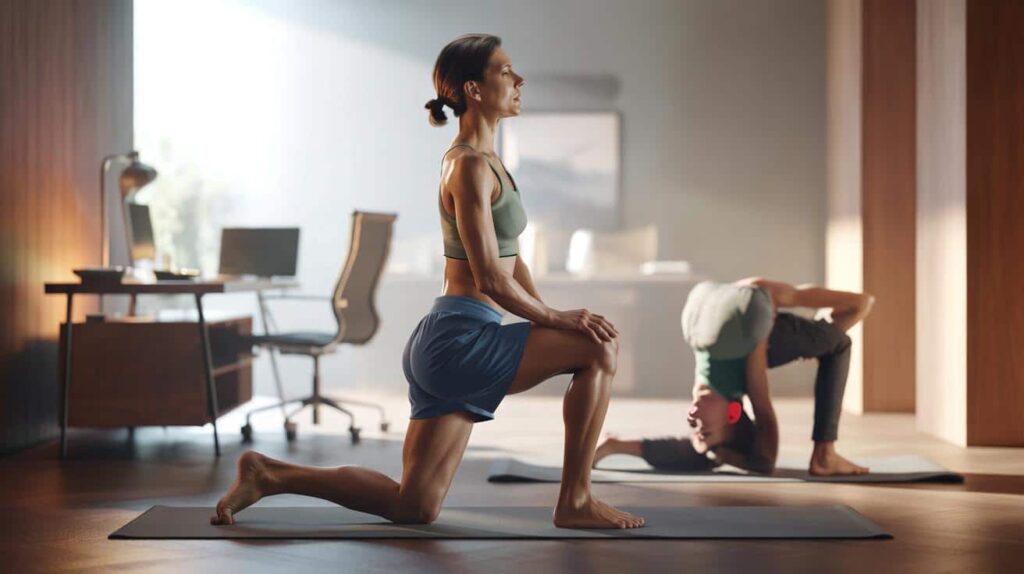
Start with a simple kneeling hip flexor stretch.
One knee on the floor, the other foot planted in front like a lunge. Instead of leaning forward aggressively, tuck your tailbone slightly, squeeze the glute on the back leg, and gently move your hips a few centimeters forward. You should feel a deep stretch at the front of the hip, not in your lower back.

Hold for 30–45 seconds while breathing slowly through your nose.
Then switch sides. That’s your base move, the one you can sneak in between emails.
Most people rush this stretch like they’re trying to fast-forward through a boring scene.
They drop into a big lunge, arch their back, and chase sensation, thinking “more stretch equals more benefit.” It feels dramatic for 10 seconds, then the body panics and tightens right back up. The goal isn’t to attack your hip flexors, it’s to convince them that length is safe again.
Think of it as a negotiation, not a battle.
Slow entry, gentle hold, calm breathing. That’s how you get lasting change, not just a quick jolt of discomfort.
Once you’ve got that base, you can build a short daily sequence around it:
*“My hips feel ten years younger when I actually do this for a week straight,”* a client told me recently, surprised at how fast things changed.
- 90/90 hip opener – Sit on the floor with one leg in front at 90 degrees and the other behind at 90. Gently rotate your torso over the front leg, breathing into any tight spots.
- Low lunge with side reach – From the kneeling hip flexor stretch, raise the arm on the kneeling side and lean slightly away to open the entire front chain.
- Glute bridge holds – Lie on your back, feet flat. Press through your heels, lift your hips, squeeze your glutes, and hold for 20–30 seconds to wake up the muscles that balance the hip flexors.
- Standing quad stretch – Hold your ankle behind you, knees together, gentle tuck of the tailbone so the stretch moves to the front of the thigh and hip.
- Deep squat sit
Let’s be honest: nobody really does this every single day.
But three or four times a week? That’s enough to feel your stride change.
Living with looser hips in a sitting world
Once your hip flexors start to open up, everyday movements feel subtly different.
Standing up from your chair no longer comes with that stiff, robotic first step. Walking to the bus, climbing stairs, or kneeling to tie a shoe suddenly feels… available again. Not heroic, not athletic, just natural.
That’s the quiet win of a good stretching routine.
You don’t feel like you’ve “worked out.” You feel like someone quietly oiled the hinges on your entire lower body.
| Key point | Detail | Value for the reader |
|---|---|---|
| Consistent, gentle stretching beats aggressive “deep” stretches | Short daily or near-daily sessions calm the nervous system and retrain muscle length | Less pain, more mobility, without feeling wrecked after stretching |
| Hip flexors affect both hips and lower back | Tight psoas and iliacus tilt the pelvis and compress the lumbar spine | Understanding the link explains why desk time shows up as back pain |
| Pair stretching with activation | Glute bridges and simple strength work help “lock in” new range of motion | More stable hips, easier walking, running, and standing posture |
FAQ:
- Question 1How often should I do this hip flexor routine to feel a difference?
- Answer 1Three to five times per week is a solid target. Spend 8–12 minutes each time, moving slowly and breathing. Many people feel changes within 7–10 days.
- Question 2How long should I hold each stretch?
- Answer 2Hold each stretch for 30–45 seconds, repeat 2–3 times per side. Short, rushed holds rarely change long-term tightness.
- Question 3My hip flexor feels “pinchy,” not stretchy. What should I do?
- Answer 3Back off the intensity, reduce the angle, and focus on a gentle tailbone tuck and glute squeeze. If pinching persists or sharp pain appears, stop and consult a professional.
- Question 4Can walking replace stretching for hip tightness?
- Answer 4Walking helps, but if your hip flexors are very tight, they often need direct, targeted stretching plus some glute activation to fully reset.
- Question 5Do I need any equipment?
- Answer 5No. A mat or soft surface is enough. A cushion for under your knee can make the kneeling stretch more comfortable, but it’s optional.