The little blue tin snaps open with a familiar click. A scent you’ve probably known since childhood floats up: clean, creamy, reassuring. A mom massages it into a child’s red cheeks before school. A nurse keeps a pot in her locker for cracked hands. A teenager dabs some on a dry patch, copied from a TikTok hack. Nivea cream is everywhere, passed down like a family secret rather than a cosmetic product.
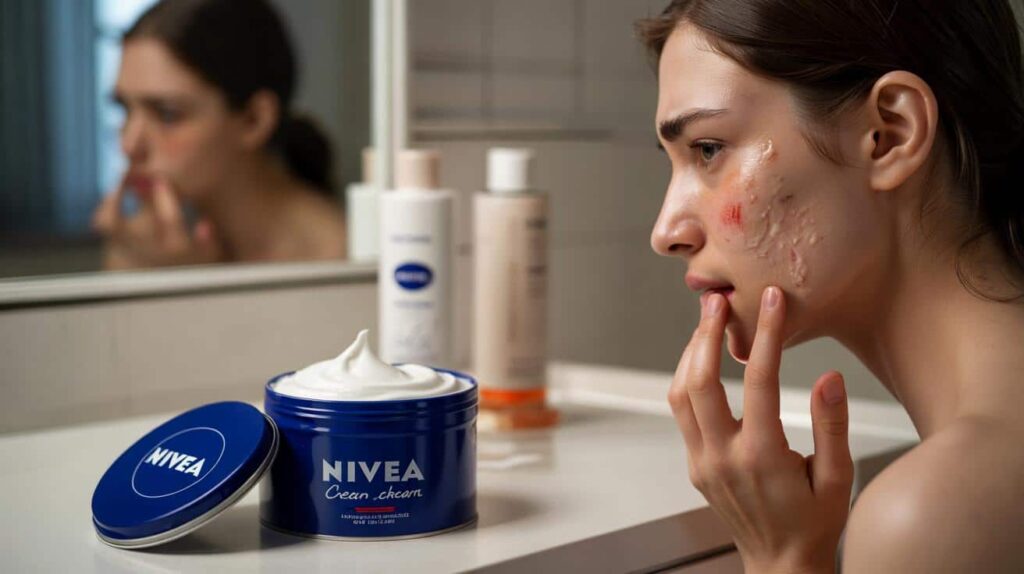
Yet behind that nostalgic smell, something is shifting. Dermatologists, toxicologists and consumer groups are quietly sounding the alarm. They’re asking the same unsettling question.
What if that “harmless classic” isn’t quite so harmless anymore?

Why Nivea’s cult cream is suddenly under scrutiny
Walk into any drugstore and you’ll spot it instantly. The blue Nivea tin has the quiet authority of something that’s “always been there”. It sits next to flashy serums and glass-skin lotions, completely unbothered by trends. People buy it on autopilot. No one reads the label.
That blind trust is exactly what worries some experts. They say the formula, built on mineral oils, preservatives and fragrance allergens, belongs to another era. A time when long-term skin health, microbiome balance and endocrine disruptors weren’t even part of the conversation.
The brand still sells safety by association. Familiarity, not transparency.
Dermatology clinics are seeing a slow but real pattern. Patients come in with persistent redness, tiny bumps, stinging around the eyes. They almost always say the same thing: “But I only use something simple. Just Nivea.”
One London-based dermatologist describes an office-week in which four different patients had contact dermatitis reactions linked to the same type of traditional cream, including the Nivea-style formula. None of them suspected it. They thought the irritation was from pollution, makeup, or stress.
The shock on their faces is weirdly similar. A kind of betrayal: how could the cream that soothed their childhood winters now be making their adult skin miserable?
The explanation isn’t a hidden poison lurking in the tin. It’s the quiet friction between an old-school formula and modern skin realities. Many classic Nivea creams rely on mineral oil and petrolatum as occlusives. These ingredients create a heavy film that can trap sweat, bacteria and irritants.
For some skin types, especially acne-prone or sensitive, that can mean clogged pores, breakouts or rashes. Add fragrances and certain preservatives, and you have a cocktail that may be legally safe yet far from friendly to reactive skin. *Our lifestyles have changed, pollution has changed, and our skin is under different pressure — but the cream on the shelf still looks exactly the same.*
That’s the hidden cost experts keep pointing to. Not a scandal, but a slow mismatch.
What experts really want you to do with that blue tin
The first thing dermatologists say is surprisingly simple: patch test like it’s 2024, not 1994. Instead of slathering Nivea cream all over your face, try a postage-stamp area near the jawline or behind the ear for a few nights. Just that. Watch for redness, itching, burning, or tiny bumps.
Then, think about *where* you use it. Many experts now suggest treating old-school Nivea like a body balm, not a daily face cream. On elbows, knees, heels, shins in winter? Fine. On compromised facial skin, rosacea, or post-acne marks? That’s where the risks climb.

One quiet pivot changes everything: from “universal cream” to “targeted, occasional product”.
There’s also the issue of layering. People often pile it on top of acids, retinoids, exfoliating toners. Then they wonder why their face suddenly feels like sandpaper on fire. We’ve all been there, that moment when you’re staring at the mirror, wondering what on earth your skin is doing.
Dermatologists say these rich, occlusive creams can trap powerful actives against the skin for longer. That might amplify irritation from products you’re already pushing to the limit. Let’s be honest: nobody really does this every single day — the slow, spaced-out routines brands recommend. We rush, we stack, we hope for glow overnight.
That’s when a “simple” cream quietly turns into the final straw.
One French dermatologist I spoke with summed it up bluntly:
“People think Nivea is neutral. It’s not neutral, it’s a strong, occlusive texture with fragrance. That can be great for some, a disaster for others.”
So what do skin experts suggest if you still love the feeling of that thick, comforting layer? Many recommend adapting, not panicking. You can:
- Reserve Nivea-style creams for cold weather, not year-round use.
- Keep them on the body, avoid the T-zone and acne-prone areas.
- Skip them completely if you have eczema, rosacea, or fragrance allergies.
- Rotate with lighter, fragrance-free moisturizers on the face.
- Use them at night only, so you’re not trapping city grime under a heavy film.
This isn’t about demonizing a tin. It’s about respecting what that texture really does on real skin.
Your skin, your nostalgia, and the real cost of comfort
There’s a reason the Nivea debate hits a nerve. It’s not just about ingredients; it’s about memories. A grandmother’s hands, a winter holiday, a blue tin in every bathroom. When experts warn that this everyday object may carry a hidden price — irritation, long-term sensitivity, a disrupted skin barrier — it feels almost personal.
The question isn’t whether you must throw out that cream tonight. It’s whether you’re willing to look at it with fresh eyes, read the label, listen to your own skin instead of your nostalgia. One person’s miracle balm is another’s slow-burn irritant.
The future of skincare is moving toward transparency, microbiome respect, and lighter textures that work with your skin instead of sitting on top of it. Somewhere between the lab and the drugstore shelf, you get to choose. And that quiet decision, in your bathroom light, might be where the real revolution starts.
| Key point | Detail | Value for the reader |
|---|---|---|
| Formula is old-school | Mineral oils, heavy occlusives and fragrance don’t match every modern skin type | Helps you question “classic” products instead of trusting them blindly |
| Use with strategy | Patch test, keep it for body or cold weather, avoid reactive facial areas | Reduces risk of irritation, breakouts and barrier damage |
| Listen to your skin | Redness, stinging or bumps are signals, not bad luck | Gives you control over what actually works, beyond marketing or nostalgia |
FAQ:
- Is Nivea cream dangerous?Current data doesn’t classify it as dangerous for the general population, but its heavy, fragranced formula can trigger issues for sensitive, acne-prone or allergy-prone skin.
- Can I use Nivea cream on my face every day?You can, but many dermatologists now suggest limiting it on the face, especially on oily or reactive skin, and preferring lighter, fragrance-free moisturizers.
- Is Nivea comedogenic?Its thick, occlusive texture can contribute to clogged pores and breakouts in some people, particularly on the T-zone and acne-prone areas.
- What’s a safer alternative if I like rich creams?Look for fragrance-free, non-comedogenic creams with ceramides, glycerin and squalane rather than heavy mineral oils and strong scents.
- Should I throw away my Nivea tin?Not necessarily. You can repurpose it for hands, feet or elbows, patch test your skin’s reaction, and gradually shift your face routine to gentler, more modern formulas.