The sea was unnaturally calm when the first ghost ship slid past the bow of the carrier. No wake of crew on deck. No sailors leaning on the rails. Just a low, grey hull cutting through the Pacific like a moving piece of code. On the bridge, officers watched its track appear on their screens: a US warship with no one on board, sailing in tight formation with one of the most powerful carrier strike groups on Earth.
Somewhere between the quiet hum of the radar and the distant growl of jet engines, you could feel it — the sense that something irreversible had just begun.
A line had been crossed, and there was no rowing back.

The day the carrier strike group got ghost ships
Out at sea, a US carrier strike group is one of the most choreographed machines on the planet. Every turn, every launch, every radar sweep is timed, logged, argued over. For decades, the cast of characters barely changed: the carrier at the center, cruisers and destroyers around it, supply ships in the background, submarines lurking unseen.
Now, for the first time, the formation includes fully autonomous surface vessels, ships that can sail, detect threats and share data without a sailor touching the wheel. The Pentagon quietly calls it an “integrated manned–unmanned team.” Sailors use another term: crossing a technological Rubicon.
Think of a sleek, 200-foot-long vessel like the US Navy’s prototype Ghost Fleet Overlord ships. No bridge windows. Just antenna masts, sensors, satellite domes. Inside, racks of computers where bunks would normally go.
During recent exercises, these vessels didn’t just tag along behind the human-crewed destroyers. They scouted ahead, streamed radar feeds back to the group, and rehearsed missions that would once have required a full crew sweating it out on a darkened combat information center. At one point, an autonomous ship reportedly ran complex navigation patterns for days without a single human correction. It just… kept going.
The logic is brutal and simple. If a ship can sail itself into a missile threat zone, you don’t have to send 300 people with it. If it can carry sensors or even weapons, the carrier strike group suddenly grows “longer arms” and more eyes.
US planners are looking at the math: China’s warship numbers, missile ranges, drone swarms. They know they can’t just build more aircraft carriers on old timelines and hope to keep up. So they are betting on autonomy as a force multiplier, a way to add digital hulls to the fleet faster than human crews can be trained. *This is not a sci-fi experiment anymore; it’s becoming standard kit.*
How the fleet actually hands over the wheel to algorithms
On board the autonomous vessels, there is no helmsman spinning a wooden wheel. The “hands” are a mesh of sensors: radar, cameras, LIDAR, GPS, infrared. Those feeds pour into autonomy software that learns the rules of the sea — traffic separation schemes, collision-avoidance protocols, even the subtle dance of who yields first at a crowded strait.
When the carrier strike group moves, the unmanned ships slot into a preplanned pattern, updating it in real time if a fishing fleet appears, weather shifts, or a destroyer needs to change speed. Humans don’t disappear. They just move up a level, overseeing routes, confirming missions, and stepping in if something feels off.
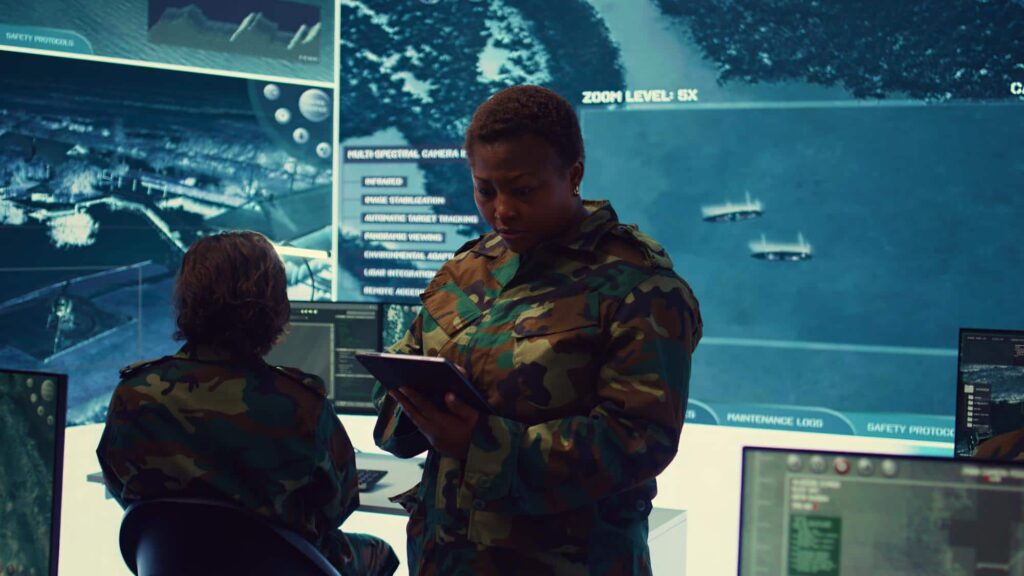
Picture a watch officer on a destroyer at 2 a.m., coffee cooling on the console. Next to his radar screen, a status panel shows two autonomous ships 30 nautical miles ahead, sweeping for threats. He doesn’t “drive” them. He checks health reports, fuel levels, sensor performance, like a project manager tracking remote teams.
At one recent exercise, an unmanned ship reportedly detected a simulated enemy vessel and pushed the track into the group’s combat system almost instantly. No radio call, no shouted order, just machine-to-machine communication. Hidden in that tiny moment is the big change: the ship behaved less like a tool, more like a teammate.
This shift doesn’t happen on trust alone. Engineers spend months running these vessels through edge cases: what happens if GPS drops, if another ship ignores the rules, if a sensor fails in rough seas. Lawyers comb through international maritime regulations asking awkward questions: Who’s “in command” if no one stands on the bridge?

There’s also the human side. Crews need to learn how to collaborate with steel hulls that don’t eat, sleep or complain. That means new checklists, new instincts, new ways of saying “stop” when the algorithm is technically right but tactically wrong. Let’s be honest: nobody really does this every single day without a few uneasy glances at the empty decks of the ship sailing beside them.
Hype, fear, and the plain truth about robot warships
If you strip away the military jargon, the method is surprisingly down to earth: start small, fail quietly, scale what works. The Navy began by sending experimental autonomous ships on simple transit routes, then added more complex tasks — formation sailing, basic threat detection, data-sharing under electronic jamming.
Each mission adds another brick: a new weather pattern learned, a new type of vessel recognized in the cameras, a better rule for when to give human operators a nudge. The carrier strike group is just the most public stage of a process that has been grinding forward for years in test ranges and simulation labs.
From the outside, it’s easy to get stuck at the extremes. Either “killer robots will replace sailors” or “this will never work in real combat.” Reality is stuck in the messy middle. Systems fail. Software updates break things. Autonomy that looks perfect in calm seas suddenly struggles with a storm or a chaotic port.
The people closest to it talk about trust like it’s a dial, not a switch. Too much trust, and crews get lazy. Too little, and the autonomous vessels become expensive, remote-controlled toys. Many sailors admit they’re still figuring out where that dial should sit on an average day, especially with headlines screaming about AI warfare.
“Crossing this ‘technological Rubicon’ isn’t about flipping a moral switch,” a retired Navy captain told me. “It’s about asking, every single mission: What risk do we put on steel, and what risk do we put on flesh?”
- What these ships actually do today
Mostly sensing, scouting, data relay, and experimental logistics — not Hollywood-style autonomous combat. - Where the real tension lies
Balancing speed and innovation with safety, ethics, and international norms that were written for ships with people on board. - **Why you should care even if you’re not a defense geek**
The tech being tested at sea — autonomy, resilient communications, human–machine teaming — is already leaking into civilian shipping, ports, and even self-driving cars.
What this ocean experiment says about us
The US fleet’s move to deploy autonomous surface ships inside a carrier strike group isn’t just a story about missiles and metal. It’s a snapshot of how fast we’re willing to hand over life-and-death margins to algorithms when the stakes feel high enough. War tends to accelerate changes that would take decades in peacetime.
There’s a quiet irony here. The ocean has always been a place where humans measured themselves against chaos — storms, darkness, navigation by stars. Now, some of that uncertainty is being outsourced to code running in a steel box bolted below deck, far from the spray.
Geopolitically, this move sends a clear signal to rivals: the US doesn’t plan to win a numbers game ship-for-ship. It plans to bend the rules of what “a ship” is. A hull with no crew suddenly counts as combat power. A carrier strike group with autonomous outriders becomes a distributed web, not a tight ball.
Ethically, the questions get heavy fast. What happens when these unmanned ships carry offensive weapons, not just sensors? Who is accountable if an autonomous vessel misreads a situation in a tense encounter and escalates a crisis? These are not hypothetical “next decade” questions anymore. They sail with the fleet.
At the same time, there’s something very human in the way sailors react. Some feel pride, being part of the first generation to work with this tech at sea. Some feel uneasy watching a ship leave harbor with no one waving from the rails. Others are just practical: if a robot hull can take the first incoming missile instead of a manned destroyer, they’ll take that trade.
We’ve all been there, that moment when a new tool at work quietly changes not just how you do your job, but how you think about your own value. The ocean version of that moment is happening now, somewhere far over the horizon, where a ghost-grey ship is keeping perfect station beside a carrier — and no one is standing on its bridge.
| Key point | Detail | Value for the reader |
|---|---|---|
| Technological Rubicon | First-ever deployment of autonomous surface ships inside a US carrier strike group | Understand why this marks a historic shift in naval power and AI use |
| Human–machine teaming | Manned crews oversee, task, and correct unmanned vessels rather than directly piloting them | Grasp how autonomy actually works in practice, beyond the hype |
| Wider implications | Military advances in maritime autonomy feed back into civilian shipping and global norms | See how distant defense experiments may soon shape everyday technologies and regulations |
FAQ:
- Are these autonomous ships armed right now?Most of the current deployments focus on sensors, communications, and logistics. Weapons integration is being tested in controlled settings, but widespread routine use in fully autonomous mode is still a red line for many policymakers.
- Can an unmanned ship legally be “in command” under maritime law?International rules assume a responsible human operator. Today, that role is usually assigned to a remote human commander or the officer overseeing the autonomous system, even if no one is physically on board.
- What happens if an autonomous vessel hits another ship?Responsibility would likely fall on the state or entity operating the vessel, similar to any other warship. Investigators would then dig into logs, sensor data, and human oversight decisions to trace fault.
- Could hackers take over these unmanned warships?Cybersecurity is one of the biggest concerns. These vessels are designed with hardened, layered defenses and limited external access, but no serious expert pretends the risk is zero.
- Will autonomous ships replace human crews entirely?Unlikely in the near term. The trend points toward mixed fleets where humans handle judgment, adaptation, and escalation decisions, while unmanned platforms take on dull, dangerous, and dirty tasks.