The video starts with the sound before the sight.
A low grinding scrape, a jolt, and then the camera swings down toward a churning patch of steel-grey water. On a small sport-fishing boat off the coast, you can hear the nervous cackle in the voice of the man filming as the anchor rope tightens like a drawn bow. Seconds later, a dark, muscular shape brushes past the hull and someone shouts, “Orcas! They’re on the rope!” Another voice, flatter, insists, “No way that’s a shark.” The argument crackles through the sea breeze while the line jerks again, fraying against rows of unseen teeth.
No one on board is completely sure what’s attacking them.
Online, though, everyone suddenly is.
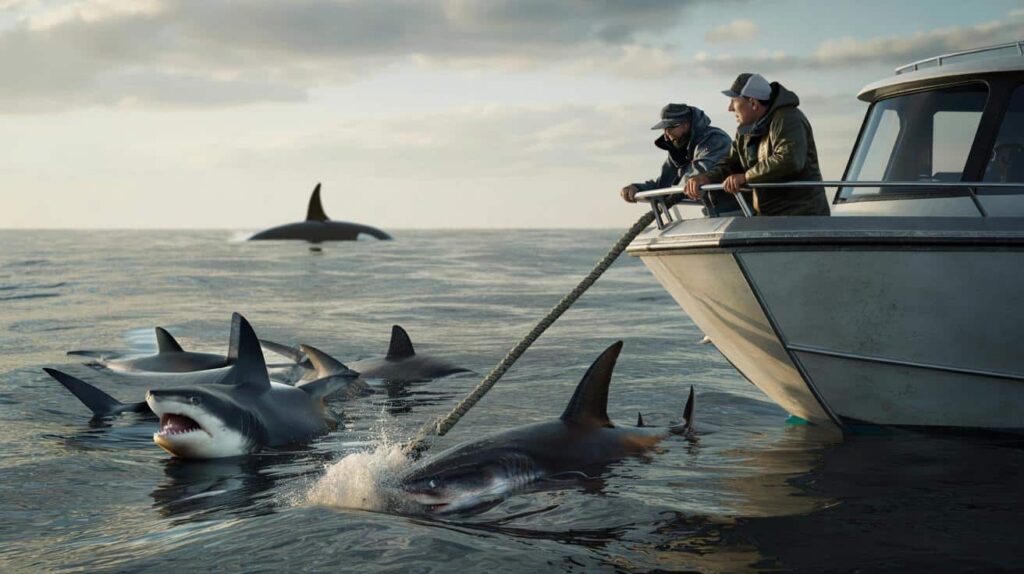
From viral clip to witch-hunt: when sharks meet anchors and orcas take the blame
The clip hit social media like a wave slamming into a breakwall.
Within hours, accounts on TikTok, Instagram Reels and YouTube Shorts were recutting the footage: a straining anchor rope, a flash of fin, a voice yelling “killer whale!” and a terrified laugh in the background. By the time it reached X (formerly Twitter), the headline had already been written by angry commenters: “Fishermen lie, blame orcas for shark attack.” A few marine biologists chimed in, pointing out the body shape and behavior looked far more like sharks circling the rope than any coordinated orca pod. The tone shifted fast, from fascination to accusation.
One Australian charter skipper, who asked not to be named, recognized the scenario instantly.
He’d had a similar episode last year off the New South Wales coast, when a hooked tuna dragged under the boat attracted multiple sharks. As his crew tried to pull up the anchor to reposition, sharks began lunging at the line, mistaking the vibration for another struggling prey. “You feel the whole boat lurch,” he said. “It’s like being tied to a wild animal you can’t see.” He never mentioned orcas in his report. Yet when someone reposted his own GoPro clip months later with the caption “orca attack,” strangers accused him of clickbait and lying to stoke fear.

So why are fishermen suddenly in the dock, and why are orcas the easy villains?
Part of it comes from the recent wave of reports from Europe of orcas bumping boats and damaging rudders, stories that travel well because they sound almost like ocean revenge tales. When any large, dark shape comes near a hull now, people’s brains fill in the gaps with killer whales. Then the algorithm rewards that framing. “Orca attack” gets more taps than “sharks test anchor rope.” Fishermen, long used to being doubted on their “one that got away” stories, now face a fresh suspicion: that they’re playing up orca drama for views, while sharks quietly take the blame or the bites.
What really happens when sharks and boats cross paths at anchor
The unglamorous reality is that sharks are opportunists, not movie monsters.
When a fishing boat anchors over a reef or a drop-off, its presence can send signals down the water column: the hum of the engine, the flicker of fish struggling on lines, the faint blood of bait. Sharks feel that low-frequency vibration through their lateral lines, long before anyone on deck spots a fin. If the crew has been bringing in fish, leftovers and scraps might drift down. Anchors and ropes become part of that noisy, interesting zone where dinner might appear at any moment.
Plenty of crews quietly talk about “anchor tax” days.
They’ll drop a hook, start catching fish, then notice more and more bites ending in shredded leaders or halved bodies. Someone curses: “The sharks have found us.” Pulling anchor becomes a race. As the boat slowly winches up, that thick rope or chain trembles through the water like a cable plugged into nature’s loudest speaker. Sharks sweep closer, bumping and tasting, sometimes biting straight into the fibers. One Florida guide told me about watching a big bull shark clamp down on his anchor rope and thrash like a hooked marlin. “It felt like the whole ocean wanted to drag us sideways,” he said.
From the surface, in shaky phone footage, that chaos looks mysterious.
You see white water, a dark back, a fin that appears at a strange angle, and your mind grabs the most dramatic label it knows. Yet shark attacks on anchor gear are well documented in charter logs and safety briefings from Australia to South Africa. Orcas, on the other hand, tend to go for high-value targets: rudders, propellers, and hulls that interrupt their travel paths or resemble prey. Marine behaviorists have pointed out that the “orca blamed” videos often show solitary animals or small groups behaving like scavengers, not coordinated whale teams. And let’s be honest: nobody really frame-by-frame analyzes a clip before hitting “post.”
How fishermen can film close calls without fanning online fires
If you fish for long enough, you’ll see something that makes your stomach drop.
A shark lunging at your anchor rope. A huge shadow sliding under the hull. That’s the footage friends beg you to upload. Before you do, small choices can change everything. Naming the species only when you’re certain, adding a short context line (“we think these were bronzie sharks, not orcas”), and stating where and when it happened all quietly steer the story toward reality. One coastal crew now keeps a cheap underwater camera clipped near the bow, so when something hits the rope they can grab a few seconds of clearer proof instead of only panicked surface shots.

The temptation is always to punch the drama up a notch.
We’ve all been there, that moment when a story sounds just a little better if you lean into the legend. The problem is that on social media, a nudge becomes a landslide. Call a shark an orca once and you’re suddenly “the guy who lied about killer whales,” no matter what you actually believed in the chaos of the moment. A calmer strategy helps: describe what you felt and saw, not what you think the headline should be. If you’re unsure, say you’re unsure. *Ambiguity in the caption can be more honest than shaky certainty in the comments.*
“People assume we’re playing things up for clicks,” one seasoned skipper told me. “Most of us are just scared and reacting in real time. You don’t calmly ID a dorsal fin when your anchor line is screaming.”
- Film first, narrate later: Let the raw footage speak. Add voiceovers or text after you’ve cooled down and maybe checked with someone who knows marine life.
- Use cautious language: Phrases like “looks like” or “we thought this might be” keep you from painting yourself into a corner when experts weigh in.
- Credit corrections: If a biologist or experienced diver flags a misidentification, pin their comment or add a subtitle on the repost instead of digging in.
- Watch the emotional framing: Words like “attack” and “killer” pull angry eyes, but they also shape policy debates and public fear long after your 15 seconds of virality.
- Remember real stakes: Sensational clips can fuel calls to cull sharks or push orcas into the “dangerous pest” box. That backlash lands on actual animals, not just on your reputation.
A sea story that’s really about trust, not just teeth
What sits under this whole orcas-versus-sharks-versus-fishermen storm is something quieter: who we choose to believe about the ocean.
On one side, there are skippers with salt in their eyebrows swearing that in the moment, those shapes by the anchor looked like whales. On the other, there are scientists and keyboard experts dissecting dorsal fins like detectives. Between them, an algorithm that rewards outrage every time someone shouts “liar” in the comments. It’s messy, and no one comes out looking completely clean.
These viral clashes also shape the way the wider public sees the sea.
If every big fin near a hull is framed as a “rogue orca” or “man-eating shark,” it gets harder to talk calmly about conservation, bycatch, or how climate change is shifting where predators move. Fishermen, already blamed for overfishing, now brace for being blamed for overhyping. Scientists, already frustrated with misinformation, feel their work is reduced to side notes under viral clips.
Maybe the more interesting question isn’t “who lied about the orcas?”, but “how do we tell stories about danger without turning everything into war?” A rope shredded by curious sharks is frightening enough without a villain upgrade. A pod of orcas altering sailboat rudders in Spain is fascinating without being cast as a coordinated uprising. Out on the water, the line between fear and wonder is as thin as an anchor rope under strain. The next time a shaky video of a “terrifying sea showdown” crosses your feed, the most radical response might be the simplest: pause, breathe, and ask what you’re not seeing just outside the frame.
| Key point | Detail | Value for the reader |
|---|---|---|
| Shark behavior at anchors | Sharks respond to vibrations, bait, and struggling fish around anchored boats, sometimes biting ropes and gear | Helps explain what’s really happening in viral “anchor attack” clips |
| Orcas vs. social media framing | Recent orca-boat incidents are being used as a dramatic label for many unrelated encounters | Gives context for why orcas are blamed even when footage points to sharks |
| Responsible storytelling at sea | Careful captions, honest uncertainty, and listening to experts can defuse online witch-hunts | Offers a practical way to share ocean experiences without feeding misinformation |
FAQ:
- Are fishermen really lying when they blame orcas instead of sharks?Sometimes they’re wrong, not lying. In a chaotic moment with poor visibility, it’s easy to misidentify a big animal near the boat. The real problem starts when people keep pushing the orca angle even after experts correct them.
- How can you tell an orca from a shark in these videos?Look for body shape, dorsal fin size and position, and behavior. Orcas have a more rounded head and tall dorsal fins; sharks are sleeker and often circle or dart at gear like ropes and fish, not rudders or hulls.
- Do sharks often attack anchor ropes?“Attack” overstates it, but yes, sharks sometimes bite and thrash at anchor lines, especially when they’re attracted by bait, blood, or struggling fish near the boat. It’s a known headache for many charter crews.
- Are orcas becoming more aggressive toward boats worldwide?There are specific hotspots, like the Iberian coast, where orcas interact with sailboats, especially rudders. That doesn’t mean every region or every sighting signals a global uprising of “killer whales.” Local context matters a lot.
- What should you do if a big animal hits your anchor rope?Stay calm, keep hands and feet away from the line, and avoid leaning over the side. If possible, record from a safe distance, then rewatch later before labeling what you saw. Safety first, storytelling second.