The shouting starts over something tiny. A half-finished homework sheet, a cereal bowl left in the sink, a jacket thrown on the floor again. The parent’s voice rises without really knowing why, the child’s shoulders tense, and the air in the room turns heavy. Ten minutes later, everyone has calmed down. Nobody quite remembers what the fight was about, only that the house suddenly feels a little colder.
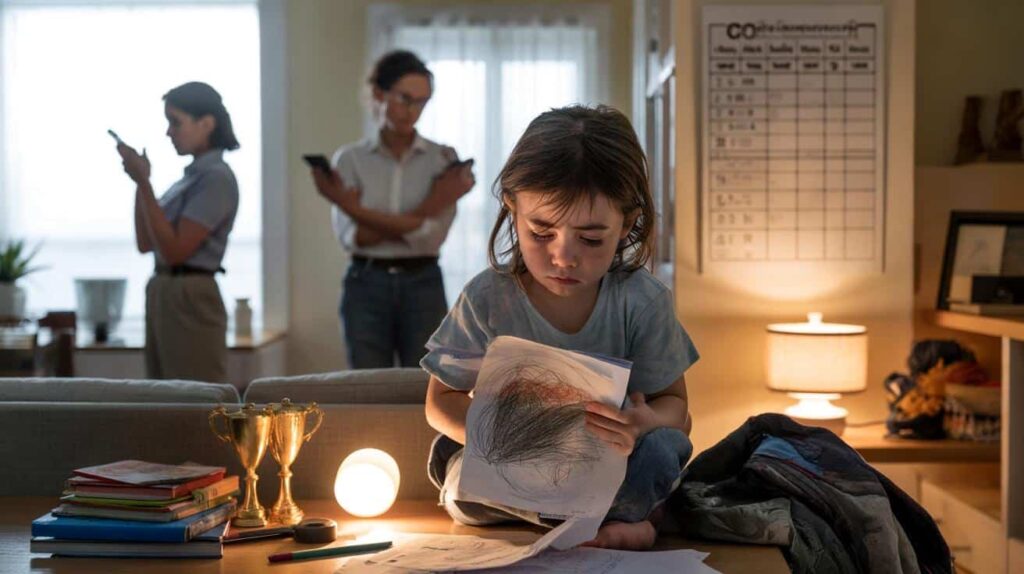
Scenes like this repeat in thousands of homes, often with loving parents who are doing their best while running on empty. The kids are not “traumatized” in the textbook sense, they still laugh, go to school, post silly videos. And yet, something in their eyes looks older than their age.
That quiet sadness doesn’t come from nowhere.

1. Constant criticism that eats away at self-worth
Some parents don’t scream, don’t hit, don’t slam doors. They just comment. All. The. Time. “Why are you so slow?”, “You could have done better”, “Your sister never forgets her stuff.” On paper, it sounds like guidance. In real life, it feels like walking through life with a judge sitting on your shoulder.
Psychologists see this in therapy rooms again and again: adults who still hear a parent’s voice louder than their own. The result isn’t motivation. It’s shame, hiding behind fake perfection.
Picture a 9-year-old boy bringing home a drawing he’s proud of. He puts it in front of his dad, waiting for that little spark of approval. The first words he hears: “Why is the house crooked? Houses don’t look like that.” The boy laughs it off, shrugs, says, “Yeah, it’s stupid anyway.” That shrug is a small self-betrayal.
Over time, research shows that kids exposed mainly to negative feedback tend to internalize a harsh inner critic. They get good grades, they help everyone, they smile politely. Inside, they’re exhausted from never feeling “enough.”
Psychologically, constant criticism is experienced as a threat to belonging. A child’s brain is wired to scan for signs: “Am I safe? Am I wanted?” When almost every interaction is a correction, their nervous system stays on alert.
They grow up believing love is something you earn by not messing up. That belief quietly kills joy. It makes them terrified of trying new things, of failing in front of others, of being seen as they are instead of as they “should” be.
2. Emotional neglect disguised as “giving space”
Some parents are physically present yet emotionally unreachable. They pay the bills, cook, drive to activities, but rarely ask, “How are you, really?” When the child cries, they say, “Go to your room and calm down.” When the child is upset, they get a lecture instead of a hug.
On the outside, this looks like independence training. On the inside, the child learns that big feelings are private problems, not something you share with the people you love. That’s how loneliness settles in, even in a full house.
A teenager once told a therapist: “If I got a 19/20, my mom said ‘Good.’ If I got a 9/20, she said ‘Work harder.’ No one ever asked why I couldn’t sleep at night.” She wasn’t beaten or insulted. She had Wi-Fi, a bedroom, clean clothes. What she didn’t have was emotional shelter.
Research on attachment shows that when parents consistently miss or minimize emotional signals, kids develop what’s called “insecure attachment.” They start to believe their inner world isn’t welcome. They stop bringing their feelings to the table.
From a psychological point of view, emotional neglect is slippery because it’s often invisible to the adults involved. They think, “I’m not smothering them, I’m giving them autonomy.” That sounds modern, almost progressive. Yet children need co-regulation: they learn to regulate their emotions because someone first helps them do it.
When that step is skipped, they can look strong and self-sufficient, but inside, anxiety and sadness pile up with nowhere to go. *Feeling deeply alone while living with your own family is one of the most corrosive experiences a child can have.*
3. Overcontrol and lack of autonomy
There are homes where every minute is scheduled and every choice is pre-checked by an adult. What to wear, what to eat, who to be friends with, which sport to choose. The intention is protective: “I know what’s best for you.” The side effect is brutal: the child never gets to feel like the pilot of their own life.
Psychology calls this “low autonomy support,” and it’s strongly linked to lower well-being and higher risk of depression in teens.
Imagine a 12-year-old girl who loves drawing and wants to sign up for art club. Her father insists she choose coding instead because “art doesn’t pay.” Every time she expresses a wish, she meets a wall of “No, that’s not smart.” She stops proposing things. She becomes the child who says, “I don’t care, you decide.”
Later, as an adult, she might stay in jobs or relationships that make her miserable, simply because she never practiced listening to her own desires without guilt.
Human beings need to feel some sense of control over their choices to be psychologically healthy. Kids who are never given small decisions are robbed of the training ground for bigger decisions. They don’t get to test, fail, adjust.
Overcontrolled children often become anxious rule-followers or secret rebels. Both profiles carry a quiet unhappiness: either they live for other people’s expectations, or they live in constant conflict. Neither option feels free.
4. Conditional love and performance-based affection
One of the most painful patterns: love that intensifies when the child shines and cools off when they struggle. Extra warmth after good grades. Distance and icy silence after a bad report card. The message is subtle but crystal clear: “You’re lovable when you succeed.”
Studies on “conditional regard” show that kids exposed to it do work harder… but they also feel more shame, pressure, and long-term resentment. They chase achievements while secretly fearing they’re replaceable.
Picture a boy stepping off the soccer field after missing the decisive penalty. His parent walks toward him, face tight, and says, “You embarrassed us.” That one sentence lands deeper than any loss. The child learns that mistakes are not moments, they are identities.
Years later, he might still replay that scene when he hesitates to take a risk at work or open up in a relationship. A single episode doesn’t define a life, yet repeated emotional patterns carve deep grooves.
Love that feels like a contract creates children who become adults terrified of dropping the ball. They tie their worth to numbers: grades, kilos, salaries, followers. If those numbers fall, so does their sense of being lovable.
Kids need to feel that who they are matters more than what they produce. Without that, joy gets replaced by pressure, curiosity by obsession, and play by performance. Let’s be honest: nobody really does this every single day. But when the overall climate is conditional, unhappiness quietly becomes the family’s background noise.

5. Shaming and humiliation as “education”
Some parents confuse discipline with humiliation. They roll their eyes, they mock, they expose their child’s mistakes at family dinners for a cheap laugh. “Tell them what you did, so they know how silly you were.” The room laughs, the child smiles on the outside and wants to disappear on the inside.
Psychology is clear: shame attacks the person, not the behavior. And when a child feels that who they are is wrong, not just what they did, sadness takes root.
A classic scene: a kid spills juice on the table. Instead of “Let’s clean it up,” they hear, “You’re so clumsy, you always ruin everything.” The word “always” is a tiny knife. No one always ruins everything, but a growing brain takes language literally.
Over time, children who are frequently shamed tend to withdraw or lash out. Teachers describe them as “overly sensitive” or “aggressive,” when in fact they’re just defending a self that has been on trial for years.
Shame-based parenting often comes from parents who were themselves raised this way and truly believe it builds character. It doesn’t. It builds armor. Kids learn to hide, lie, or become brutally self-critical to beat others to the punch.
Healthy discipline focuses on behavior: what happened, what needs to change next time. Humiliation focuses on identity: who you supposedly are. One corrects; the other wounds. And wounded kids rarely grow into carefree, genuinely happy adults.
“You can’t insult a child into becoming confident,” says clinical psychologist Dr. Lisa Damour. “You can only teach them that the world is unsafe and love is unstable.”
- Replace labels like “lazy” or “dramatic” with descriptions of behavior.
- Talk privately, not in front of siblings or guests.
- Focus on repair (“How can we fix this?”) instead of blame.
- Acknowledge your own tone if you cross the line and say, “That was harsh.”
- Protect their dignity the way you would want yours protected.
6. When parents’ unresolved pain becomes the child’s burden
Behind many unhappy children, there’s a tired adult dragging a backpack full of their own unfinished stories. A father who never processed his own strict upbringing. A mother who still feels like a scared little girl around conflict. Without noticing, they pass that weight forward. Their fears turn into rules, their anxiety into overprotection, their anger into explosions.
Kids sense all of it. They walk on eggshells, trying not to press the invisible buttons. The family looks “fine,” but the emotional climate feels like thin ice.
A classic example: a parent who grew up poor and terrified of scarcity becomes obsessed with success and security. Their child gets showered with opportunities but also with endless pressure to “never end up like us.” The child starts living not for their own dreams, but to heal a story that didn’t begin with them.
That’s a lot to carry for someone who still needs help tying their shoelaces or choosing a high school.
Psychologists talk about “intergenerational transmission of trauma.” Big word for a simple reality: what we don’t heal tends to leak. Not all parents can go to therapy, not all have time or money. Yet even small acts of awareness change the script bit by bit.
When an adult can say, “This fear is mine, not yours,” they free the child from being their therapist, their trophy, or their emotional crutch. Kids who are allowed to just be kids, instead of emotional caregivers, have a far better shot at real, grounded happiness.
Parenting with more lightness: small shifts, big impact
None of this means parents must become saints overnight. The research is reassuring on one point: what matters most isn’t perfection, it’s the overall pattern and the ability to repair. A sharp comment followed by, “I was stressed, that wasn’t fair to you,” can completely change how a child stores that memory.
Psychologists call this “good enough parenting.” Not flawless, not Instagram-ready, just responsive most of the time and humble enough to course-correct. That’s already a powerful antidepressant for a young soul.
What often helps is to pick one attitude to soften for a week instead of trying to transform everything. Less criticism at homework time. Or one moment a day where you genuinely listen without your phone. Or deciding that mistakes will be talked about calmly, not turned into a family show. Tiny, boring, repeatable actions.
Kids don’t need grand speeches. They need a different rhythm. When the emotional climate warms up, their natural joy tends to reappear almost by itself.
There’s also something quietly revolutionary in admitting, “I’m learning this as I go.” Children who hear a parent say, “I didn’t get this kind of care when I was young, but I want to do it differently with you,” receive a legacy of honesty, not denial. That vulnerability is a kind of emotional vaccine.
They understand that love can evolve, that adults can grow too, that family patterns are not destiny carved in stone. That single idea can turn a heavy childhood into the starting point of a lighter, more conscious generation.
A different kind of childhood is still possible
When you look at these nine attitudes, it’s tempting to count your own “mistakes” and sink into guilt. That won’t help you or your child. What does help is noticing patterns with a bit of curiosity instead of self-attack. “Where did I learn to talk like this? What happens in me just before I snap?” Those questions open a door.
Children don’t need parents who never lose their temper or never say the wrong thing. They need adults who come back after the storm and say, “You matter more to me than my pride.”
Every family has its soundtrack: words, gestures, silences that play on repeat. Some tracks come from your own parents, grandparents, culture. You can’t rewrite the past, but you can adjust the volume in the present. Turn down the criticism a notch, turn up the listening, cut the shaming track altogether.
Little by little, the atmosphere changes. The house feels less tense. The kids argue and slam doors, as they always did, but the repair comes faster. Their sadness doesn’t have to root itself as deeply.
If you recognize yourself in any of these attitudes, that recognition itself is a sign of health. It means you’re not on autopilot anymore. It means your children are already living with a parent who’s willing to look, reflect, and maybe try again tomorrow. That’s rare, and it counts.
Some pains will still happen, some tears will still fall. Yet when a child grows up feeling seen, respected, and loved even on their worst days, the chances that they become quietly unhappy adults drop dramatically. And maybe that’s the most powerful gift any of us can offer: not a perfect childhood, but a kinder one than the one we received.
| Key point | Detail | Value for the reader |
|---|---|---|
| Critical vs. supportive language | Shift from judging the child to describing behavior and offering guidance | Helps reduce shame and build genuine self-esteem in kids |
| Emotional presence | Respond to feelings with listening and validation, not dismissal | Strengthens attachment and lowers the risk of quiet, internalized sadness |
| Repair after ruptures | Apologize, explain, and reconnect after conflicts or harsh moments | Teaches resilience, models healthy relationships, and softens past hurts |
FAQ:
- Question 1Can I “undo” the impact of past harsh parenting on my child?
You can’t erase past moments, but consistent new experiences reshape how your child’s brain and heart interpret those memories. Repair conversations, warmth, and different responses over time really do matter.- Question 2What if I sometimes lose control and yell?
Most parents do at some point. The key is what happens next: calm down, take responsibility, and talk it through. Saying “I’m sorry I shouted, you didn’t deserve that” is deeply healing for a child.- Question 3How do I know if I’m being too controlling or just setting limits?
Limits protect safety and respect; control invades preferences and autonomy. If you’re dictating tastes, hobbies, or feelings, you’ve likely crossed into overcontrol.- Question 4My parents raised me strictly and I turned out “fine”. Does that mean this doesn’t apply to me?
You may feel fine and still carry hidden costs like chronic anxiety, people-pleasing, or fear of conflict. Exploring this isn’t about blaming your parents, but about choosing what you want to keep or change.- Question 5What’s one small thing I can start doing tonight?
Spend five undistracted minutes really listening to your child talk about their day. No advice unless they ask, just curiosity and presence. For many kids, that’s already a game-changer.