On a cold hillside outside a small town, a group of amateur stargazers huddles around a battered telescope. Their breath hangs in the air, their fingers numb, their phone screens dimmed. One of them whispers, “It’s up there tonight. The comet from another star.”
Nobody speaks for a moment. The sky looks calm, ordinary, almost bored.
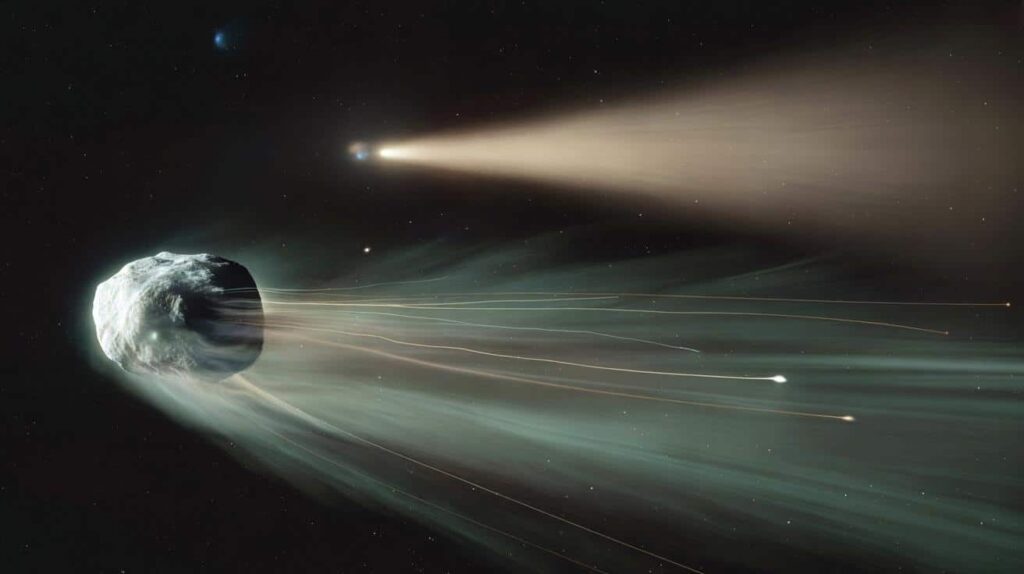
Then the first image appears on a laptop, streamed from a professional observatory half a world away. A ghostly smear of light, streaked with structure and color, slides into focus.
This is 3I ATLAS, the third known interstellar comet, and the newest set of images is turning that faint smudge into a detailed visitor.
We’re finally seeing a stranger’s snowball, up close.

The night the sky got a new foreign visitor
For years, comets have been the familiar “dirty snowballs” of astronomy: icy relics, looping the Sun on long, predictable orbits. Then ATLAS changed the script. Spotted racing through the Solar System on a trajectory that doesn’t loop back, this object is on a one-way trip from another star.
Astronomers knew at once: this was a chance you don’t get twice.
The latest images, released from a coordinated campaign of ground and space telescopes, sharpen that chance into something almost intimate. You can trace the sweep of its tail, see the asymmetry in its glow, watch the way sunlight is peeling material off its surface.
Suddenly, that cold point in the sky feels oddly personal.
One sequence of images comes from a mountain-top observatory in Hawaii, another from Chile’s Atacama desert, another from the Hubble Space Telescope, far above our atmosphere. Each contributes a piece: one captures the wide tail, another the compact, bright nucleus, another the faint gas halo spreading like smoke.
Stacked together, aligned, cleaned, and stretched, they form a composite unlike any comet portrait we’ve had before.
You can actually see subtle jets of material, thin as threads, fanning out from the nucleus. A few years ago, spotting that level of detail on a fast-moving, dim interstellar object would have sounded like sci‑fi.
Tonight, it’s a downloadable PNG.
The reason this level of clarity matters is simple: 3I ATLAS does not come from here. Its speed and path tell astronomers it’s unbound to the Sun, flying on a hyperbolic orbit that will send it back into deep space forever. That means every pixel in these images encodes chemistry and structure from another planetary system altogether.
By dissecting the light from its glowing coma and tail, researchers can read what ices and dust grains it carries. Some early spectra hint at familiar molecules like water and carbon monoxide, but the ratios are subtly off.
That small difference is the quiet headline: other star systems make comets too, and they don’t follow exactly the same recipe.
How astronomers squeezed this detail from a moving speck
Capturing an interstellar comet is part science, part choreography. First, you need to know exactly where it will be, down to a fraction of a second in time and a sliver of a degree in the sky. Teams feed orbital data into scheduling software, racing to book precious minutes on giant telescopes. Then the real juggling act begins.
Because 3I ATLAS is moving so fast relative to the background stars, astronomers track the comet itself, allowing the stars to smear into streaks while the nucleus stays sharp.
Later, specialized software reverses that movement, aligns dozens of exposures, and teases out details buried in the blur.
The hardest part is that the comet is changing while they’re watching it. As it falls toward the Sun, the heat boils off surface ices, reshaping the coma and tail from week to week. Observers from different continents trade notes like field journalists comparing eyewitness accounts. “We see a new jet at this angle.” “The brightness jumped by half a magnitude overnight.”
One team even scheduled back-to-back observations on telescopes separated by thousands of kilometers, catching ATLAS at slightly different angles. That gave them a quasi-3D hint of its structure.
It’s a bit like photographing a sprinting athlete with cameras along the track, then reconstructing the motion frame by frame.

All this effort highlights a plain truth: astrophotography at this level is not just “point, click, and sharpen in Photoshop”. It’s timing, patience, and a mountain of data processing. The raw frames are often underwhelming—grainy, streaked, crowded with cosmic rays and sensor noise.
The magic happens when teams layer exposures, subtract background light, and use algorithms to isolate the comet’s faint outer halo. *What you finally see in the press releases is the result of nights of coffee, code, and very tired eyes.*
The result is a set of images where the interstellar visitor stops being a rumor, and starts looking like a world in the making.
What these new images quietly reveal about alien worlds
The sharper views of 3I ATLAS are not just pretty wallpaper. They let scientists perform a kind of remote autopsy on a body that formed around another star, billions of years ago. By mapping the brightness of the coma in different filters, they can infer which gas jets are strongest, how dust grains are distributed, and whether the nucleus is smooth or lumpy.
One practical trick: compare images taken in visible light with those in infrared. Dust loves to glow in the infrared, while some gases pop out in the visible. Where the two maps disagree, you learn if ATLAS is shedding more solid grains or more gas in a given direction.
There’s a human side to all this data crunching. We’ve all been there, that moment when a project becomes personal. For a young researcher whose first observing run happens to be chasing 3I ATLAS, this comet might define an entire career. Nights at the telescope blur into quiet rituals: checking the guiding, watching the faint blob crawl across the screen, sending quick messages to colleagues waking up on another continent.
Sometimes the comet dips too low, clouds ruin everything, or a guiding error smears an hour of data into useless streaks. Let’s be honest: nobody really nails this on every attempt.
The final set of images is built on a trail of small failures that most press releases never mention.
“Every photon from 3I ATLAS is a gift from another solar system,” one astronomer told me. “We’re trying not to waste a single one.”
- The nucleus profile – Subtle brightness gradients hint at an irregular shape rather than a perfect sphere. This suggests complex formation and erosion history.
- Tail structure – Filament-like strands in the dust tail point to rotating jets, giving clues about the comet’s spin and internal layering.
- Color variations – Slight shifts in color along the tail betray different grain sizes and compositions, like a fingerprint of its birth disk.
- Gas halo size – The extended, faint envelope of gas helps estimate how fast ices are sublimating as ATLAS nears the Sun.
- Brightness changes over time – Comparing images across weeks reveals outbursts and lulls, showing how the comet “breathes” under solar heating.
A fleeting visitor and a long aftertaste of questions
In a few months, or a few years at most, 3I ATLAS will be gone. Its path will carry it back into the dark, and no telescope on Earth will be able to pull a signal from the noise. The images released now are a kind of farewell album, the best portraits we’ll ever get of this passing stranger.
Yet the questions it leaves behind will linger much longer. How typical is this chemistry for other planetary systems? Do these alien comets carry the same building blocks that once seeded Earth’s oceans and maybe its first living molecules? Are we looking at something utterly ordinary on a galactic scale—or at a rare flavor of cosmic debris that only drifts through our skies once in a generation?
For the rest of us, outside the observatories and control rooms, there’s something quietly grounding in knowing that a visitor from another star is slipping past, right now, above city lights and bedroom ceilings. Astronomers are squeezing every possible detail from its fleeting light, but the awe isn’t theirs alone.
These images will circulate through feeds and news apps, tapped open on buses and in waiting rooms, a reminder that we share a sky with objects that were never meant to belong to us.
Maybe that’s the real value of 3I ATLAS: a brief, sharp awareness that our Solar System is not an island, and that the universe still has ways of surprising us when we look up at the right moment.
| Key point | Detail | Value for the reader |
|---|---|---|
| Interstellar origin | 3I ATLAS follows a hyperbolic path, unbound to the Sun, confirming it came from another star system. | Gives context for why this comet is rarer and more newsworthy than “normal” comets. |
| Unprecedented imaging | Coordinated observations from multiple observatories produced the sharpest-ever views of an interstellar comet. | Helps readers grasp why these new pictures are scientifically and visually special. |
| Clues about alien systems | Chemistry, dust structure, and tail dynamics reveal how other planetary systems form and evolve icy bodies. | Connects distant space science to big questions about origins, planets, and possibly life. |
FAQ:
- Is 3I ATLAS visible to the naked eye?
No. Even at its brightest, 3I ATLAS is far too faint to see without telescopes. The stunning images come from long exposures on large professional instruments, not from casual backyard viewing.- What does “3I” mean in its name?
The “3I” stands for the third officially confirmed “interstellar” object. The first was ‘Oumuamua (1I), the second was comet Borisov (2I). ATLAS is the third in this new category.- Could this comet ever hit Earth?
No. Its trajectory has been carefully calculated and it never comes remotely close to an impact path. It’s a fast passer-by, not a threat.- How do astronomers know it came from another star?
Its speed and orbit are the key. 3I ATLAS is moving too fast to be bound by the Sun’s gravity and follows a hyperbolic path that doesn’t loop back, which means it must have originated outside our Solar System.- What’s the biggest scientific payoff from these images?
They let researchers compare the makeup of an alien comet with our own, testing ideas about how planets and comets form across the galaxy. In practical terms, that means better models of planetary systems—and a deeper sense of how typical, or unusual, our own system really is.