The dog started pacing before the sirens did.
In a quiet cul-de-sac in Oklahoma, the sky was still that weird, fake blue it gets before a storm, the kind that looks like a movie set. The local TV was full of polished graphics, expert panels, arguments about how “unprecedented” the next 48 hours might be. On the porch, nobody was staring at charts. They were staring at the dog.
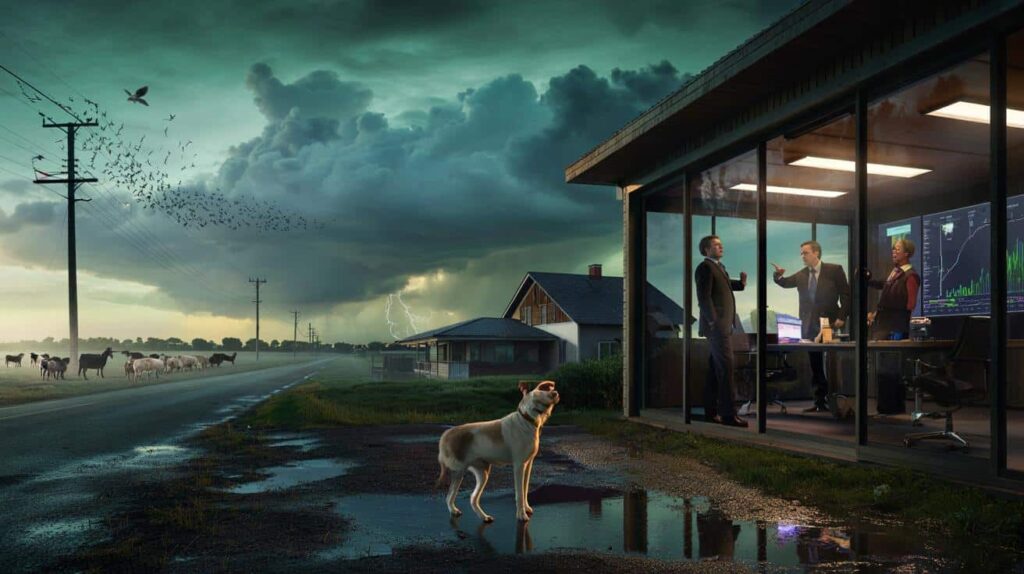
The lab mix refused to come inside, nose pulled toward the horizon, ears twitching at a thunder that hadn’t arrived yet. The grandfather, who’d seen more tornado seasons than any forecast model, just muttered, “He knows.”
Inside, on the kitchen radio, a politician was mocking “weather hysteria” and “overblown climate drama.”
Outside, a line of birds had already vanished from the power cables.

Someone was lying to themselves.
When animals notice the storm before we do
Spend time in a rural village during monsoon season and you’ll notice something eerie. Long before the first alert pings your phone, goats start crowding under the same corrugated roof, chickens go quiet, street dogs vanish from alleys. The air still feels thick and hot, but there’s a low-level tension, like a breath held too long.
Meanwhile, on TV, two experts argue about whether this year’s deluge fits into “Scenario A” or “Scenario B” for 2050. Their voices rise, their graphs glow. Out in the fields, frogs are already climbing to higher ground, as if they got the memo hours earlier.
It’s not glamorous. It’s not clean data. It’s just bodies reacting to something we don’t fully hear anymore.
Take the 2004 Indian Ocean tsunami. Survivors in Sri Lanka and India still talk about the elephants. Park rangers reported herds breaking loose and heading inland moments before the wave struck. Dogs refused to walk on the beach. Birds flew inland in frantic flocks. Humans, meanwhile, stayed to film the retreating sea with early digital cameras.
More recently, in Italy, researchers tracked cows and sheep near the Apennines and found that they changed behavior hours before earthquakes: restless steps, sudden grouping, abrupt feeding changes. Not a Hollywood prediction. Just nervous movement on an ordinary hillside that, later, matched seismic data.
We like technological drama. Phones buzzing, dashboards lighting up. Animals don’t do drama. They just quietly move their bodies out of harm’s way.
Scientists point to pressure changes, low-frequency rumbles, shifts in humidity and static electricity. Things that touch fur, feathers, bones, and inner ears directly. What we call “instinct” is often a body tuned to micro-signals we’ve trained ourselves to ignore.
At the same time, climate models are trying to read the future at a planetary scale. Politicians latch onto those models when they fit their agenda, mock them when they don’t, and shout about uncertainty as if that were a reason to sit still. Animals don’t debate uncertainty. They respond to it.
That’s the uncomfortable link: while we fight over spreadsheets and slogans, pigeons, cattle, street cats and village dogs keep running a real-time risk assessment with every storm, heatwave and cold snap. And they act.
Learning to read the quiet warnings
You don’t need a PhD or a smart home to start watching the world the way your grandparents did. Start simple. Before you open your weather app in the morning, step outside and just look and listen for 30 seconds. Are the usual neighborhood birds singing at full volume, or oddly silent? Are insects buzzing or strangely absent?
Then notice the pets. The dog that usually begs for a walk but suddenly refuses the front step. The cat that keeps pacing the windowsill and staring at a patch of sky. These are tiny signals, easy to laugh off on a normal Tuesday.
Collect them. Mentally. Day after day. You’ll start to recognize the difference between “my dog is weird” and “my dog is worried about something big.”
A lot of us feel guilty admitting we trust the family dog more than a press conference. Yet that’s exactly what happens in many rural communities facing rising floods or changing storms. A farmer in Bangladesh will watch his cows more closely than any speech from the capital. A fisherman in the Philippines will cancel a trip because the sea birds vanished, not because a politician said the word “resilient” ten times.
Don’t beat yourself up if you haven’t been paying attention. Our lives are built around screens, traffic, indoor lighting. The hum of appliances drowns out the hum of the weather. Let’s be honest: nobody really watches the sky every single day.
You can start now without becoming some mystical weather prophet. You’re just rebuilding a muscle that your body still has, buried under notifications.
“Animals don’t care if a storm is ‘once in 100 years’ or ‘statistically significant’. They just ask one question: do I move, or do I stay? We should listen more carefully to that question.”
- Watch baseline behavior
Notice how local animals behave on an ordinary calm day: noise level, movement, where they rest. This gives you a reference point. - Track sudden silences
If birds or insects go from busy to almost mute without obvious cause, treat that as a real-time nudge to check the sky and updated forecasts. - Pair instinct with data
Use animal cues as the first whisper, then open radar apps, local alerts, river level maps. The mix of gut and data is far stronger than either alone. - Share local observations
Talk with neighbors who keep animals. Patterns emerge faster when everyone compares notes after a strange night or sudden storm. - Prepare simple “if-then” rules
For example: “If the dog won’t leave the cellar and the air feels electric, we move the car to higher ground, no debate.” These quiet rules save time when panic hits.
Between climate models and the backyard crow
Walk through any town after a so-called “surprise” storm and you’ll hear the same sentence: “It came out of nowhere.” Meteorologists wince when they hear that. Their models probably flagged the risk days earlier, even if the timing or intensity was off. On the other side, old residents will swear they “felt it in their bones” or “knew when the swallows left.” Both sides sound a little defensive.
Maybe we’re trapped in the wrong debate. It doesn’t have to be climate models versus animal instinct, the IPCC versus the neighborhood crow. We’re the only species on Earth that can access both supercomputers and the original warning system walking around on four legs in our kitchen.
*What does it say about us that we keep choosing either-or in a world that’s clearly both-and?*
| Key point | Detail | Value for the reader |
|---|---|---|
| Animals sense micro-changes | Many species react to pressure, vibration, and electrical shifts before extreme weather is visible | Gives you early, low-tech signals to complement official alerts |
| Models and instinct can align | Climate forecasts offer the big picture, while local animal behavior reflects real-time conditions | Combining both improves your personal safety decisions |
| Everyday observation is a skill | Short, consistent attention to pets, birds, and insects rebuilds lost “weather awareness” | Helps you feel less powerless and more prepared in a changing climate |
FAQ:
- Do animals really predict disasters, or is it just stories?There’s a lot of folklore, but also real research. Animals don’t predict dates on a calendar. They react to physical changes we barely notice, like pressure drops or low-frequency rumbles. It’s not magic, it’s sensitivity.
- Should I trust my pet more than weather forecasts?You shouldn’t replace forecasts with your pet. Use them together. If the app shows a risk window and your usually calm dog is suddenly anxious before a storm, that’s a strong cue to act earlier, not later.
- What kind of animal behavior is most worth noticing?Anything that breaks the usual pattern without a clear cause. Birds going silent, insects vanishing, pets refusing to go outside, livestock huddling or heading uphill can all signal that the environment just shifted.
- Can this help with slow crises like climate change, not just storms?Yes. Changes in migration timing, nesting spots, or where urban animals find shade all point to how local climate is drifting. Those shifts won’t give you an exact date, but they show you the direction of travel.
- What’s one small habit I can start this week?Pick one daily moment—morning coffee, evening walk—and spend one minute off your phone, just watching and listening outdoors. Notice the animals you see and hear. Over weeks, you’ll start catching subtle shifts you never registered before.