The café window was fogged up so thick you could trace drawings in it with a fingertip. Outside, the first snow of the season was falling in clumps, turning parked cars into soft white hills while people shuffled past with hunched shoulders and red noses. Inside, the TV in the corner was running yet another weather bulletin, the headline bar screaming about “an exceptional winter episode” hitting earlier than expected.
Someone muttered, “If it’s this bad now, what’s it going to be like in February?” and the table went uncomfortably quiet. We’re at that point of the year when everyone dreams of the days getting longer, the air softening, the coats getting lighter.
Except the latest outlook for February 2026 points in a very different direction.

February 2026: a winter that doesn’t want to leave
Meteorologists are starting to say it openly: February 2026 will not be the gentle, late-winter pause many are hoping for. Several long-range models hint at a stubborn cold pattern, hanging on over parts of North America and Europe while the atmosphere stays unusually agitated. Think: snow that keeps coming back just when you thought it was over, freezing rain mixed into commutes, and temperatures that bounce between mild and bitter from one week to the next.
A winter that refuses to exit the stage quietly.
Take western Europe as an example. Early projections show a high risk of blocked atmospheric patterns, those pressure systems that “lock” the weather over the same regions for days or weeks. In real life, that means the kind of situation where one city sees five days of heavy snow in a row, while another, just 300 kilometers away, gets hit by icy rain and stormy winds.
The same logic appears over the eastern half of the United States, with a stronger than usual contrast between Arctic air plunging south and warm, moist air climbing up from the Gulf of Mexico. That’s a recipe for violent clashes in the sky.
Why this messy pattern? Part of the answer lies in the transition from El Niño/La Niña cycles and a jet stream that’s increasingly wavy. When that high-altitude river of air bends and dips, it drags cold down and pulls warmth up in exaggerated swings. The ocean is also running warmer than the long-term average, loading the atmosphere with extra energy.
Put simply: the background climate has shifted, so classic “calendar” winters don’t behave like they used to. February 2026 looks like one of those months that will prove it, again.
After the snow: the real threat is what comes next
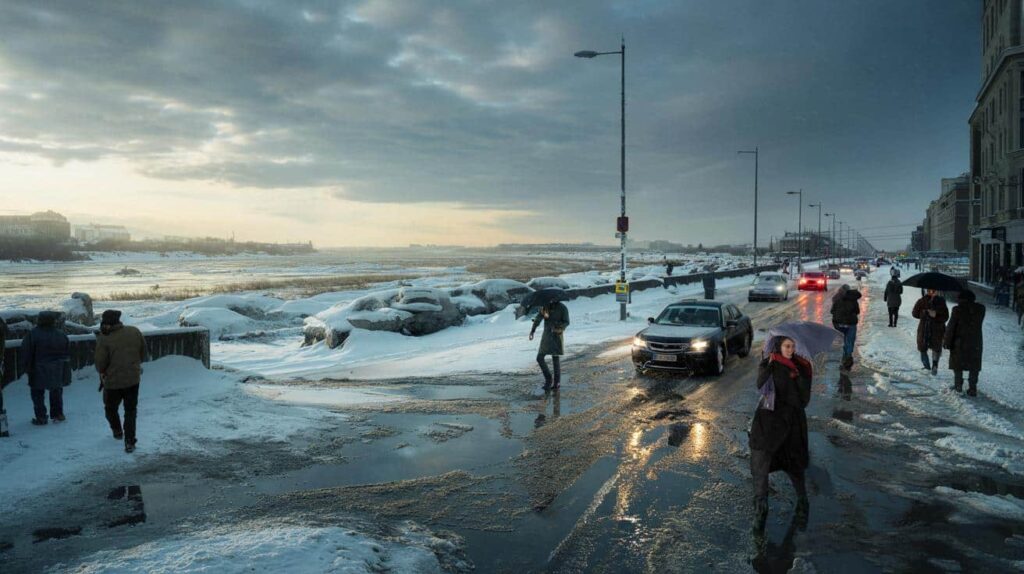
If the maps are right, the sharpest danger in February 2026 won’t be from postcard-perfect snowfalls. It will come from what happens when that snow melts too fast, or turns to ice at the wrong moment. One scenario stands out in the seasonal outlooks: a strong cold spell followed by abrupt mild spikes that send rivers and urban drainage systems into panic mode.
That’s when basements flood, slopes slip, and roads turn into dark mirrors overnight.
We’ve all been there, that moment when you step out in the morning, thinking the thaw has made everything safer, only to realize the sidewalk is a thin sheet of black ice. Now imagine that scene scaled up to an entire region. In February 2025, for instance, parts of central Europe saw a week of deep cold followed by a sudden warm surge and rain. Result: snowpack collapsing, rivers swelling nearly 1 meter in 48 hours, emergency crews pumping out underground parking lots.
The emerging signals for February 2026 show similar risk zones stretching from the Great Lakes to New England, and across large sections of France, Germany, and the UK.

There’s a nasty logic behind it. Warmer oceans add moisture to weather systems, so when mild air finally overruns a cold, snowy ground, it doesn’t just “soften” the landscape. It dumps heavy rain on top of old snow, turning it into a fast-moving slush that rivers and drains simply can’t absorb in time. That’s why **hydrologists are watching February 2026 almost as closely as the meteorologists**.
*The month might end up being remembered less for record-low temperatures and more for the chaos that came when those temperatures suddenly rebounded.*
How to live through a jumpy February without burning out
Weather experts talk in maps and anomalies, but daily life runs on habits. One concrete way to handle a jittery February 2026 is to think in “three-day windows” instead of assuming a full week will behave the same. Before planning a big drive, an outdoor event, or even a work trip, check the 72-hour forecast with one clear question: “Could this switch from snow to rain or from mild to freezing in that time?”
Adjust the timing by 24 hours if needed. That small buffer can mean you travel on wet roads instead of ice, or avoid a train line that ends up half-blocked by snowdrifts.
Another simple gesture: prepare for repeated power and transport disruptions, not just one big “once and done” storm. That means having a second charging cable in your bag, a small battery pack that actually works, a couple of shelf-stable meals at home, and layers you can add quickly when the heating falters. Let’s be honest: nobody really does this every single day.
Still, February 2026 is shaping up as the kind of month where a little boring preparation can spare you a lot of angry waiting in dark stations or freezing stairwells.
On the mental side, the roller coaster between bright, almost spring-like days and grim, slushy mornings is exhausting. One climatologist I spoke to summed it up in a single sentence:
“The hardest part won’t be the cold itself, it will be the constant shift between ‘maybe it’s over’ and ‘no, winter’s back again’.”
That emotional whiplash is real. To soften it, you can build yourself a mini “February survival kit”:
- One small, low-effort ritual for dark mornings (music, a warm drink, a five-minute stretch).
- A backup commute option for days when trains or buses go off the rails.
- A short list of people you actually call when things go sideways, not just text.
- A realistic indoor activity for kids or teens when outdoor plans get cancelled last minute.
- One treat you reserve only for storm days, so they feel less like punishment.
A month that says a lot about where our seasons are heading
February 2026 won’t just be another “bad winter month”. It’s shaping up as a snapshot of this new climate age where extremes stack on top of each other: early cold waves, erratic thaws, rain where you used to count on dry snow, and a growing sense that the calendar no longer guarantees anything. People will grumble about forecasts, of course, because forecasts are never perfect. Yet the general pattern that’s emerging — colder episodes that sting, followed by wild rebounds that flood and freeze in quick succession — keeps matching what the long-term data has been whispering for years.
Some will adapt almost instinctively, changing routes, shifting work schedules, quietly rethinking how they heat and insulate. Others will feel more anger than resignation, especially when bills climb and commutes crumble. That tension, between daily survival tactics and big systemic questions, is exactly where February 2026 will leave us: staring out at another slant of wet snow, wondering not “When will this winter end?” but “Is this our new normal now?”
| Key point | Detail | Value for the reader |
|---|---|---|
| Persistent cold spells | Models hint at blocked patterns keeping winter conditions in place | Helps plan travel, heating costs, and daily routines with fewer nasty surprises |
| Rapid thaws and heavy rain | Higher risk of snowmelt floods, icy roads, and drainage overload | Encourages early protection of homes, cars, and work schedules |
| Emotional fatigue from unstable weather | Frequent shifts between “spring-like” and “deep winter” days | Invites people to build small, concrete coping strategies for the month |
FAQ:
- Is February 2026 going to be the coldest on record?Current seasonal projections don’t show a record-breaking freeze everywhere, but they do point to significant cold episodes that could feel harsher because of the sharp contrasts with milder spells.
- Will it snow more than usual?Some regions, especially downwind of large lakes and in elevated areas, could see above-average snowfall, while lowlands might get more mixed events like sleet and freezing rain.
- Should I be worried about flooding after the snow?Yes, if you live near rivers, in low-lying zones, or in cities with poor drainage, the combination of snowpack plus heavy rain and rapid thaws deserves real attention.
- Are long-range forecasts for February really reliable?They don’t nail down specific days, but they are useful for spotting general trends like “more cold spells” or “higher flood risk”, which is what February 2026 is signaling.
- What’s the one thing I can practically do right now?Check your home and routine as if you were expecting two separate winter events instead of one: one heavy cold snap, and one messy thaw, and prepare minimally for both.