It starts with that tiny click in the hallway.
The sort of sound you only notice on cold nights, when you’re padding around in thick socks and the radiators feel… suspiciously lukewarm. You glance at the thermostat: still set to 21°C, little flame icon on, but the boiler has gone quiet. Seconds later it kicks back in, then cuts out again. You fiddle with the dial, bump it up a degree, then two, half-convinced the heating “isn’t working properly”.
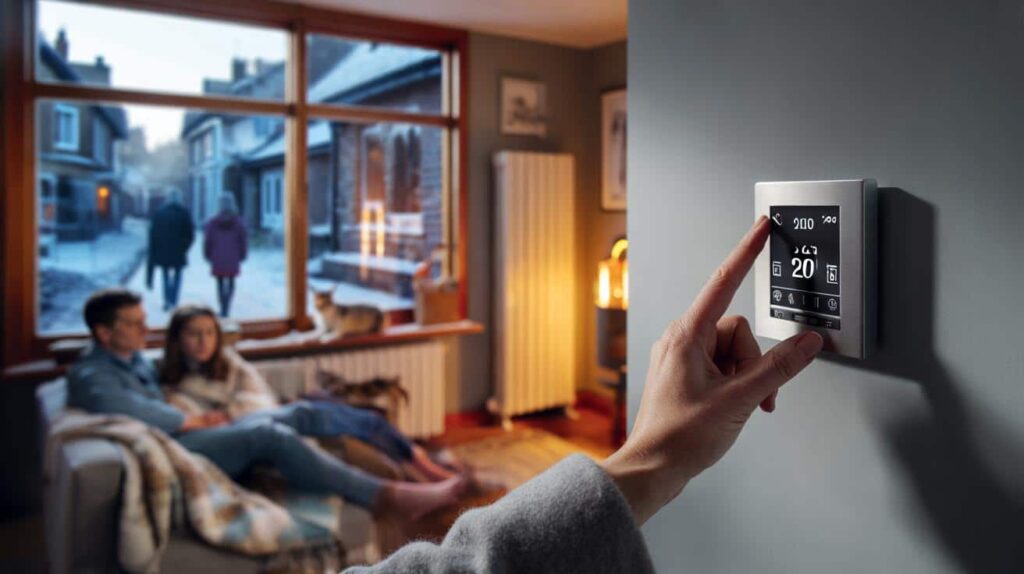
Outside, the temperature’s dropping. Inside, you’re wondering if every click is costing you money.
Most people misread what’s really going on.
 Psychology explains why certain people feel emotionally tired without being physically exhausted
That strange on‑off dance your thermostat does in the cold
Ask any heating engineer and they’ll tell you: winter callouts are full of worried homeowners convinced their boiler is dying, when all that’s happening is a thermostat doing its job. The on-off cycling that feels like a fault is usually your system quietly trying to keep things steady.
What changes during a cold spell is not the thermostat’s “mood” but the battlefield it’s fighting on. The heat is leaking out of your walls and windows much faster, so your heating has to work in shorter, sharper bursts to hold the line. The result is a pattern that looks random and slightly alarming, especially once you start listening for it.
Take a semi-detached house built in the 90s. On a mild October day, the thermostat clicks the boiler on, warms the place up, then might sit in silence for half an hour or more. The temperature glides gently down, nobody notices a thing.
Fast-forward to a freezing January night. Outside, it’s -3°C and the wind is shoving cold air at every gap. Now that same thermostat is clicking on, then off, then on again every few minutes. The radiators feel hot, then just warm, then hot again. The owners start Googling “boiler short cycling cost” at midnight, convinced their gas bill is exploding with every restart.
What’s really happening is a simple bit of physics wrapped in plastic. A room thermostat is not a volume dial for “more heat”, it’s a target-setter. Once the room hits the chosen temperature, the thermostat tells the boiler to stop. As soon as the room falls below that point, it calls for heat again.
During a cold snap, your house is losing heat relentlessly, so the dips between “on” and “off” get much closer together. That doesn’t automatically mean you’re burning more energy per click. You’re using more energy because the building is leaking warmth faster, not because the thermostat is somehow misbehaving. *The click is just the messenger.*
The big misunderstanding: your thermostat is not an accelerator pedal
The most common mistake engineers hear on doorsteps goes like this: “We were cold so we cranked it up to 28 to warm the house faster.” It sounds logical. Press harder, go faster. Except a thermostat doesn’t work like a car pedal. Setting it higher won’t speed up the boiler, it only changes where it decides to stop.
A gas or oil boiler usually runs at the same output regardless of whether the thermostat is set to 19°C or 25°C. It’s either on or it’s off. The radiators don’t suddenly pump out extra power just because the number changed. All you do by overshooting the setting is push the system to keep heating long past the point you would have felt comfortable.
Engineers see the same pattern again and again. A family comes home to a cold house and slams the thermostat up “just temporarily”. The boiler runs flat out, the rooms warm nicely, someone forgets to turn it back down. Two hours later, it’s 24°C, everyone is half-asleep on the sofa and the cat is lying spread-eagle on the radiator.
By the next bill, they’re complaining that “the boiler must be inefficient” or that “it uses more gas on really cold days”. Of course it does: the house lost more heat, and they heated it beyond what they actually needed. The thermostat did exactly what it was told. The misreading of that on-off behaviour is what quietly empties their wallet.
There’s a plain truth here that most of us resist. Your thermostat is basically a light switch with a brain, not a magic comfort dial. Turning it up doesn’t push heat into the house faster, it just tells the system: “Don’t stop until this higher number is reached.”

From an energy point of view, each extra degree you ask for can add roughly 5–10% to your heating use across a cold spell, depending on your home. That on-off dance people worry about is usually the system finely holding a line, not wasting energy. The real waste happens when we chase quick comfort with big, impatient jumps on the dial.
How to “talk” to your thermostat so it stops sabotaging your bill
Heating engineers repeat the same tip so often they could print it on the van: pick a realistic comfort temperature and leave it alone. For most homes, that’s somewhere around 19–21°C in living areas. The aim is to let the thermostat do small, gentle corrections rather than wild swings.
Start by watching how your home behaves during a cold day with the thermostat fixed. How long does it take to warm from 16°C to 20°C? Do certain rooms lag behind? Once you know the rhythm, you can put the dial out of your mind and let the system cycle naturally, without constantly intervening and creating spikes.
The second big move: lower slowly, not dramatically. If you’re going out for a few hours, nudging the thermostat down a couple of degrees is often enough. Dropping it to 10°C every time you leave can mean the boiler works harder and longer to catch up, especially in older, leaky homes.
We’ve all been there, that moment when you get back to an icy house and rage-twist the thermostat three or four notches in revenge. Energy-wise, that revenge is expensive. You’d usually spend less across a full week by letting the house cool only slightly, then asking the system to climb a smaller hill when you return.
One London engineer I spoke to summed it up simply:
“Most of my winter call-outs could be avoided if people treated the thermostat like a steering wheel, not a panic button. Small, steady moves cost far less than slamming it from one extreme to the other.”
To turn that into something practical, focus on three simple habits:
- Pick a “default” temperature you genuinely find comfortable and stick with it on cold days.
- Use timed schedules rather than manual yo-yoing whenever you go out or go to bed.
- Change the thermostat in 1°C steps, then wait and see before touching it again.
Let’s be honest: nobody really does this every single day. Yet the people who come closest are usually the ones who stop wincing when the gas bill arrives.
What that little click really tells you during a cold snap
Next time the frost hits and your hallway fills with the familiar soundtrack of clicks and soft boiler rumbles, try listening differently. That stuttering pattern is not your boiler gasping or your money evaporating with every restart. It’s your heating system quietly wrestling with the laws of physics, losing heat through brick and glass and trying to keep you inside a narrow comfort band.
The trick is to stop fighting it. **Understand that the thermostat is only a messenger**, not an accelerator. **Accept that a colder outside world means more work for the same warmth inside.** And then use that knowledge to make calmer choices: smaller adjustments, realistic targets, perhaps a bit of insulation or draft-proofing where you feel the cold pouring in.
People love to argue about the “right” temperature. The more interesting question is this: what would your winter feel like if you stopped focusing on the dial, and started paying attention to how your home actually behaves?
| Key point | Detail | Value for the reader |
|---|---|---|
| Thermostats don’t heat faster | Turning the setting up only raises the final target temperature, not the speed of heating | Helps avoid cranking the dial unnecessarily and wasting energy during cold spells |
| Frequent clicking isn’t always waste | Shorter on-off cycles in freezing weather usually mean the system is maintaining a steady temperature | Reduces anxiety about “boiler problems” and prevents unnecessary callouts or costly changes |
| Small, steady adjustments work best | Choosing a realistic comfort level and changing it gradually saves energy and keeps comfort stable | Gives a clear, easy strategy to lower bills without sacrificing warmth |
FAQ:
- Why does my boiler keep turning on and off more in very cold weather?Because your home is losing heat faster, the thermostat is calling for heat more often to hold the same temperature, which looks like more cycling but is usually normal behaviour.
- Does setting my thermostat higher warm my house faster?No, most boilers heat at the same rate; a higher setting only tells the system to keep going until it reaches a hotter temperature.
- Is frequent cycling bad for my boiler?Some cycling is normal, especially in cold snaps; extremely rapid cycling every minute or two can signal an issue that a heating engineer should check.
- What’s an efficient temperature to set during a cold spell?Many engineers suggest around 19–21°C for living areas, then a couple of degrees lower at night if your home holds heat reasonably well.
- Should I turn the heating off completely when I go out?For short absences, dropping it a few degrees is often better; turning it completely off can mean a long, costly reheat in very cold weather, especially in older properties.