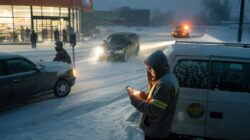
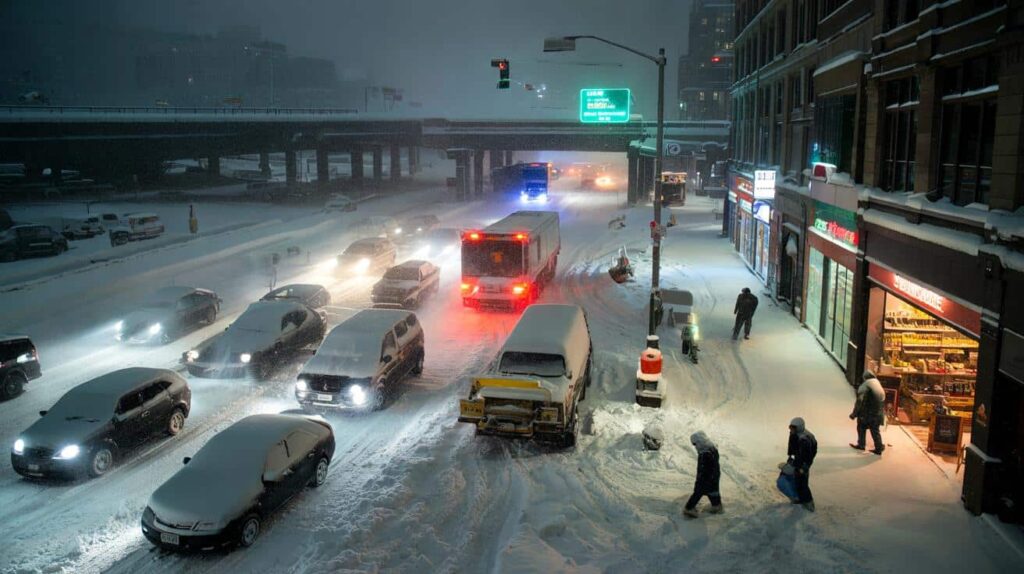
By 7 p.m., it wasn’t charming anymore. Headlights glowed through a thick white curtain, tires spun at the lights, and the usual ten‑minute drive home stretched past forty. On the radio, the traffic reporter’s voice grew tighter with each update: pile‑ups on the ring road, jackknifed trucks on the highway, buses trapped on hills.
Then the push alerts hit phones almost at once. Authorities urging people to stay home. Business federations warning against “paralyzing the economy”. Restaurant owners begging customers not to cancel. A supermarket chain emailing its staff: “Normal operations expected.”
Same storm. Two totally different realities. And tonight, they’re about to collide.

Snowstorm warnings collide with open-for-business pressure
By late afternoon, the weather map had turned into a painter’s smear of deep blue and purple bands. Meteorologists spoke of “historic totals”, with up to 40 centimeters expected overnight in some areas. On social networks, videos of already‑blocked secondary roads spread faster than the clouds themselves. Local officials stepped in front of cameras, asking people to work from home, postpone outings, avoid “all non‑essential travel”. The term “non‑essential” landed like a slap for many whose rent depends on every single shift.
On the commercial side, the tone was very different. Retail groups sent internal memos reminding managers that “customer demand remains strong” and that closures should be a “last resort”. A logistics firm circulated a message warning of “disciplinary follow‑up” for unjustified absences, screenshots of which quickly leaked online. Maria, a nurse’s aide, showed one of those messages on her phone outside a late‑night pharmacy. “They tell people not to drive,” she said, pulling her scarf tighter, “then my boss tells me to be there at 6 a.m. No shuttle, no taxi. Just me and the ice.”
That’s where the debate sharpens. Public authorities look at the big picture: crowded emergency rooms, blocked highways, tow trucks working non‑stop. Business owners look at margins, survival, staff schedules locked in weeks before. *The snow doesn’t care which side you’re on.* What people feel, stuck in the middle, is that they’re the ones taking the risk for choices made far above their pay grade. And that tension, between risk and revenue, is what keeps flaring up every time the forecast turns white.
How to navigate the “stay home” advice when your job says “come in”
When the alerts start popping up on your phone and your boss still expects you at 8 a.m., you need a clear game plan. Start with information that’s local, real‑time, and specific: check your city’s traffic webcams, public transport feeds, and short‑term radar rather than just a vague “heavy snow tonight” headline. Take screenshots of official advisories that mention your area by name, not just the region. That small file can later support you if you have to justify a late arrival or an absence.
Next, document your own situation with the same calm precision. No need for drama, just facts. Is your street already blocked by abandoned cars? Is the hill by your house impassable for small vehicles? Did your bus line suspend service? One clear photo, a quick note sent before your shift, and a proposed alternative (“I can work from home”, “I can swap shifts”, “I can stay later tomorrow”) often lands better than a panicked last‑minute cancellation. Let’s be honest: nobody really does this every single day. But on nights like this, it can be the thin line between being seen as “irresponsible” and being treated like an adult.
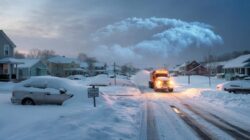
There’s also the hidden emotional layer. We’ve all been there, that moment when you stare at your car buried in snow and feel both guilty and angry. Guilty for thinking of yourself, angry that the storm suddenly became “your problem”. Talking about safety with a manager who only mentions lost revenue can sting. That’s why some workers quietly share scripts in group chats, simple sentences that sound calm, not confrontational.
“I’ve checked the official warnings and my route is currently considered hazardous. I’m not refusing to work; I’m refusing to take a risk the authorities are asking us to avoid. Here’s what I can offer instead.”
On those nights, it helps to keep a tiny, practical toolbox in mind:
- Have one colleague you can swap shifts with at short notice.
- Keep screenshots of transport cancellations and road warnings.
- Suggest remote tasks you can do from home, even if your job is mostly in‑person.
- Know your company’s bad‑weather policy before the storm hits.
- Write one clear message, then stop apologizing for protecting your safety.
Where do we draw the line between public safety and staying open?
Behind every “stay home” push alert and every “we’re open as usual” post, there are real people juggling incompatible pressures. A cafe owner who had already ordered extra stock for the weekend, terrified of wasting it. A ride‑share driver who earns only when the wheels turn. A bus driver who knows that one wrong slide could send thirty passengers into a ditch. On social media, the comments section becomes a battleground: one side accusing businesses of greed, the other accusing officials of alarmism and “killing the economy”.
The truth sits somewhere in the grey zone. Extreme weather doesn’t care about our schedules, but bills don’t melt away just because snow is piling up. Some regions have started experimenting with clearer thresholds: automatic school closures and remote‑work recommendations once a certain snowfall or ice index is reached, pre‑agreed wage coverage for cancelled shifts funded partly by the state. It’s not perfect, yet it moves the argument from “who’s to blame?” to “what do we do next time?”.
Tonight, as the snow keeps falling, every driver leaving their driveway is making a very personal risk calculation. Some will get home fine, others will encounter the blue flash of hazard lights on a half‑cleared curve. What lingers after the storm isn’t just photos of snowdrifts, but that nagging question: was this trip really worth it, or did someone push a little too hard for **business as usual** in anything but usual conditions?
| Key point | Detail | Value for the reader |
|---|---|---|
| Reading the warnings | Use hyper‑local forecasts, webcams, and official advisories to assess real risk on your route. | Gives you concrete arguments to push back if you’re pressured to drive in unsafe conditions. |
| Communicating with work | Send calm, documented messages with photos, screenshots, and practical alternatives. | Reduces conflict and shows you’re committed to work while protecting your safety. |
| Knowing your limits | Recognize when profit talk is overshadowing basic safety, and be ready to say no. | Helps you draw a personal line and avoid preventable accidents during severe storms. |
FAQ:
- Question 1Can my employer legally force me to drive in dangerous snow conditions?It depends on your country and contract, but they generally cannot force you to break official bans or drive when authorities have formally closed roads. Legal advice from a local labor organization is your safest source.
- Question 2What should I tell my boss if I decide it’s too dangerous to come in?Keep it short and factual: describe road or transport conditions, attach screenshots, and offer alternatives like remote work, shift swaps, or making up hours later.
- Question 3Are businesses exaggerating the need to stay open during storms?Some are simply trying to survive tight margins, others push unnecessarily. The line between **survival and pure profit** changes a lot between a small shop and a large chain.
- Question 4How can I prepare before a big snow event hits?Check your workplace’s bad‑weather policy, plan backup transport, coordinate with colleagues, and stock basic supplies so you don’t feel forced to go out for trivial reasons.
- Question 5Is staying off the road really that impactful during a storm?Yes. Fewer cars mean fewer accidents, less pressure on emergency services, and more room for snowplows and ambulances to operate safely.