Markets that spent the week hoarding safe-haven metals suddenly changed course on Friday as a new central bank name emerged.
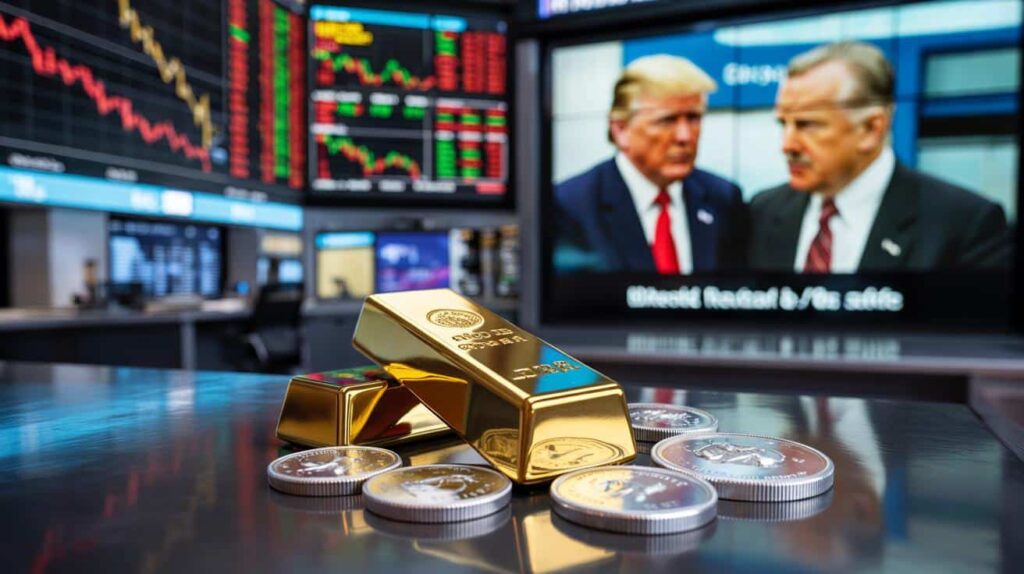
After days of panic buying and record-breaking highs, gold and silver were hit by a violent correction when Donald Trump signalled his choice to lead the US Federal Reserve. The move calmed fears that the central bank could become a political tool, and it triggered a rush to cash in profits on precious metals.
Gold and silver go from record highs to brutal sell-off
By early Friday afternoon, the price swings were striking. Gold, which had briefly plunged by more than 8% intraday, was still down 6.27%, trading around $5,037.91 an ounce. Silver fared even worse, having at one point lost over 17.6%, and settling on a fall of 14.30% to $99.1537 an ounce.

The sharp drop in gold and silver marked a dramatic reversal from record levels reached just 24 hours earlier.
On Thursday, both metals had smashed through previous records: gold had hit $5,595.47 an ounce, while silver touched $121.6540. Those peaks capped a blistering rally driven by a cocktail of geopolitical tensions, US political uncertainty and nagging doubts about the Fed’s independence.
From the start of the year to Thursday’s highs, gold had gained almost 30%. Silver, boosted not only by its safe-haven role but also by strong industrial demand from solar panels and electronics, had surged close to 70%. Similar enthusiasm spilled into industrial metals such as copper, which benefited from a general rush into tangible assets seen as more trustworthy than currencies.
Trump’s pick: Kevin Warsh calms central bank fears
The trigger for Friday’s reversal was political, not geological. Donald Trump announced he wants Kevin Warsh, a former Federal Reserve governor, to take over as Fed chair when Jerome Powell’s term ends in May.
Warsh is widely viewed as a figure grounded in traditional central banking. He previously served on the Fed’s Board of Governors during the global financial crisis and has since built a reputation in financial circles as a conservative but institutionally minded policymaker.
Traders read Warsh’s nomination as a sign that the Fed would not simply bend to the White House’s wishes.
In recent months, Trump has repeatedly attacked the Fed and Powell, demanding deeper cuts to interest rates. Those clashes rattled investors, who began to treat precious metals as insurance against a future in which the US central bank might lose its autonomy and credibility.
Analysts said the new name shifted that narrative. A candidate viewed as “conventional”, and not merely an extension of the president, eases fears of a politicised Fed. That makes gold and silver less urgent as a hedge against institutional breakdown.
Profit-taking accelerates the fall
The selling pressure was not only about central bank politics. Many traders had been sitting on hefty paper gains after the metals’ vertical rally. Friday’s news offered a clean excuse to lock in profits.
Once prices started to slip, algorithmic trading and stop-loss orders likely amplified the move. Large speculative positions, built up during the recent surge, can unwound quickly when sentiment shifts, driving prices down faster than fundamentals alone would justify.
The scale of the correction suggests investors had been waiting for almost any pretext to cash out.
Several market analysts argued that the drop looked less like panic and more like a sharp but rational reset. After such extraordinary gains over a short period, even a partial return to earth can look dramatic on charts.

Why “safe havens” suddenly looked less urgent
Gold and silver are typically sought out during periods of anxiety: wars, financial crises, currency scares. This year’s rally fed on all three themes:
- Rising tensions in the Middle East and between Washington and Tehran
- Concerns about US political instability in an election cycle
- Questions over whether the Fed would keep monetary policy anchored in data or bend to politics
When Trump’s choice of Warsh tempered one of those fears – the Fed’s independence – the calculus changed. The scenario of a central bank recklessly slashing rates or monetising political promises felt less probable. That reduced the appeal of parking cash in gold as a defensive move.
How the Fed’s independence links to metal prices
For many retail investors, the connection between a central banker’s name and the price of a gold bar can seem abstract. Yet the chain is fairly direct.
| Fed perception | Investor reaction | Impact on gold & silver |
|---|---|---|
| Independent, credible | More trust in the dollar and bonds | Lower demand for safe-haven metals |
| Politicised, unpredictable | Shift into hard assets and foreign currencies | Higher demand for gold and silver |
If investors expect the Fed to hold the line against political pressure, they are more comfortable holding dollars and US government debt. Yield and safety sit there, not in a metal that pays no interest. If that expectation weakens, bullion suddenly looks like a more attractive store of value.
Friday’s move suggests markets are leaning toward the first scenario, at least for now. Warsh is seen by many as a “defender of the Fed’s independence”, a phrase that directly counters months of speculation about a politically captured central bank.
What this means for ordinary investors
The violent swings highlight how treacherous trading precious metals can be, especially for newcomers. Anyone who bought gold or silver at Thursday’s peak based on social media momentum or fear-driven headlines would be sitting on steep losses just a day later.
Safe-haven assets are not automatically safe if they are bought at euphoric prices.
For long-term savers, gold can still act as a hedge against inflation or currency risk, but only within limits. Many financial planners suggest keeping any precious metals exposure at a modest slice of an overall portfolio rather than treating it as a one-way bet.
Key terms worth unpacking
Several phrases thrown around this week can sound technical but drive real-money decisions:
- Safe-haven asset: An investment that tends to hold value when markets are stressed, like gold, US Treasuries or the Swiss franc.
- Profit-taking: Selling an asset after a strong rise to lock in gains, which can trigger or deepen corrections.
- Fed independence: The idea that central bankers set interest rates based on economic data, not on short-term political goals.
- Correction: A rapid price drop that reverses some of a previous rally. Painful, but not necessarily the start of a full crash.
Possible scenarios for gold and silver from here
Looking ahead, several paths are plausible. If geopolitical tensions intensify or US growth data weakens, safe-haven demand could return quickly, pushing gold and silver back up. On the other hand, if Warsh confirms a cautious, predictable stance and inflation keeps easing, metals might stabilise at lower levels.
One realistic scenario is choppy, sideways trading: prices oscillating in broad ranges as investors weigh each new data release and political headline. In that environment, short-term traders may thrive on volatility, while long-term holders focus more on whether metals continue to outpace inflation over years rather than days.
Individual investors considering metals now face a balance of risks. Buying after a steep fall can feel attractive, but volatility remains high, and another policy shock – from Washington, Tehran, or elsewhere – could swing prices again. Blending precious metals with other assets such as bonds, equities and cash can lessen the impact of these sharp moves while still keeping some protection against financial or political stress.