The first sign doesn’t come from the sky, but from your phone. A push alert, a breaking-news banner: “Day set to turn into night: the longest solar eclipse of the century now has an official date.” You’re on the bus, or in the kitchen with a coffee going cold, and for a second the world zooms out. Groceries, emails, deadlines… all of it shrinks in front of this quiet announcement that the Sun itself is about to blink.
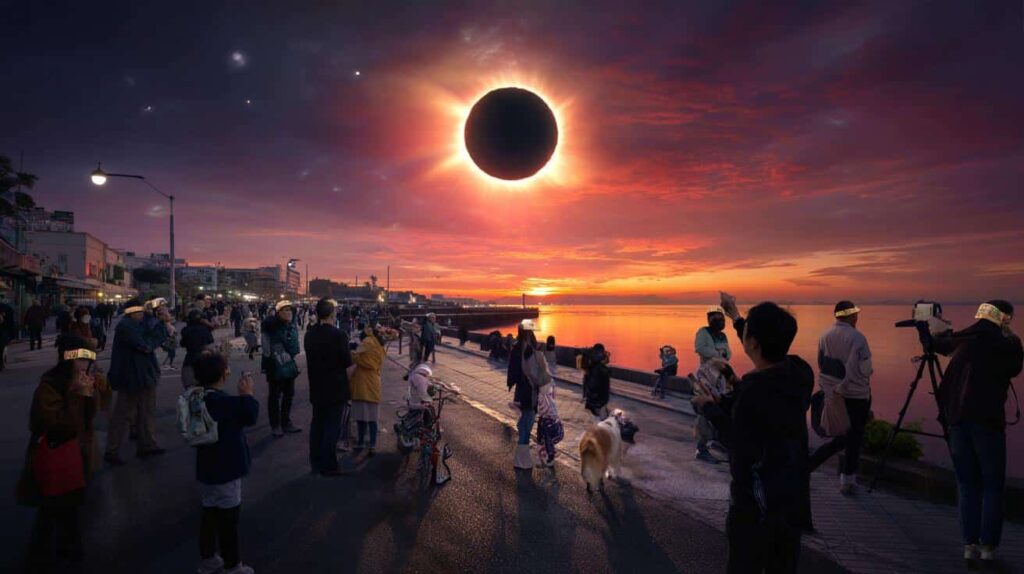
You picture midday shadows stretching like late evening. Birds going silent. Streetlights flicking on by instinct. Somewhere, thousands of people already refreshing flight pages, hunting for the right spot on Earth to stand in the path of the Moon.
The date is set. The countdown has started. And this time, the darkness will linger.
 Amazon : A 7.5-metre giant anaconda never seen before is found during a Will Smith documentary shoot
The day the Sun will step off stage
Astronomers have now circled it in red on their calendars: **August 2, 2027**. On that day, the Moon will slide perfectly in front of the Sun and hold its position long enough to create the longest total solar eclipse of the 21st century. At the very peak of the event, near Luxor in Egypt, the Sun will vanish for around 6 minutes and 23 seconds. That’s an eternity in eclipse time.
Most total eclipses barely give a couple of minutes of darkness before light floods back. This one will feel almost slow, like the universe is pressing pause. The path will cross the Atlantic, sweep over North Africa and the Middle East, then fade out over the Arabian Peninsula.
Ask anyone who’s seen a total eclipse: it’s not like a sunset, and it’s not like turning off a lamp. One French teacher who chased the 1999 eclipse across Europe described it as “watching the world’s lighting rig fail in real time.” Pets froze. A rooster crowed at 11 am. People applauded the sky.
For 2027, cities like Tangier, Tunis, Tripoli, Luxor and Mecca are in the crosshairs of the Moon’s shadow. Tour operators are already blocking out hotel rooms in Luxor, where the longest darkness is expected. Airlines are quietly eyeing special flights that might cross under the path of totality just as the Sun disappears.
We’ve all been there, that moment when an extraordinary event suddenly reorganizes your priorities for a whole year.
The reason this eclipse is so long is basically geometry, not magic. The Moon will be near its closest point to Earth, looking a little larger in our sky. The Earth, for its part, will be near aphelion, slightly farther from the Sun. The result: the Moon’s disk has a tiny size advantage, enough to cover the Sun more comfortably and for longer.
On top of that, the path of the shadow crosses regions close to the equator, where Earth’s surface is moving fastest. That motion stretches out the time the umbra — the core of the Moon’s shadow — spends over each point. Put all those details together, and you get the headline: the darkest midday of the century, and a duration that will feel almost unreal.
How to actually live this eclipse, not just scroll past it
If you want to see totality, the first step is simple: decide which side of the path you want to stand on. The 2027 eclipse line passes across southern Spain’s skies as a deep partial, but true totality starts over the Atlantic and slashes across Morocco, Algeria, Tunisia, Libya, Egypt, and Saudi Arabia. The longest darkness will hover near Luxor, roughly at 12:00–12:30 local time.

From there, you work backwards. Flights, leave time, budget, safety. Eclipses don’t care about your schedule, they arrive on the dot and leave without looking back. The best strategy is to give yourself at least two or three days on location, so one delayed plane doesn’t steal your sky moment.
The second piece is gear — and not the fancy kind. Certified eclipse glasses are non‑negotiable for any phase before and after totality. Regular sunglasses are useless and dangerous. You can find ISO 12312-2 compliant viewers for a few euros or dollars, and they weigh less than your keys. A simple paper solar viewer or a pinhole projector made from cardboard can turn the partial phase into a game for kids and adults alike.
The mistake most people make is overcomplicating it. They show up with three cameras, a tripod, two lenses and a phone, then spend the whole eclipse fiddling with buttons. Let’s be honest: nobody really does this every single day. The people who walk away glowing are usually the ones who watched with their own eyes first, and only then grabbed a quick photo.
The last piece is emotional, even if nobody really talks about it. A long total eclipse doesn’t just dim the light — it scrambles your senses. Temperature drops, winds shift, the horizon glows like a 360° sunset. Then there’s the collective gasp as the corona appears, that white, ghostly halo of the Sun’s outer atmosphere.
“During totality, I forgot to breathe,” recalls Salma, an amateur astronomer from Casablanca who chased the 2017 eclipse in the US. “I had this stupid plan to film it on my phone. When the Sun went dark, I dropped the phone into the grass and just stared. For those two minutes, nothing else in my life existed.”
To keep the 2027 experience grounded, it helps to have a tiny, personal ritual ready:
- Decide who you want beside you when the light goes out.
- Choose one thing you’ll focus on during totality: the corona, the stars, the silence, someone’s face.
- Prepare one sentence you’ll write down right after, before the memory blurs.
- Plan a low‑tech way to observe (cardboard viewer, simple glasses) in case gadgets fail.
- Leave a few minutes after totality just to sit, no photos, no posting, no talking.
When the universe rearranges your sense of time
There’s something quietly subversive about a midday eclipse. We build our lives on the assumption that the Sun is reliable, that noon is bright and predictable. August 2, 2027 will tug at that certainty, especially in places where the sky is usually a hard blue wall all summer long. Day will slip into an eerie twilight, not because of clouds, but because the clockwork above our heads is flexing in full view.
For some, it will just be a cool story: “Remember that day the lights went out in Cairo?” For others, it will flip a hidden switch. Some will book their first trip abroad just to stand under that shadow. Others will pull their kids out of school for a day, because this isn’t a show that comes back next season.
*You can feel, even now, that it’s going to be one of those rare dates people remember exactly where they were when the sky went dark.*
| Key point | Detail | Value for the reader |
|---|---|---|
| Official eclipse date | August 2, 2027, with maximum totality near Luxor, Egypt | Lets you plan time off, travel, and viewing location early |
| Exceptional duration | Up to about 6 minutes 23 seconds of total darkness | Offers a rare, extended chance to observe the corona and atmosphere |
| How to experience it fully | Simple gear, early planning, and an intention to watch with your own eyes | Transforms the event from a news item into a deeply personal memory |
FAQ:
- Question 1When exactly will the longest phase of the 2027 eclipse occur?The peak of totality will occur around midday local time near Luxor, Egypt, with detailed timing (down to the second) available from national observatories and NASA as the date approaches.
- Question 2Which countries are in the path of totality?The main path crosses the Atlantic, then passes over Morocco, Algeria, Tunisia, Libya, Egypt and Saudi Arabia, before fading over the Arabian Peninsula.
- Question 3Is it safe to look at the eclipse with the naked eye?It’s only safe to look without protection during the brief window of totality, when the Sun is completely covered. For all partial phases, you need certified eclipse glasses or an indirect viewing method.
- Question 4Do I need professional equipment to enjoy the eclipse?No. The most powerful tools are your eyes and a pair of quality eclipse glasses. A basic camera or smartphone can capture the ambiance, but the real memory will be what you saw and felt.
- Question 5What if I can’t travel to the path of totality?You may still see a deep partial eclipse from large parts of Europe, North Africa and the Middle East. Local astronomy clubs, science centers and streaming events will also offer shared ways to experience the moment.