A dozen volunteers in bright hi-vis vests lined up in a muddy field on the edge of town, each clutching a skinny sapling like a promise. Selfies, drone shots, a local councillor in a clean pair of boots. It looked exactly like the kind of scene that goes viral with the caption “10,000 trees planted in one day”.
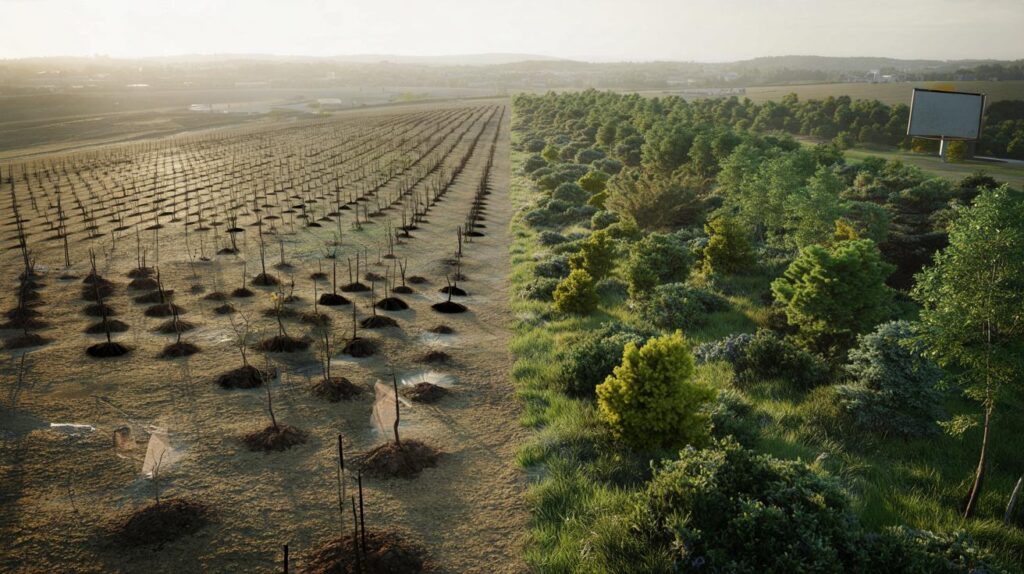
Six months later, hardly anyone came back. The banner was gone, the signs had faded, and the “future forest” was mostly brown sticks and plastic guards flapping in the wind. The rows were perfect. The survival rate wasn’t.
Something crucial was missing in that neat grid of good intentions.

When forests look good on camera but die quietly
Walk through a real, old woodland and the first thing you notice isn’t order. It’s chaos that somehow works. Leaf litter, tangled branches, patches of shadow and sudden sun. Oak next to birch next to hazel, with fungi working silently underneath. Nothing about it is tidy, yet everything is thriving.
Now picture the classic mass tree-planting photo: long, military-straight lines of the same species, identical height, same age, same tiny root ball. Efficient for the eye and the spreadsheet. Less so for life. Those plantations often grow fast at first, like teenagers shooting up overnight – then stall, struggle, or crash at the first drought, storm or pest.
The problem isn’t that we plant too few trees. It’s that we keep planting the same ones in the same way, expecting a different result.
On the outskirts of Lisbon, a well-publicised post-wildfire project planted thousands of fast-growing pines in tight rows to “bring the forest back quickly”. They did grow quickly. Then came another dry summer, a bark beetle outbreak, and a windstorm. Within a few years, huge patches of the new plantation were dead or dying, creating fresh fuel for the next fire.
By contrast, in a nearby valley, a smaller, quieter project went slower. Locals planted a mix of cork oak, strawberry tree, ash, and shrubs. They staggered the spacing, left old stumps and logs in place, and allowed natural regeneration between planted trees. It looked messy for a while, almost like neglect.
A decade on, that “messy” site holds more shade, more soil moisture, more birds, and far fewer dead trunks. Nobody cut a ribbon there. But the forest is actually behaving like a forest again.
Ecologists have a blunt way of putting it: tree farms are not forests. A forest is a living network where species back each other up. Different trees draw water from different depths, flower at different times, feed different insects and birds. When one species takes a hit – disease, frost, heatwave – neighbours with other strengths keep the system standing.
High-density monocultures do the opposite. Trees are forced into tight competition for light and nutrients, roots clash, crowns entangle, and stress goes up. Stressed trees invite pests and disease. One problem becomes many, fast. *Diversity spreads risk in space and time; density stacks it in the same place.*
That’s why planting numbers alone tell us so little about future forests. Ten thousand identical saplings is a bet. A varied mix, spaced with room to grow, is a strategy.
How to plant like a forest, not a factory
If you’re planning a tree-planting day – with your street, school, company, or council – there’s one simple mental switch: stop counting holes, start counting roles. Ask what each species will actually do in that landscape. Who brings shade, who brings nectar, who stabilises slopes, who feeds birds in winter?
Start by choosing at least five to ten native species, not just one “hero tree”. Mix long-lived giants with small, fast-growing pioneers. Leave more space between trees than feels comfortable; forests are not meant to be tight grids. Think clusters instead of rows: pockets of two or three of one species, next to a different pocket, with gaps for shrubs and natural seedlings to appear later.
The goal isn’t to fill every square metre. It’s to set up a conversation between species that will continue without you.
On a rainy morning near Manchester, I joined a community group on a small former pasture. Their first instinct was to cram as many saplings as possible into the field. “We’ve got 1,000 trees, we should use them all,” one organiser said, eyeing the space like a game of Tetris.
A local ecologist gently pushed back. He suggested planting only 600 that day and leaving room for natural regeneration. Elder and hawthorn were already popping up from the hedgerows. Blackthorn suckers were sneaking in from the edges. Rather than fight them, he argued, work with them. The group reluctantly agreed.
Two years on, the “gaps” they worried about are full of self-sown saplings, brambles sheltering birds, and wildflowers feeding pollinators. The original 600 planted trees are healthier because they’re not choking each other. The other 400 weren’t wasted – they were planted later in bare patches where nature hadn’t stepped in.

There’s a hard truth that many reforestation projects avoid saying out loud: a lot of trees die for the photo. Planting days get the headlines, not five-year survival rates. Soyons honnêtes : personne ne revient arroser religieusement tous les jours. Volunteers move on, budgets shift, land managers change jobs.
High-density planting is partly psychological. It looks like progress. It also allows funders to boast about big numbers: “We planted 50,000 trees this year.” But cramming saplings shoulder to shoulder doesn’t magically create a forest any more than filling a warehouse with toddlers creates a school. Without diversity, spacing and long-term care, many of those impressive numbers quietly fade away.
The mindset shift that changes everything
A practical rule of thumb used by some restoration teams is brutally simple: plant fewer trees, spend more time on each one. That means properly preparing the soil, protecting against grazing, watering during the first dry spells, and – crucially – choosing the right mix and spacing for that exact site.
Think in layers rather than lines. Tall canopy trees, mid-height species, shrubs, ground cover. Ask older residents what used to grow there before the field was cleared. Check which trees nearby are actually thriving, not just surviving. Aim for variety in root depth, leaf size, flowering period. That quiet complexity is what keeps a forest resilient when weather gets weird.
If you have a limited budget, it can be smarter to diversify species and reduce density, instead of buying “more of the same”. You’re building a community, not a crowd.
People often confess, in a low voice, that they feel guilty about not planting “enough” trees. Social media feeds are full of big, round numbers; small, careful projects can feel almost embarrassing in comparison. The pressure to go big is real, especially for companies and cities under scrutiny for their climate promises.
Yet the most common mistakes all point in the same direction: too many, too close, too uniform, too fast. Over-planting that starves roots of water. Single-species blocks that collapse at the first disease. Ignoring shrubs and understory plants, as if a forest is just tall trunks. Forgetting that local people will live with these trees for decades, not just one planting day.
On a human level, dense monoculture projects also create fragile expectations. When drought or pests hit, volunteers see brown rows and feel they’ve failed. Projects become one-off stunts instead of long-term relationships with a place. That’s how enthusiasm quietly dies.
“Planting trees is the easy part,” a Scottish forester told me, watching a group of teenagers wrestle with spades in wet peat. “Growing a forest is about who turns up five years later.”
That “who” isn’t just professionals. It’s the neighbour who keeps an eye on browsing deer. The teacher who brings a class back each spring. The walker who notices when a particular species is struggling. Diversity in people mirrors diversity in trees; both spread the load.
- Think in decades, not days – Survival after 5–10 years matters more than planting-day numbers.
- Mix native species and structures – canopy, understory, shrubs and ground cover share the stress.
- Leave space for life – Gaps, dead wood and “mess” help water, wildlife and seedlings.
- Work with what’s already there – Existing trees, hedges and seeds are allies, not obstacles.
- Celebrate care, not just planting – Watering, thinning and monitoring deserve as much attention as photos.
The forest we plant says who we think we are
On a crisp winter afternoon, I watched a small group in Wales walk slowly along a hillside where they’d planted mixed native trees five years earlier. They stopped at individual oaks like old friends. Someone pointed out where ash dieback had cut a gap, and how rowan and birch had stepped in. Nobody mentioned how many trees went in that first day. They were more interested in who had made it through the last dry summer.
That’s the quiet power of planting for diversity rather than density. It creates forests that can surprise us, rather than disappoint us. Systems that bend without breaking. Landscapes where no single failure brings everything down. On a warming, less predictable planet, that kind of resilience is not a luxury. It’s the difference between a green promise and a brown field of broken sticks.
We all know the feeling of walking into a place that just breathes life – a shady park corner, a scruffy hedgerow buzzing with insects, an old oak with a mossy trunk. Those places aren’t perfect. They’re layered, mixed, a bit untidy. That’s what gives them staying power.
The next time you see a triumphant post boasting about a million trees planted, let your eyes linger a second longer. Ask what species, what spacing, what future is really being sown. Ask who will be there when the photos are gone and the hard years come. A diverse, well-spaced forest might not fit so neatly into a headline.
It has a much better chance of still being there when our children go looking for shade.
| Point clé | Détail | Intérêt pour le lecteur |
|---|---|---|
| Diversité plutôt que monoculture | Mélanger plusieurs espèces natives, tailles et rôles écologiques | Comprendre pourquoi des projets plus petits et variés survivent mieux |
| Densité raisonnable | Planter moins serré, laisser des espaces, éviter la compétition excessive | Améliorer les chances de survie des arbres plantés localement |
| Vision long terme | Penser en décennies, suivre les plantations, accepter le « désordre » vivant | Participer à des projets qui créent de vraies forêts, pas seulement des chiffres |
FAQ :
- Why is planting a single tree species risky?Because one pest, disease or weather pattern can hit that species hard, and with no variety around it, the whole plantation can suffer at once.
- How many different species should a small project aim for?Where possible, at least five to ten native species, mixing long-lived trees, faster pioneers, and shrubs that fill the gaps.
- Isn’t high-density planting good for capturing more carbon quickly?It can boost short-term growth, but stressed, overcrowded trees are more likely to die early, losing that carbon and reducing long-term benefits.
- What if my site is very small, like a school yard or pocket park?Focus on structure: a few well-chosen species in layers (one or two canopy trees, some smaller trees, shrubs and ground cover) can mimic a tiny forest.
- How can I tell if a tree-planting project near me is serious or just a stunt?Look for questions about species mix, spacing, aftercare and monitoring – and whether anyone talks about survival rates five years from now.