The volunteers had been at it since dawn, boots sunk in orange mud, fluorescent vests already streaked with earth. A local politician posed for photos, gently pressing a tiny sapling into the ground, camera shutters clacking like crickets. Someone passed around branded water bottles. A drone buzzed overhead to capture the “before and after” for social media. By midday, thousands of trees were in, hashtags were flying, and everyone walked away with that warm sense of having done something good.
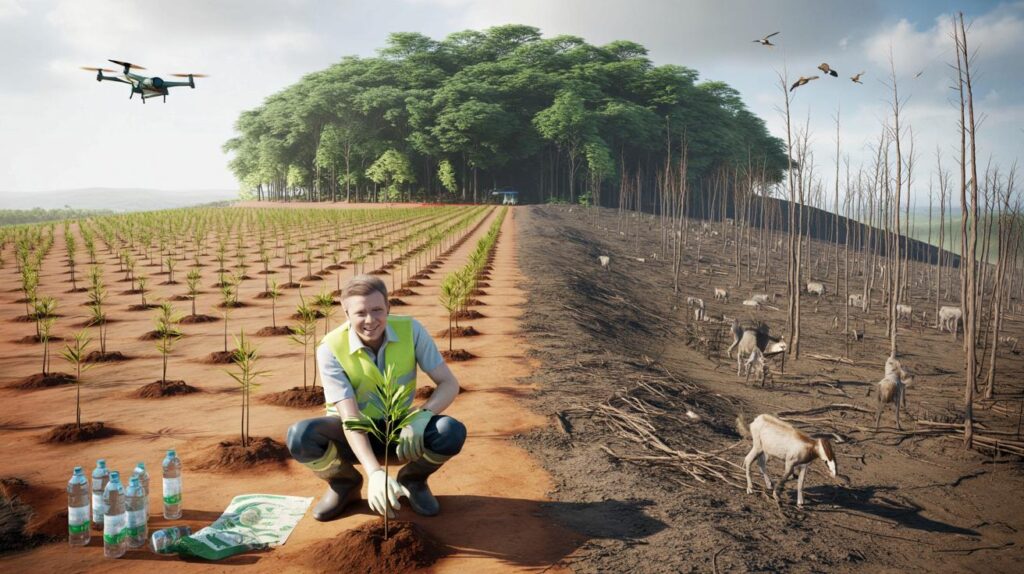
No one, though, wrote down how many of those saplings would still be alive in three years. Or even in three months. And that’s the awkward bit almost no one wants to talk about.
Why “millions of trees planted” doesn’t tell the real story
The big numbers come first. One million trees. Ten million trees. A billion trees. Brands love them. Politicians repeat them. News headlines grab them and push them into your feed, bright and shiny like a climate miracle on sale.

On paper, it sounds unstoppable. Forests returning, carbon being sucked from the air, animals getting their homes back. You can almost hear the applause.
Yet if you ask a simple follow-up — “How many of those trees are still alive?” — the room suddenly gets very quiet.
Take Ethiopia’s famous tree-planting day in 2019. Officials announced that 350 million trees were planted in just 12 hours. The figure went around the world in a heartbeat, repeated in headlines, panels, and climate summits. It was a spectacular story: record broken, hope renewed, problem solved — at least for a news cycle.
What barely made it into the conversation was survival. Local foresters on the ground later spoke of saplings planted in dry soils, without protections, in places where grazing animals roam freely. Some sites weren’t visited again for months.
When independent researchers tried to track what was left years later, numbers were patchy, scattered, or just missing. The “350 million trees planted” story stayed, while the “how many are alive?” story never really caught up.
There’s a simple reason this keeps happening. Counting how many tiny trees you put in the ground is easy. Tracking how many survive over five, ten, twenty years is slow, expensive, and frankly less glamorous. Grants and headlines rarely reward patience.
Many projects are scored by how fast they can plant and how cheaply they can report success. That nudges organisations to go wide instead of deep, to focus on the moment of planting instead of the hard, messy years that come after.
So reforestation success ends up being told like a fireworks show. Bright, quick, spectacular. The long, quiet work of keeping trees alive just doesn’t trend as well.
From planting trees to growing forests: how to do it differently
The shift starts with one stubborn question: “What’s your survival rate after three or five years?” Any serious reforestation project should know that number, or at least be trying hard to find it. Without it, those glossy “impact reports” are just wishful thinking dressed up as data.
Good projects do something very simple that many flashy ones skip: they go back. They walk the same lines months and years later, counting dead saplings, checking which species thrive, and which patches failed. And then they adapt.
It’s not as photogenic as a planting day, but it’s where forests actually happen.
On a hillside in Nepal, a small community project quietly flipped the script. Instead of boasting about “trees planted”, they limited themselves to what their group could realistically care for. Fewer species, fewer sites, more attention.
They planted at the start of the monsoon so rainfall would do most of the work. They fenced off the young trees from goats using scrap materials. Each family “adopted” a small patch and visited it regularly, partly out of pride, partly because they wanted the shade, fruit and firewood long-term.
Their initial planting numbers looked modest on paper. Yet after five years, locals could walk journalists through real young forest, not just lines in a spreadsheet. That’s the part that rarely makes a press release.
The logic behind this is almost embarrassingly straightforward. Trees are living beings, not widgets. They need the right species in the right place, at the right time, with care that lasts longer than a weekend campaign. Dry soil, wrong altitude, poor spacing, or a surprise drought can kill most of a planting in a single bad season.
When survival rates are tracked and shared, everyone behaves differently. Funders stop chasing the biggest number and start asking for proof of long-term growth. Project leaders think twice before planting in the wrong spot just to hit a target. Communities get more power, because their knowledge of local soils and seasons becomes clearly valuable.

The story subtly shifts from “How many did we plant?” to “How many are still standing when the cameras are gone?”
How to spot real reforestation (and support it)
There’s a simple method anyone can use, even scrolling on a phone between two meetings. When you see a bold claim about forests or trees, hunt for three things: survival rate, time frame, and local involvement. If at least two of those are missing, treat the claim like an unfinished puzzle.
Look for phrases like “80% survival after five years” or “monitored annually since 2018”. Numbers tied to specific dates matter. So does mention of local communities deciding where and what to plant.
If all you see are giant totals and drone shots, you’re probably looking at marketing, not a forest.
On a personal level, many people donate to tree campaigns because they just want to help. On a busy day, you tap “plant 10 trees” on an app, feel a small thrill, and move on. On a human level, that impulse is beautiful.
Where things get tricky is when guilt or urgency pushes you to fund anything with a green logo. **Ask one or two annoying questions** before you give money: “Who checks the trees after planting?” and “What’s your survival rate and over how many years?”. If the answers are vague, you’re not being picky, you’re being responsible.
On a deeper level, we all know forests can’t be built by press release alone. Soyons honnêtes : personne ne lit vraiment les rapports de 40 pages envoyés par email après un don impulsif.
At the heart of this, there’s a quiet emotional truth. On a walk through a young forest in Brazil, a local ecologist summed it up in one sentence:
“People love the idea of planting trees, but what the planet needs is people who commit to growing them.”
It’s an unglamorous commitment. It means budgets for maintenance, not just planting days. It means monitoring teams going out in the rain. It means sometimes admitting, publicly, that a site failed and needs to be redone.
- Ask for survival rates over at least three years.
- Favour projects led with local communities, not around them.
- Look for smaller, verified numbers rather than giant unchecked claims.
Rethinking “success” before the forests vanish from the fine print
Once you start noticing how rarely survival rates appear, it’s hard to unsee. Press statements talk about hectares “restored” and trees “put in the ground”, while the real measure of success quietly hides in field notebooks and half-finished databases. The gap between what’s said and what’s actually growing can be wide.
We’re at a moment where every climate promise counts. If those promises lean on forests, the least we can do is drag survival rates out of the footnotes and into the headlines.
On a more personal level, there’s something honest about asking, “Will this still be here when my kids are grown?” We’ve all lived that moment where a beautiful project gets announced, shared, celebrated… and then silently dissolves. *Trees are too slow, too patient, to fit this rhythm of viral attention and quick wins.*
The remedy is not to stop planting. It’s to enlarge the story. To treat every sapling as the first chapter, not the whole book.
Real reforestation success will probably never fit neatly into a single photo. It looks more like someone walking the same hillside, year after year, noticing which patches darken with shade and birdsong. It sounds like communities arguing over land use, and then, gradually, agreeing on a future they share with trees.
That’s messier than a headline about “a billion trees”. It’s also far more powerful. The question now is whether we’re ready to trade easy numbers for living forests — and whether we’re willing to keep asking what survives once the cameras are gone.
| Point clé | Détail | Intérêt pour le lecteur |
|---|---|---|
| “Trees planted” ≠ forests grown | Planting numbers say little without survival rates over several years. | Avoid being misled by impressive but shallow claims. |
| Survival tracking changes behaviour | Monitoring forces projects to adapt methods and focus on quality. | Helps you support initiatives that actually regenerate ecosystems. |
| Three questions to always ask | Survival rate, time frame, and role of local communities. | Simple filter to choose credible reforestation projects and donations. |
FAQ :
- Why is the survival rate of trees rarely mentioned?
Because long-term monitoring is slow, costly and less glamorous than big planting numbers, many projects prioritise quick results and headlines over tracking what actually survives.- What is a good survival rate for a reforestation project?
Context matters, but a commonly cited benchmark is 70–80% survival after three to five years, with honest reporting and clear methods for how that figure was measured.- Are big “one day” planting events useless?
Not always, but without preparation, maintenance and follow-up, they often deliver far fewer living trees than promised. They work best as a start, not as the whole strategy.- How can I check if a project is serious about long-term success?
Look for transparent data on survival over time, involvement of local communities, and clear plans for maintenance, such as watering, protection from grazing and managing fires.- Is planting trees always the best climate solution?
No. Protecting existing forests, restoring natural regeneration and cutting emissions at the source often have a bigger, faster impact than planting new trees alone.