While people worry about the spread of giant “murder hornets”, a common local frog is quietly ambushing them, swallowing the wasps alive – stinger first – and walking away as if nothing happened.
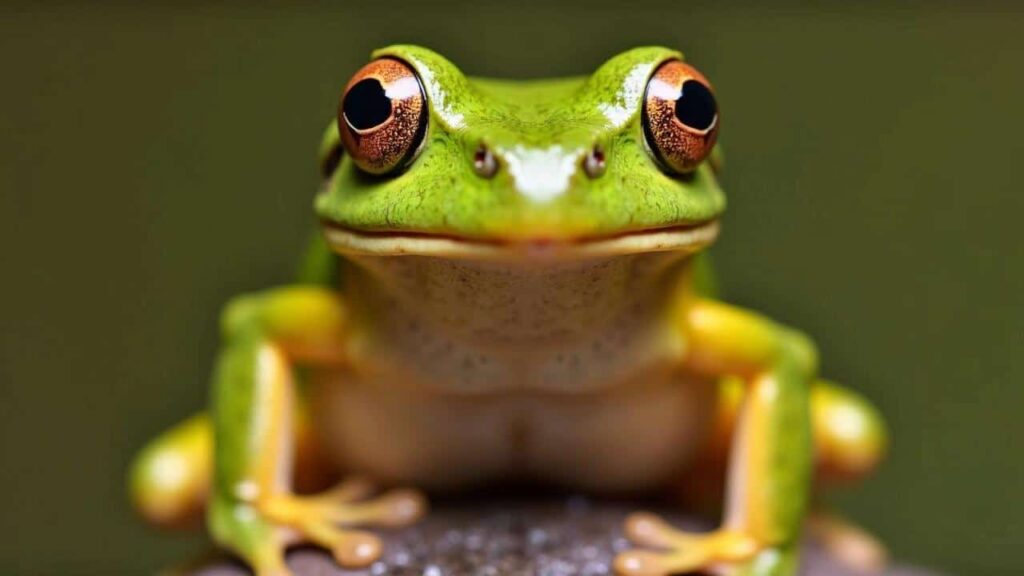
A tiny hunter takes on a feared insect
The Asian giant hornet, Vespa mandarinia, has earned a frightening reputation. Its sting triggers intense pain, and in rare cases, multiple stings can be fatal to humans. Beekeepers hate it, ecologists monitor it, and headlines call it the “murder hornet”.
Yet in parts of Japan, a very ordinary-looking pond frog is treating this notorious insect like just another crunchy snack.

Ecologist Shinji Sugiura, from Kobe University, has shown that the black-spotted pond frog, Pelophylax nigromaculatus, routinely attacks and eats live hornet workers, including Asian giant hornets, without flinching from their venomous stings.
Footage from the study shows hornet stingers visibly embedded in the frog’s mouth at the very moment it swallows – with no sign of pain or poisoning.
This frog is a familiar sight in East Asia. It lives around rice fields, ponds and irrigation channels, feeding on a mix of insects. Until now, no one had carefully documented its willingness to take on large, dangerous prey armed with potent venom.
Inside the experiments: frogs vs murder hornets
To find out whether these encounters were just chance events or a regular hunting tactic, Sugiura designed a series of controlled tests. Adult frogs were placed one by one in enclosures and presented with female hornets from three species:
- Vespa mandarinia – the Asian giant hornet
- Vespa analis
- Vespa simillima
Only female hornets have a functioning stinger, loaded with venom. That made them an ideal test for how the frogs handle real risk.
Researchers watched every interaction closely. They recorded whether the frog attacked, whether the hornet fought back, if the frog was stung, and how the frog behaved in the minutes that followed.
The frogs showed no avoidance at all – they went straight for the hornets, even after being stung.
The numbers were striking. Frogs captured Asian giant hornets in about 79% of encounters. For the two other hornet species, capture rates climbed above 90%. That is not clumsy opportunism. It looks like a predator that knows exactly what it can handle.
Many of the photos from the study show hornets jabbing their stingers into the frogs’ mouths as they are being swallowed. For most animals, a sting like that would be agony. For these frogs, it seems to be little more than background noise.
A venom that hurts humans, ignored by frogs
Asian giant hornet venom is a complex chemical mix. It contains:
- Mastoparan – a peptide that triggers histamine release and intense local pain
- Phospholipase A2 – an enzyme involved in inflammation and allergic reactions
- Other components that damage cells and red blood cells
In people, a sting can cause swelling, tissue damage and in rare, severe cases, anaphylactic shock. In livestock and pets, multiple stings can be life-threatening. The venom is designed both to subdue prey and to deter predators.
Yet the frogs in Sugiura’s trials showed no signs of distress. They did not rub at their mouths, stop moving, lose balance or display odd behaviour. After swallowing a hornet, they simply sat, or went on hunting.
This calm reaction points to a genuine biological resistance, not a lucky escape.
Why the venom fails to work on them remains uncertain. Sugiura and colleagues suggest several possibilities. Amphibian nerves and cell receptors may respond differently to the hornet’s toxins. Frog tissues could lack the precise molecular docking points that make mammal nerves so sensitive to the venom.
 If you feel drained after social interactions, psychology explains what your brain is actually doing
Another scenario is biochemical defence. The frogs may produce proteins or other molecules that neutralise the venom almost as soon as it enters their tissues. Their cell membranes might also be less vulnerable to venom enzymes that rip apart mammalian cells.
What this means for food chains
Asian giant hornets are usually treated as near top-level predators among insects. They raid bee hives, decapitate honey bees and can clear out a colony in hours. Few animals are thought to regularly prey on adult hornet workers.
The Japanese pond frog changes that picture. It shows that in some landscapes, even large, aggressive hornets are just one more link in the food chain.
A feared invasive insect can become lunch for a small, semi-aquatic amphibian that most people barely notice.
From an ecological angle, this matters. If frogs are routinely eating hornet workers in rice paddies and wetlands, they may slightly reduce local hornet numbers. They are unlikely to “solve” any invasion problem on their own, but they could act as one of several natural checks on hornet populations.
The study also highlights how incomplete our understanding of predator–prey relationships can be. Adult hornets were long assumed to have almost no vertebrate predators. Careful field observation and simple experiments showed that assumption was wrong.
Could frogs help control invasive hornets elsewhere?
As Asian giant hornets spread beyond their native range, especially into North America, scientists and wildlife managers have searched for control options: traps, nest removal, and potential biological control agents.
Finding a native predator that reliably eats the hornets sounds attractive, but the Japanese frog story comes with caveats. Pelophylax nigromaculatus evolved alongside these hornets; their relationship is old, probably shaped over thousands of years. Introducing this frog to other regions would risk creating a new invasive species with its own impacts on local wildlife.
A more realistic route is to look for similar resistance in native species. Do North American frogs, toads or lizards attack stinging wasps and hornets without being harmed? If so, some might play a minor but helpful role in containing hornet spread, at least locally.
Why venom resistance fascinates scientists
This frog–hornet interaction sits inside a broader scientific theme: animals that shrug off venoms that are deadly to others. Researchers have already identified:
- Ground squirrels that resist rattlesnake venom
- Some mongooses that can withstand cobra bites
- Opossums that tolerate toxins from pit vipers
These examples often involve subtle changes in the structure of nerve receptors or blood proteins. The toxins still enter the body, but they cannot lock onto their targets properly, so the venom loses its punch.
If frogs have evolved something similar against hornets, the underlying biology could guide new pain treatments. Venom components such as mastoparan activate nerve pathways that scream “pain” to the brain. Understanding how frog tissues blunt that signal might one day help design drugs that tone down severe pain in people without heavy side effects.
Key terms worth unpacking
Two concepts in this research show up often in ecology and toxicology:
- Trophic dynamics: This refers to how energy and nutrients move through food webs, from plants to herbivores to predators. When a supposedly “untouchable” predator, like a hornet, turns out to be regular prey for frogs, it shifts those dynamics.
- Nociception: This is the nervous system’s process of detecting harmful stimuli, such as extreme heat or a sting. Animals with unusually high tolerance to venom may have altered nociception, meaning the pain signal is reduced or processed differently.
Future work on these Japanese frogs will likely involve lab-based analyses of their blood and tissues, looking for proteins that bind or break down venom components. Researchers may also test whether the frogs resist venom from other stinging insects, such as bees or different wasps, to see how broad their tolerance is.
For now, field ecologists in Japan will keep watching the ponds and paddies at night. Somewhere out there, another frog is lining up its shot, flicking out a sticky tongue, and turning a “murder hornet” into a mid-evening snack – no protective gear required.