The envelope arrives in your mailbox with that familiar logo. You already know what’s inside before you tear it open: your electric bill, a number that seems to stretch a little higher every single month. Maybe you glance at the thermostat, then at the kids on their tablets, then at the humming fridge in the kitchen and think, “Where is all this money actually going?”
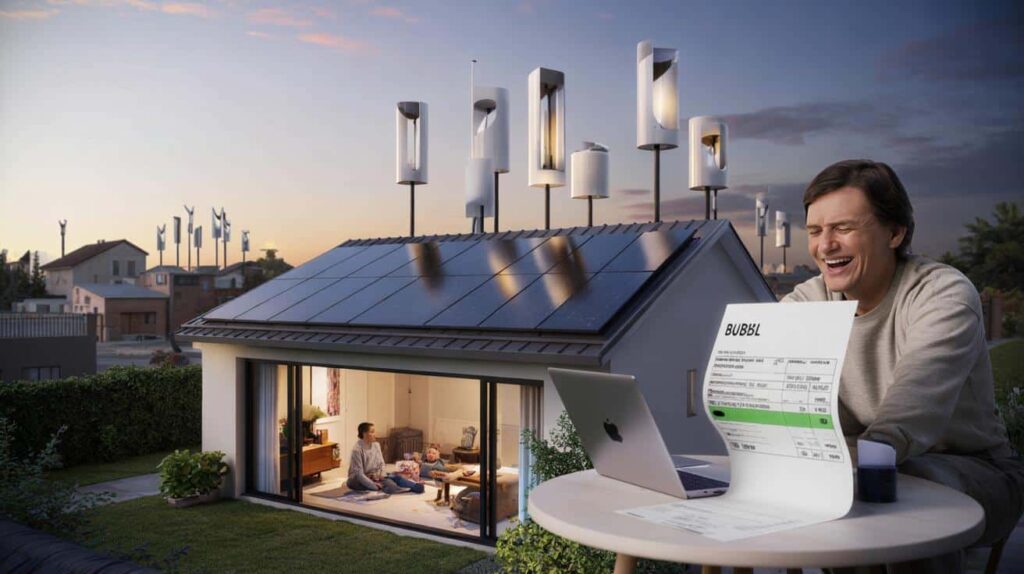
Now picture this: instead of crossing your fingers before opening the bill, you look out your window. On the edge of your roof or at the back of your garden, a small vertical wind turbine turns quietly in the evening air. No giant blades, no roaring sound, just a discreet column catching every gust and nibbling away at your bill.
Somewhere between those two images sits Bill Gates – and a very unexpected revolution in miniature wind.

Bill Gates’ quiet bet on pocket-sized wind power
Bill Gates isn’t up on a rooftop with a wrench and a safety harness. He’s doing something more powerful: pouring money and credibility into startups trying to turn small wind turbines into the new solar panels. The big idea is simple enough to fit on a sticky note: **shrink the wind farm and bring it home**.
These aren’t the clunky, rattling DIY towers that neighbors complain about. They’re compact vertical turbines, often tubular or helical, designed to rotate no matter which way the wind blows. Think “urban lamppost” more than “country windmill”.
The promise is bold. Cut the price of wind energy by three. Install them almost anywhere in under a year. Let the breeze do the quiet, invisible work your wallet never sees.
Take Aeromine, a startup backed by Breakthrough Energy Ventures, the climate fund founded by Bill Gates. The device looks like a chunky white pillar at the edge of a flat roof. No spinning blades in the air, no seagull-level dangers, just a sculpted shell that sucks in the wind and accelerates it through hidden turbines.
Pilot installs on warehouses and industrial buildings in Texas and Michigan show something striking. Combined with solar panels, these “boxy” turbines can supply up to half of a building’s electricity needs, depending on the site. That’s not a futuristic lab test, that’s real kilowatt-hours taken off real bills.
Another Gates-funded team is working on vertical-axis turbines you can line up along roofs, parking lots or noise barriers along highways. Where there’s dead space and a bit of air movement, they want to plant power.
Why does the price drop so sharply? Physics and logistics, mostly. Traditional wind turbines need tall towers, deep foundations, heavy cranes and tons of steel. Miniature wind skips most of that drama. The structures are shorter, lighter, often modular. They slide into place with regular construction equipment, sometimes just a small crane.
They also thrive in places where big wind is impossible: dense suburbs, warehouse districts, ports, retail parks, even service-station roofs. That means no endless legal battles over landscape “pollution” or angry villagers. Installation timelines shrink from years to months.
And once you stop paying for lawyers, ultra-high masts and heroic logistics, you can sell each kilowatt-hour for roughly a third of the classic price in the right conditions. That’s the bet Gates is making with his checkbook.
How these miniature turbines actually slash your bill
Imagine your home or building as a hungry beast that never sleeps. Every light, plug, and charger is a tiny bite. Solar panels cut into that appetite during the day. Miniature wind wants the night shift. It spins when the sun is gone, when the sky is grey, when winter makes your heaters work overtime.
That combo changes everything. Instead of just lowering your annual bill a bit, you flatten the worst spikes: those cold, windy evenings when everyone cooks, Netflixes and charges at the same time. You generate right when the grid is most expensive.
The practical method is simple on paper. First, analyze your roof or property: wind exposure, height, nearby obstacles. Then match a turbine layout to your real consumption curve, not just a glossy brochure. One medium-sized rooftop turbine for a house, or a whole line for a warehouse.
The most convincing numbers don’t come from glossy climate reports. They come from building managers who literally sit with the bills every month. One logistics center in the US Midwest using a Gates-backed turbine system reported internal estimates of up to 60% lower energy costs on windy days when paired with solar, and around 20–30% off the annual bill after the first year, once the system had been fine-tuned.
Not every site gets that lucky, of course. A sheltered house tucked behind trees and taller buildings? The benefit drops. An exposed hill, a coastal zone, a high warehouse in a windy corridor? That’s premium real estate for miniature wind.
 Heavy snow expected starting tonight and how climate change activists are already blaming you
We’ve all been there, that moment when you stare at the “kWh used” line on the bill and wonder if something’s broken. For the first time, regular people and small businesses are starting to talk about adding wind the way they’ve learned to talk about solar: “What’s your payback time?” instead of “Isn’t that just for giant farms?”
There’s a logic behind the “install almost anywhere in a year” headline too. Micro-turbines generally dodge the worst of the permitting nightmare. Many models sit below height thresholds that trigger endless hearings, and their noise levels are closer to background traffic than a jet engine. That lowers community resistance.
From a money point of view, developers are designing them like Lego. Pre-fab modules. Standard mounts. Plug-and-play inverters that speak the same language as existing solar or battery systems. Installers can train quickly, so labor costs don’t explode.
Let’s be honest: nobody really reads grid interconnection manuals every single day. What people want is something that doesn’t fight with their existing setup. That’s exactly where Gates’ money is going – into technologies that behave well with what’s already on your roof or in your basement.
Thinking of it for yourself? Here’s how to approach it
If you’re starting to mentally measure your roof, slow down and do what the serious players do: start with data. A basic wind assessment is your best ally. Look up the average wind speed in your area, then check what actually happens at roof level. Nearby trees, other buildings, hills and valleys all twist the airflow.
Some of the new services funded by Gates’ ecosystem use satellite data and 3D models of cities to simulate turbulence and identify “sweet spots” on roofs. They’ll tell you if your home is a good candidate or if you’d just be installing a very expensive spinning sculpture.
From there, the method is almost boringly practical. Size the turbine to cover a realistic chunk of your yearly demand, not a fantasy “100% off-grid” dream. Connect it with existing or future solar plans. Then ask one hard question: when does the system pay for itself in your specific case?
The biggest mistake people make is falling in love with the gadget before running the numbers. A sleek vertical turbine on Instagram does not equal a lower bill on your kitchen table. The Gates-backed teams know this, which is why many are shifting to performance-based contracts: they get paid when your kilowatt-hour cost really falls.
Another trap is ignoring the neighbors. Even if a device is technically within regulations, a constant low hum or flickering shadow can poison relations quickly. The newer designs work hard on that, with enclosed blades, slow rotations and dampening systems. Still, a friendly talk across the fence can save you months of tension.
*The emotional side counts more than brochures admit.* People want to feel proud of their installation, not secretly guilty every time the wind picks up. Choosing a design that blends into your building and a developer that communicates clearly matters almost as much as the raw price.
Bill Gates summed up his strategy for these technologies in one crisp sentence during a climate talk: “We have to make clean energy not just cleaner, but cheaper and easier than what people already use, or they simply won’t switch.”
- Ask for a site-specific wind and consumption study
Not a generic map, but a simulation or measurement of your exact location and roof height. - Compare total cost per kilowatt-hour, not just hardware price
Installation, permits, maintenance and grid connection all count toward your real savings. - Combine with solar and, if possible, a small battery
Using wind and sun together smooths out production and protects you from price spikes. - Check noise levels and visual impact in real-world installs
Visit an existing site or watch unedited videos, not just marketing animations. - Plan for a one-year learning period
Expect adjustments, firmware updates and fine-tuning before hitting peak performance.
The bigger picture: from bills to a quiet energy revolution
Zoom out from your own roof for a second. Picture thousands of flat retail roofs, empty parking structures, highway walls and warehouse districts. All that dead surface, suddenly colonized by rows of discreet vertical turbines, each shaving a little off someone’s bill and a little off the grid’s fossil demand.
That’s the vision Bill Gates is betting on: not heroic individual homesteaders, but entire cities quietly turning into patchwork wind farms. The tech is still young, the marketing sometimes overexcited, and not every design will survive real weather and real economics. Some prototypes will stay prototypes. Some startups will disappear.
Yet the direction is clear. Energy is becoming local, stacked in layers: solar, miniature wind, batteries, smart meters. Your bill stops being a mysterious verdict and starts to look like something you can negotiate with the sky above your head.
The day you open that envelope and find a number that finally goes down instead of up, you might not think about Bill Gates or his venture fund at all. You’ll think about the quiet column spinning above you, doing its job every time the wind remembers your address.
| Key point | Detail | Value for the reader |
|---|---|---|
| Miniature wind costs three times less in the right sites | Lower towers, simpler logistics and fewer permits slash total costs per kWh | Understand where real savings come from, beyond just buying cheaper hardware |
| Fast installation “almost anywhere” in under a year | Compact turbines fit on roofs, parking lots and urban spaces with minimal disruption | See how quickly a project can move from idea to reduced electric bill |
| Works best combined with solar and smart planning | Wind covers evenings and bad-weather days, solar covers sunny peaks | Learn how to design a system that attacks the most expensive hours on your bill |
FAQ:
- Question 1Are these Bill Gates–backed miniature turbines already available for private homes?
- Answer 1Some models are starting to reach the residential market in test regions, but most Gates-funded projects are still focusing on commercial and industrial roofs. Expect broader home offers over the next few years as costs drop and installers gain experience.
- Question 2Can a small wind turbine really power my entire house?
- Answer 2On most sites, one turbine will cover a part of your annual consumption, not 100%. The realistic approach is to aim for a significant cut, then combine wind with solar and efficiency upgrades to reduce your dependence on the grid.
- Question 3What happens when there’s no wind for several days?
- Answer 3You stay connected to the grid, and any solar or battery you have helps bridge the gap. The wind system is there to lower your average cost and protect you during windy, high-price periods, not to guarantee 24/7 autonomy on its own.
- Question 4Are miniature turbines noisy or dangerous for birds?
- Answer 4Vertical and enclosed designs spin more slowly and have fewer exposed blades. Noise levels are comparable to background urban sound, and bird collisions are much rarer than with large horizontal turbines, though long-term studies are still ongoing.
- Question 5How do I know if my roof is a good candidate?
- Answer 5Start with local wind data, then talk to a provider who can simulate airflow around your exact building. Flat, exposed roofs in windy areas usually perform best; deep valleys, dense tree cover and tall surrounding buildings weaken the benefit.