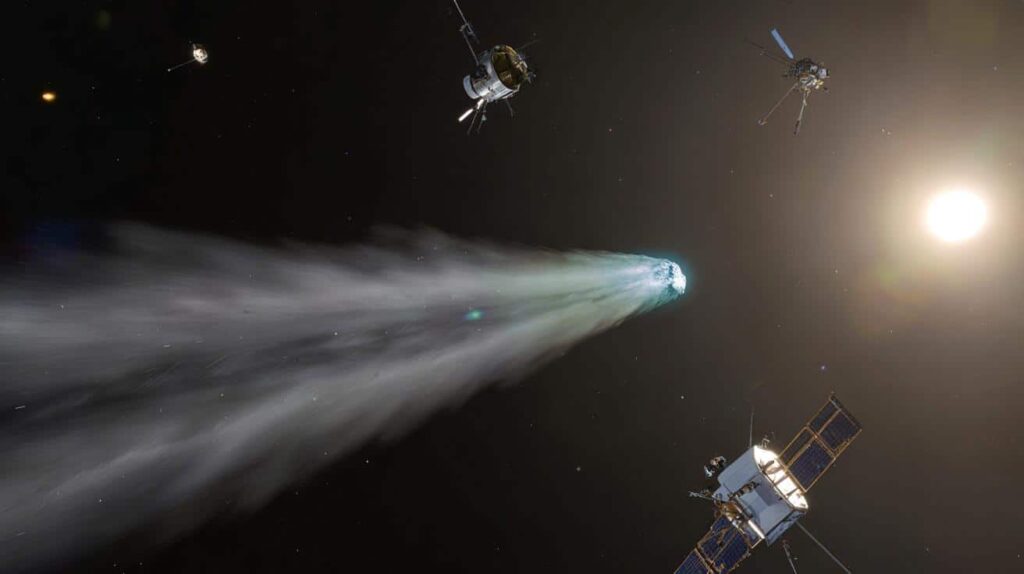
The first time you see the new images of the interstellar comet 3I ATLAS, they don’t feel like ordinary space photos. Your brain needs a second to catch up. There’s this slender, ghostly streak crossing pure black, sharp as if someone drew it with a razor blade of light, and around it, a faint haze that whispers: this thing does not belong here.
You can almost feel the silence of deep space.
Somewhere between the quiet pixels and the cold scientific labels, you sense a bigger story trying to unfold.

A stranger cutting across our sky
The eight new spacecraft images of 3I ATLAS look nothing like the fuzzy comets of school textbooks. Each frame, captured by different instruments and perspectives, locks onto a traveler that has crossed the void between stars and wandered, briefly, through our celestial backyard.
The shape is stretched, almost exaggerated, as if the comet has been pulled like taffy by gravity and speed. Taken together, the images feel less like data and more like a stop‑motion film of an outsider just passing through.
One series comes from a solar observatory that usually spends its days watching eruptions on the Sun. For a few hours, it pivoted its gaze and caught 3I ATLAS gliding past like a thin scratch in the darkness, illuminated by reflected sunlight.
Another image, processed painstakingly by astronomers from stacked exposures, reveals an extended, dusty tail that arcs away like vapor from a speeding train. Tiny background stars appear as dots, while the comet stretches across the frame, a quiet reminder of how fast it’s really moving.
This clarity is not a lucky accident. Astronomers knew that 3I ATLAS was rare: only the third confirmed interstellar visitor after ‘Oumuamua and 2I/Borisov. So they choreographed a careful campaign, aligning spacecraft and observatories to catch it from multiple angles before it slipped back into the dark.
The result is a kind of cosmic portrait session, except the model is racing through the Solar System at tens of kilometers per second. The sharpness of the images comes from this mix of planning, clever image processing, and the unforgiving physics of deep space.
How scientists turned a faint streak into a sharp story
Capturing a fast interstellar comet sounds romantic, but the method is almost stubbornly technical. You start with a spacecraft camera pointed incredibly close to the Sun, where ATLAS briefly wandered into view. Then you tell that camera to track either the stars or the comet itself, and you take a rapid series of exposures instead of just one impressive shot.
Later, on the ground, you line up those exposures pixel by pixel, correcting for motion so the comet doesn’t blur into nothing. Small adjustments, big payoff.
A single raw image of 3I ATLAS from these instruments would look surprisingly underwhelming to most people. A skinny gray line, a bit of grain, background noise that feels more like an old TV channel with bad reception. This is where patience comes in.
Astronomers stack dozens, sometimes hundreds, of frames. They subtract unwanted light from the Sun, filter out cosmic rays, and isolate the faint glow of dust and gas streaming off the comet’s nucleus. Step by step, the ghost sharpens into a defined shape. That’s how you go from “Is that it?” to “Wow, look at that tail.”
The logic behind this method is simple enough: the signal from the comet adds up, the random noise does not. So the more images you combine, the more the true comet stands out. **What feels like magic in the final pictures is really just statistics, patience, and some stubborn software.**

These eight new views of 3I ATLAS benefited from years of lessons learned on previous comets and from interstellar visitor 2I/Borisov. Each image is a small victory against distance, faintness, and motion. Each one is an argument that this strange object is not just a blur, but a messenger from another star.
What these images quietly reveal about other star systems
Behind the pretty pictures, scientists see something more practical: clues. The brightness and color of the dust in the 3I ATLAS images hint at what the comet is made of. By measuring how quickly its tail fans out, researchers can estimate how easily its ices turn into gas under sunlight, which says a lot about the kind of deep-freeze the comet once called home.
This is the quiet trick of comet images: they’re chemistry papers disguised as space wallpapers.
We’ve all been there, that moment when you zoom into a photo on your phone and realize you can’t actually see the details you hoped for. Space scientists deal with the same frustration, just at a more cosmic scale. With ATLAS, the danger was misreading noise as structure, or over‑interpreting faint blobs as exotic phenomena.
Let’s be honest: nobody really does this every single day without making at least a few mistakes, and comet science is full of false starts and re‑processing sessions at 2 a.m. That’s why teams tend to cross‑check results, share calibration tricks, and re‑run analyses when a tail looks “too perfect” or a brightness jump smells like a software glitch.
Somewhere in this careful dance between excitement and doubt, one simple sentence keeps coming back to researchers’ minds: *This rock crossed the gap between stars to get here.*
“Every interstellar comet is a sample return mission we didn’t have to launch,” one astronomer involved in the campaign explains. “It’s as if another planetary system gently dropped off a piece of itself at our doorstep, and we’re rushing to the window before it walks away.”
- Composition clues — By comparing brightness in different filters, scientists infer the proportion of dust and gas, and how they react to sunlight.
- Trajectory insights — Tiny deviations in the comet’s path, seen across the eight images, reveal how outgassing jets push on its nucleus.
- Origin hints — These details help estimate the kind of star and planetary system 3I ATLAS might have come from, even if we never know its exact birthplace.
Why this brief visitor sticks in the mind
The new images of 3I ATLAS won’t stay in the news cycle for long. A few days, maybe a week, until the next launch or exoplanet discovery. Yet they linger in a different way, like a remembered face from a train window that you can’t completely forget.
This comet is not bound to our Sun. Its orbit is open, hyperbolic, a curve that comes in from nowhere and exits back to nowhere. That simple fact breaks the comfortable illusion that our Solar System is a closed stage with a fixed cast.
There’s also something quietly grounding about it. While we deal with deadlines, notifications, and bills, a chunk of primordial ice from another star system sweeps through, gets photographed by our machines, and leaves again without ceremony. No grand message, no obvious purpose, just a moving piece of evidence that other planetary systems are real, messy, and throwing debris into space just like ours.
These eight images are, in a sense, eight short conversations with the outside universe. Not enough to fully understand it, but enough to know we’re not isolated. And that feeling, small and strange as it is, tends to stay with you.
| Key point | Detail | Value for the reader |
|---|---|---|
| Interstellar origin | 3I ATLAS follows a hyperbolic path, proving it comes from beyond the Solar System | Gives perspective on how open and connected our cosmic neighborhood really is |
| Imaging technique | Stacked spacecraft exposures and careful processing reveal a sharp tail and nucleus | Helps readers understand how a faint streak becomes a detailed scientific image |
| Scientific payoff | Dust brightness, tail shape, and motion offer clues to another star system’s building blocks | Shows how a single comet can act as a free sample of distant worlds |
FAQ:
- What exactly is 3I ATLAS?It’s the third confirmed interstellar object ever detected, and the second interstellar comet, cataloged as 3I and nicknamed ATLAS after the survey that helped spot it.
- How do scientists know it’s from another star system?Its orbit is hyperbolic, meaning it’s not gravitationally bound to the Sun, and its incoming speed is too high to be explained by interactions inside our Solar System.
- Why are these eight spacecraft images such a big deal?They provide unusually sharp, multi‑angle views of a very faint, fast‑moving object, giving scientists rare data on the makeup and behavior of an interstellar comet.
- Can I see 3I ATLAS with a backyard telescope?Not realistically. By the time its nature and trajectory were well understood, it was already too faint and too close to the Sun in the sky for safe, casual observing.
- What do these images tell us about other planetary systems?They hint at the kinds of ices and dust that formed around another star, suggesting that comet‑rich, debris‑filled systems like ours might be fairly common in the galaxy.