The engineer at NASA’s Jet Propulsion Laboratory looks at two clocks on his screen and pauses for a moment. On the left is Earth time moving in regular familiar seconds. On the right is Mars time running slightly behind like a clock that can’t quite match the rhythm. He understands the science behind it. Einstein explained that time changes with gravity & motion. It’s standard physics.
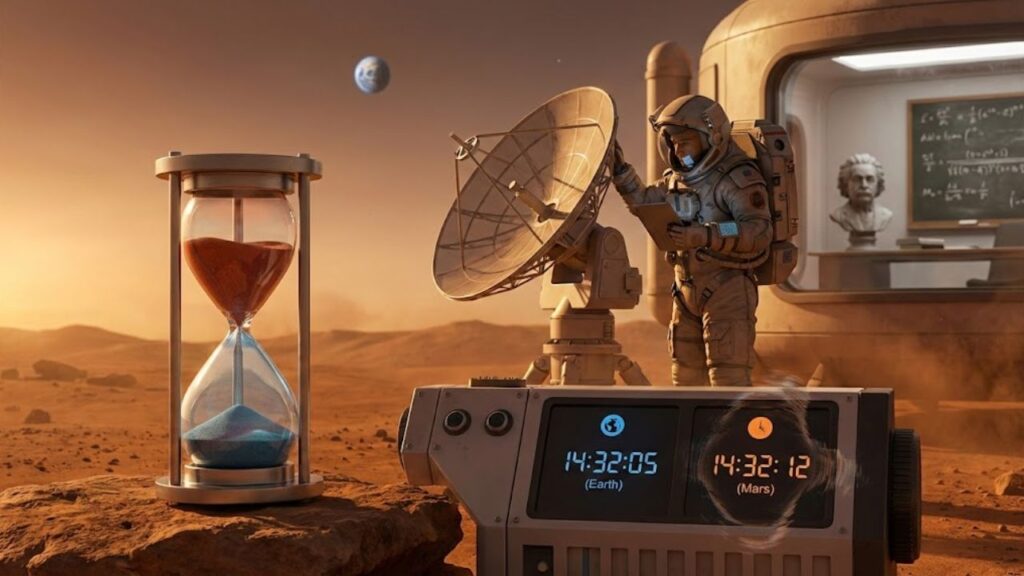
But seeing a rover on Mars actually aging slower than his own watch in Pasadena feels strange and real in a way the textbooks never captured. The difference is small and seems almost trivial at first. But when you need to land humans & coordinate robots & synchronize missions worth billions of dollars across two planets those extra seconds become a serious problem.
Einstein’s Curious Clock on the Red Planet
Einstein never saw Mars up close but his equations arrived there decades before any rover. General relativity tells us that time does not tick at the same rate everywhere. It slows down near massive bodies and speeds up where gravity is weaker and also shifts with motion. Mars is smaller and less massive than Earth with roughly 38% of Earth’s gravity. This means clocks on Mars experience slightly weaker gravitational pull. Weaker gravity means time moves a bit faster than on Earth from the planet’s own perspective.

This is not science fiction. It is math quietly controlling every heartbeat and every radio signal and every landing burn. For years this seemed more like a physics curiosity than a practical problem. Engineers already dealt with something else: one Martian day called a sol lasts about 24 hours & 39 minutes. That alone disrupted human schedules.
Teams working on missions like Spirit & Opportunity and Curiosity and Perseverance sometimes shifted to Mars time by coming into the office later each day as the Martian sunrise drifted relative to California. People joked they had jet lag without leaving the planet. But as instruments became more precise another layer emerged.
Deep space atomic clocks and laser ranging and ultra fine navigation showed that tiny relativistic differences were adding up. Not just that Mars days are longer but that Mars seconds do not perfectly match Earth seconds when gravity & motion are factored in.

How Future Missions Will Learn to Live by Martian Time
Those clocks will include Einstein’s corrections from the start. Gravity and motion and orbital speed will all be built into the firmware. Each signal sent between Earth and Mars will carry a type of time difference that both sides need to translate. Then there are the human schedules.
Mission planners are already designing how astronauts on Mars will live by local time while ground control manages Earth time & Mars time and relativistic corrections behind the scenes. Daily operations will probably run on something like Mars Coordinated Time that is linked to the planet’s rotation and gravitational frame. Spacesuit life support and habitat lighting & medical dosage timers and rover missions will all sync to that local standard.
On Earth the controllers will use conversion tools that account for signal travel time and orbital positions and relativistic offsets. The goal is to stop pretending one master clock in Houston can control both planets. Nobody really does this every day with their own calendars and mission teams are still human. Space agencies are also starting to discuss standards seriously. Right now GPS satellites around Earth already apply Einstein’s corrections or our
The Subtle Realization That Time Isn’t Universal
There’s an unexpected emotional impact buried beneath all this technical discussion. We grow up assuming that a second means the same thing everywhere and always will. Then Mars appears in our telescopes & landers touch down on its surface. The data tells us something different. Your second & my second are not identical. Your present moment on Earth & my present moment on Mars don’t match up exactly. The universe continues on without concern. We are the ones who must adapt. This adaptation is reshaping how we build spacecraft and plan for life on other worlds. It even changes how we understand what a day actually means.
| Key Insight | What’s Really Happening | Why It Matters to You |
|---|---|---|
| Mars reshapes our idea of time | Differences in gravity and orbital speed cause Martian clocks to drift from Earth time | Explains why future missions must rethink scheduling, navigation, and communication |
| Relativity becomes everyday engineering | Einstein’s corrections are built directly into mission software and onboard clocks | Reveals how abstract physics quietly underpins real-world safety and technology |
| New time standards will govern Mars life | Systems like “Mars Coordinated Time” will regulate habitats, rovers, and crew routines | Helps you imagine daily life shaped by an entirely different planetary rhythm |