On a clear night in Florida the International Space Station moves silently across the sky as a bright dot racing from one horizon to the other. On the beach a small crowd looks up with phones raised & the NASA app open to track that tiny moving pixel. Someone whispers that they can see the Station. No one says it out loud but everyone feels it. This thing has been up there almost our entire lives. It feels immortal. Then a NASA engineer standing nearby adds almost casually that we are saying goodbye to it in 2030. The group falls quiet. The ISS glows on but the countdown has already started.
The long goodbye to a historic orbiting landmark
The ISS doesn’t look like it’s dying when you see it. It appears steady and reliable and almost permanent in that dark sky. But inside NASA’s control rooms the spreadsheets tell a different story with modules aging and costs rising & risk curves moving in the wrong direction. Space hardware doesn’t wrinkle like human skin but it does get old. The year 2030 now hangs over the Station like a quiet deadline. For the first time in a generation NASA is planning for a world where low Earth orbit is no longer dominated by one massive lab but by several new private ones. Consider what the ISS has been. It’s a flying construction site and lab and diplomatic project all combined into one. Since 1998 more than 250 astronauts from 20 countries have passed through its hatch. We’ve grown lettuce in space and tested asthma drugs and studied how bones deteriorate without gravity. It’s witnessed spacewalks and leaks & arguments & laughs and that strange floating everyday life where your toothbrush drifts away if you let go. Behind every experiment there’s the price tag of roughly $3 to $4 billion a year just from the US side to keep it running. At some point the most expensive apartment in space needs a new business model. NASA’s reasoning is straightforward. Keep flying the ISS until 2030 and extract every last bit of science from it and then shift money toward the Moon and Mars and beyond. Let private companies handle the space office space closer to Earth. It’s not just about saving money. It’s about changing roles. NASA wants to move from landlord to tenant and from builder of every component to customer who buys space station time from companies like it would rent cloud servers on Earth. That’s the quiet revolution hiding behind the word commercial.
How space moves from public missions to private platforms
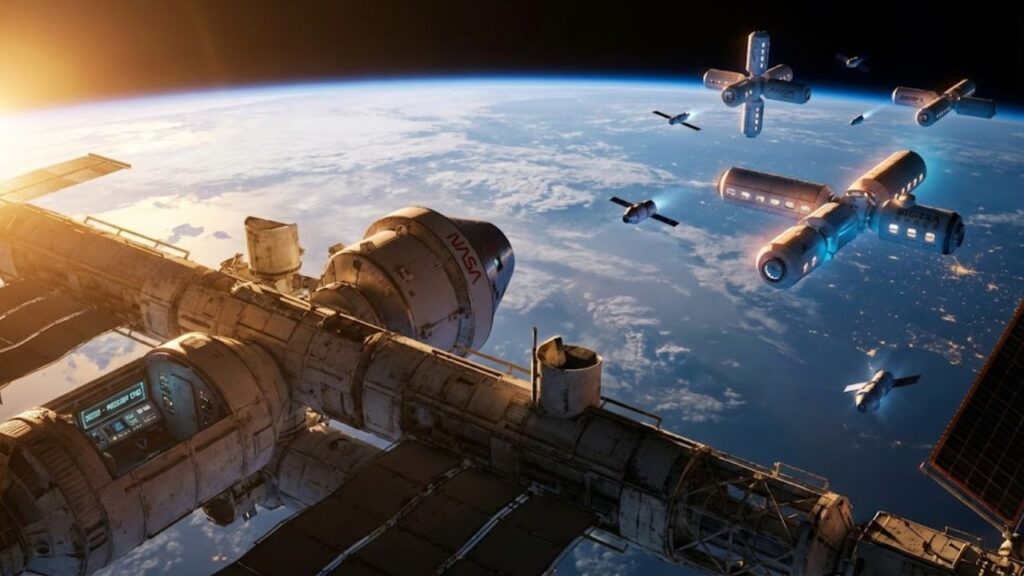
NASA’s new approach has a straightforward idea behind it: instead of owning an entire station the agency will rent space on stations built by private companies. NASA has already made early deals with several companies to create commercial space stations that could launch before the ISS shuts down. These stations will work like modular business centers in orbit. They will be smaller and cheaper and more flexible than the ISS and each one will serve different customers. One station might specialize in drug research while another focuses on making special fiber optics and another caters to wealthy tourists looking for an incredible view. Axiom Space shows how this works in practice. The company already sends private visitors to the ISS using SpaceX rockets with NASA watching over the operations. Axiom plans to connect its own commercial modules to the Station next. These modules will work like advanced attachments connected to an older structure. When the ISS eventually comes down those modules will separate and become their own independent station. Other projects like Orbital Reef run by Blue Origin & Sierra Space along with Starlab plan to create stations that serve multiple purposes. These stations would have government laboratories operating alongside startup companies and media production facilities. The ISS represented countries working together but the next generation of stations might represent business deals & contracts. The business reality is clear: companies will not build space stations just for prestige. They need paying customers to make it worthwhile. NASA has committed to being one of those customers by paying for astronaut visits and experiment time and research data. The goal is to build a functioning orbital market where different clients use the same facilities. This follows the same pattern seen with commercial cargo and crew flights. NASA provided funding for early development & then SpaceX & other companies built the vehicles. Now those same rockets carry both government astronauts and private passengers. The model is becoming accepted as normal within the space industry.

What Earth observers can expect during the transition
If you’re not an engineer or someone who follows space policy closely, this change might feel distant and hard to picture. Think about it this way: one night you look up and realize that bright dot in the sky isn’t the ISS anymore. It could be several points from several stations owned by different companies with their own logos and missions. Your children might grow up knowing specific names like Axiom’s hub or Orbital Reef instead of just the Station similar to how we distinguish between Netflix and Disney+ now. The sky starts to feel less like one shared landmark and more like a collection of competing brands. There’s an emotional side to this too. We’ve all experienced that feeling when a familiar place shuts down and something new and polished replaces it with promises of better service & more choices. Part of you feels excited while another part resents how corporate it all seems. The ISS has carried science experiments made by schoolchildren and photos stuck to walls and flags from countries that don’t always get along. When commercial stations take over, the danger isn’t just technical problems. It’s the possibility of losing that feeling of a shared human achievement once the logos and corporate sponsors move in.

- The Station will be brought down in a controlled reentry in 2030, probably over an empty stretch of the Pacific Ocean.
- Companies like Axiom and partners of Blue Origin and Voyager with Lockheed are planning new orbital platforms.
- NASA is redirecting its resources toward missions beyond low Earth orbit, focusing more on Artemis Moon missions and eventual Mars exploration.
How commercial stations will reshape the night sky
In a few years the final ISS crew will drift through those well-known modules and close hatches that have stayed open for decades. They will power down equipment that has been running quietly above us since the late 90s. Someone in mission control will send the command that starts the Station’s final descent. It will burn silently but that silence will feel deafening. By that time other stations will already be orbiting overhead if NASA’s plan succeeds. These will be smaller & newer & less sentimental. They will be open for business and research. The question is what we expect from this next chapter. Do we want space to feel more like a marketplace or more like a shared laboratory? Can it be both without losing what makes it special? The ISS showed that humans from rival nations can share a cramped metal tube and keep each other alive for months. The new stations will test something different. They will show whether we can share orbit the way we share the internet. It will be busy and commercial and uneven but also wildly creative. The sky is about to look both familiar and unfamiliar at the same time. The dot crossing your backyard might carry a billionaire or a climate scientist or a film crew or all three at once.
| Key Focus | Updated Detail | Why It Matters |
|---|---|---|
| ISS Retirement Plan | The International Space Station is set for a controlled deorbit around 2030 after decades of operation | Clarifies that the station’s end is carefully planned, not an unexpected shutdown |
| Commercial Space Stations | Private companies such as Axiom, Orbital Reef, and Starlab are developing new orbital platforms | Shows who will manage future space labs, research hubs, and space tourism sites |
| NASA’s Changing Role | NASA moves from owning space stations to purchasing services from private operators | Explains how taxpayer funding will be used and why space access may become broader |