
The drilling tent flaps in the Antarctic wind like a ship’s sail, a lonely splash of orange against a world of white. Inside, breath turns to fog as a small team of scientists hunch over screens, waiting for a signal from somewhere far below their boots.
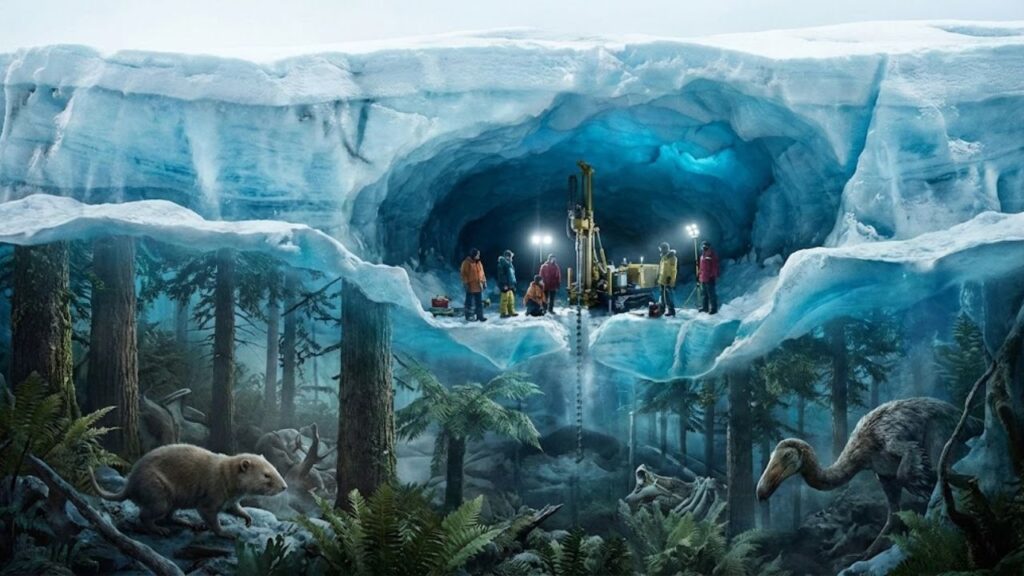
Two kilometers under the ice, a diamond-tipped drill has finally broken through into blackness – a pressure-filled pocket that hasn’t seen the sky in tens of millions of years.
Two Kilometres Beneath the Ice, a Hidden World Revealed
Picture yourself standing on a frozen desert that appears completely lifeless. You see nothing but endless white stretching to the horizon while the air is so dry it stings your nostrils. The ice beneath your feet is not one solid block but rather a layered archive of snowfalls that have compressed into ice sheets over millions of years. When drills reach about 2000 meters down through this ice they encounter something unexpected. Ancient sediment appears along with trapped water and faint remnants of organisms that lived long ago.

This material dates back roughly 34 million years to a time when Antarctica was not frozen but instead covered with forests & surrounded by rich ocean ecosystems. The difference between then & now seems almost impossible to believe. Scientists studying these deep ice cores and underground sediments describe their work as planetary archaeology.
Every layer contains pollen grains and dust particles and air bubbles and tiny shells that reveal information about warmer oceans & rainfall patterns from the distant past. Research teams have discovered ancient pollen grains that indicate beech forests once grew in places where today only howling winds blow across barren ice. Some samples contain chemical evidence of abundant plankton populations and dramatic climate shifts.
This is not vague prehistoric information but rather detailed records preserved in layers of mud and ice. Interpreting these records requires sophisticated equipment and extraordinary patience. What researchers are really trying to understand is the moment when Earth underwent a major transformation. A
bout 34 million years ago the planet shifted from a warm greenhouse climate to a cooler icehouse state. Antarctica changed from a landscape with vegetation & rivers to the frozen continent we recognize today.
How Scientists Drill Into a Long-Lost Landscape
There’s something oddly careful about breaking into something sealed for tens of millions of years. First you need heavy machinery with kilometers of drill pipe and generators running through the polar night. The logistics feel more like a space mission than anything else. Then everything slows down. Temperatures & pressures and contamination protocols all need constant attention. Engineers guide a hot-water drill or mechanical borer straight down through the ice. It melts or cuts a narrow shaft as it goes.
When they get close to the ancient lake or sediment they change their approach. The last few meters happen with extreme caution to prevent modern microbes from contaminating what lies below. When the drill brings back the first cores everything changes. The team moves with controlled excitement. People in bulky polar gear carry tubes into makeshift labs with surprising care. A researcher scrapes off the outer layer to reveal perfectly preserved mud that hasn’t seen sunlight since before humans existed.
They slice the core & label everything before passing sections into sterile rooms. Under microscopes tiny fossils appear with fragments of diatoms and traces of marine organisms. Mineral crystals hint at ancient rivers. It’s the closest thing we have to time travel but there’s no glossy presentation. Just brownish sludge under harsh fluorescent light. The method sounds simple enough. You drill and retrieve and analyze.

Reality is much messier though. A sudden storm can delay flights for weeks. A pump failure can freeze the borehole and erase months of effort. People get tired and fingers go numb & laptops freeze at the worst moment. Nobody does this work without questioning their choices sometimes. Each successful core proves the work is worth it though.
The techniques they develop in Antarctica become a blueprint for exploring other extreme places. Ultra-clean drilling and remote field labs and coordinated international teams all transfer to new environments. Deep oceans and Martian ice and icy moons like Europa. This is practice for reading alien worlds.
Why a 34-Million-Year-Old World Still Matters Today
If you look past the dramatic headlines this discovery is essentially a warning preserved in ancient rock layers. The sediments and fossils reveal what happens when a planet crosses a critical climate threshold and cannot return. During that period CO₂ levels dropped and the Southern Ocean changed its circulation patterns while Antarctica developed its first major ice sheet.
Sea levels dropped & ecosystems transformed as the Earth entered a colder phase. Now we are reversing that process by releasing CO₂ into the atmosphere and warming the oceans while disrupting established ocean currents. The ancient world buried beneath the ice serves as a natural experiment.
It demonstrates how vulnerable ice sheets can be and how quickly coastlines can transform & what the point of no return looks like in geological terms. Everyone has experienced that moment when a climate news notification appears on their phone & they simply scroll past it. Daily responsibilities take priority with bills to pay and meals to prepare. Antarctica seems impossibly distant & irrelevant. This reaction is dangerous.
The geological record beneath the ice operates independently of human attention. It proves that once certain limits are exceeded ice sheets expand or collapse according to their own dynamics and cause sea levels to rise or fall by dozens of meters. For coastal cities this is not theoretical. It represents the difference between preparing for occasional flooding and questioning whether future generations will inhabit the same coastal areas at all.
A Buried World That Is Starting to Resurface
The odd part about this 34 million year old world is how it seems both incredibly far away and strangely familiar at the same time. It comes from an Earth where humans never existed and early whales swam in warm southern oceans while forests grew in Antarctic valleys. Yet what happened back then is starting to happen again today as we sit in our hot apartments & watch floods on our screens.
What lies buried under two kilometers of ice matters to everyone and not just scientists who study polar regions. It works like a storage system for planetary history and shows us how dramatically Earth can change and how quickly those changes can happen. The information gathered from data and mud and tiny fossils all tells us the same basic truth. This frozen continent was not always covered in ice and nothing guarantees it will stay frozen forever.
| Key Insight | What Researchers Discovered | Why It Matters to You |
|---|---|---|
| Ancient climate turning point | Antarctica shifted from a green landscape to a frozen continent around 34 million years ago | Shows how rapidly an entire continent can change when climate thresholds are crossed |
| Ultra-clean deep drilling | Precision drilling methods recovered untouched sediments and fossils from beneath the ice | Builds confidence that scientists are reading an accurate record of Earth’s past |
| Direct relevance today | Ancient CO₂ levels and ice responses closely resemble patterns seen with modern emissions | Helps explain future sea-level risks and what climate change could mean for coastal communities |


