At 7:42 a.m. on a Tuesday in Tokyo, a woman in a navy suit walks into a spotless office restroom, pauses, and actually smiles at the toilet paper dispenser. Not because it’s fluffy or scented. Because it’s talking to her — silently — through a tiny QR code and a discreet LED light that just blinked green.
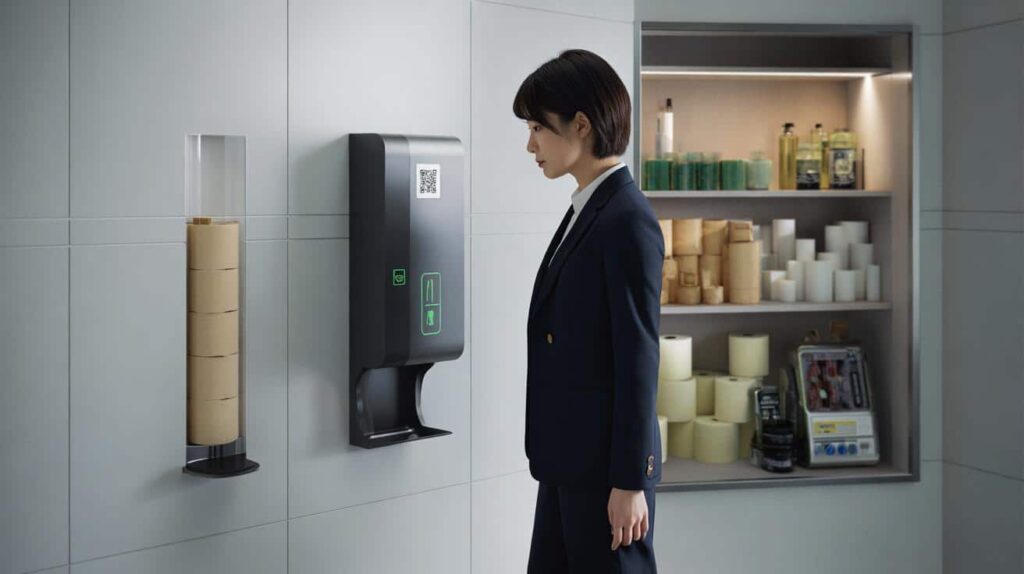
On the wall, another roll hangs in a transparent tube, compressed into a compact brick, almost like a minimalist design object. Nearby, a small sign quietly explains how this “smart roll” will last 30% longer and save water, trees, and, awkwardly, everyone’s dignity during the next supply panic.
She snaps a photo for Instagram, laughs, and texts a friend: “Only in Japan would toilet paper feel… futuristic.”

And she’s not wrong.
When toilet paper stops being boring
The first time you see it, Japanese “innovation toilet paper” looks like a joke someone forgot to end. Rolls cut in half to reduce waste. Extra-long “disaster rolls” designed to last weeks. Packs printed with calming messages for anxious shoppers.
Then there are the models that come in plastic-free, moisture-proof cylinders, stacked like wine bottles in a shelf behind the toilet. They’re not trying to be cute. They’re trying to survive earthquakes, typhoons, and the strange reality that toilet paper, of all things, can trigger nationwide panic-buying.
Walk through a Tokyo home center and you’ll see it clearly. In the aisle we once considered the dullest in the store, Japan has quietly launched a tiny revolution.
Back in 2011, after the Tōhoku earthquake and tsunami, shelves across the country were stripped bare. Not just food and batteries. Toilet paper vanished almost overnight. Factories in affected regions were knocked offline, transport was disrupted, and millions of people suddenly realized how fragile this one soft product actually is.
Fast-forward to 2020 and COVID hit. The same story played out again: rumors of shortages, lines in front of supermarkets, people hoarding 30-roll packs “just in case.” Some stores posted apologetic signs begging customers not to panic. Others rationed rolls like they were gold.
That was the turning point. Quietly, manufacturers started experimenting. Longer rolls. Space-saving packaging. Disaster reserves you could store for five years. Toilet paper changed from a forgettable purchase into a resilience strategy.
On the surface, it sounds almost absurd. New shapes for toilet paper. Tiny design tweaks. QR codes on cardboard tubes. Yet from a Japanese perspective, it all makes perfect sense.
Japan lives with the constant possibility of disruption. Earthquakes, volcanic ash, floods, supply chains cut overnight. When you accept that, you start optimizing the smallest things. Not just buildings and bridges. Everyday essentials, down to the last sheet.
So companies looked at the numbers. A standard Japanese household uses around 100–120 rolls a year. Storage is tight in many apartments. Transport costs are rising. The logic was simple: if a roll can be longer, denser, and smarter to store, you get resilience without needing a bigger home. And suddenly, toilet paper becomes a quiet pillar of national preparedness.
How Japan turned a roll into a system
The most surprising part isn’t the product itself. It’s the method behind it. Japanese brands started treating toilet paper like a small infrastructure project.
One company launched “disaster reserve” packs sealed against humidity, designed to last up to five years in a closet or under a bed. Another developed ultra-long rolls that fit into special dispensers, cutting the frequency of replacement at offices and schools. That means fewer deliveries, fewer stockouts, less chaos when supply lines wobble.
Some local governments even distribute compact toilet paper bricks in emergency kits. Not sexy. Very useful. The goal is simple: when everything goes wrong, nobody should be panicking over the last roll.
Of course, outside Japan, people mostly pay attention to the fancy washlets and musical toilets. Meanwhile, a quieter experiment is happening at shelf level.
A few companies are testing subscription systems linked to smart dispensers. The dispenser tracks usage, sends data to an app, and predicts when you’ll run out. Then it triggers a delivery before you hit that awkward cardboard-core moment. Let’s be honest: nobody really does this every single day, but in a small Tokyo apartment with kids and grandparents, it helps.
The early adopters are not tech bros. They’re caregivers, solo parents, and elderly couples who don’t want to lug huge packs from the supermarket. For them, a “smart roll” is less gadget and more lifeline.

Behind the cute packaging and quirky gadgets, there’s a harder truth: Japan’s population is aging fast. Bending, lifting, navigating crowded stores — all this gets tougher with time.
Engineers quietly adapted. Longer rolls mean fewer changes for people with mobility issues. Easy-open, no-scissors packaging reduces strain on arthritic hands. Lightly scented cardboard cores can double as deodorizing closet sticks instead of instant trash. *Even small details start to feel like respect.*
One Tokyo product designer told me that their team spent weeks just watching how seniors reached for the roll, how often they dropped it, where it was stored. The lesson was simple and slightly humbling: if you really observe everyday life, no object is too boring to reinvent.
The odd little lessons hiding in a bathroom
You don’t need a smart dispenser to borrow a page from Japan’s playbook. A first simple gesture is to think in “disaster rolls” at home — not in a paranoid way, but in a calm, practical one.
Pick a spot that you never really use: top of a wardrobe, under a low shelf, the far back of a cupboard. Create a tiny “soft reserve” of 8–12 rolls, ideally in packaging that resists humidity. Rotate them once a year and forget about them the rest of the time.
Then, on your usual shelf, reduce bulk and visual noise. One or two packs in use, the rest out of sight. You’ll feel less like you’re living in a warehouse and more like your bathroom is an actual room, not a storage annex.
Another quiet lesson from Japan is to stop treating toilet paper as a panic buy. When news hits of a storm, a strike, or a global glitch, many people still rush to grab the last mega-pack “just in case.” We’ve all been there, that moment when your basket is fuller than your actual need.
Instead, watch your real consumption for a month. Count how many rolls your household uses. Then set a simple minimum threshold — for example, “Once we hit six rolls, we buy a new pack.” That’s it. No scarcity drama.
The mistake many homes make is emotional shopping: buying out of fear rather than need. A quiet, measured rhythm feels oddly liberating, and your cupboard stops looking like a bunker built in a hurry.
In Japan, some office managers talk about toilet paper like logistics experts. One told me:
“We used to run out every few days. Now, with longer rolls and a basic tracking sheet, we almost forget it exists. And that’s the point — nobody should have to think about this at work.”
They treated the roll as a system, not just a product. And that mindset can travel.
Here are a few ideas, stripped back and simple, that you can steal today:
- Track your average monthly usage once, then stop guessing.
- Store a small, hidden reserve to avoid last-minute panic buys.
- Prefer longer rolls or compact packs if your space is tight.
- Rotate older stock once a year, like you would with canned food.
- Choose at least one option that comes in plastic-free or low-waste packaging.
These aren’t revolutionary on their own. Together, they quietly turn a vulnerable habit into a stable routine, the same way Japan did — roll by roll.
What a toilet roll says about a country
When you look closely, a roll of Japanese toilet paper starts to feel like a small mirror. It reflects an island nation thinking constantly about earthquakes, about aging, about cramped apartments and fragile supply chains.
Other countries have their own invisible pressures: energy prices, political unrest, long roads between towns, massive warehouses on the outskirts of cities. Each of those could shape a very different “innovation roll” — thicker for insulation, maybe, or designed to compact for long trucking routes, or wrapped in local fibers instead of imported pulp.
The Japanese example doesn’t say “Copy this.” It whispers something else: “Pay attention to the boring objects. They’re where your real vulnerabilities hide.” Once you’ve seen that, it’s hard to unsee it. The next time you reach for a roll, you might find yourself wondering who designed it, what crisis they had in mind, and what quiet problem they were trying to solve before you ever noticed there was one.
| Key point | Detail | Value for the reader |
|---|---|---|
| Resilience in small things | Japan designs longer-lasting, disaster-ready rolls to handle earthquakes and supply shocks | Helps you rethink your own “boring” essentials as part of your safety net |
| From product to system | Smart dispensers, subscriptions, and storage methods turn TP into a managed routine | Gives you practical ideas to avoid panic-buying and last-minute shortages |
| Design with real life in mind | Features adapted for seniors, tight spaces, and daily stress | Encourages you to choose products that respect your body, time, and living space |
FAQ:
- Question 1Is Japanese toilet paper really that different from what we use in the West?In softness and basic function, not always. The difference is in length, packaging, storage life, and how it fits into wider systems like disaster kits and smart dispensers.
- Question 2What is a “disaster roll” exactly?It’s a longer or specially packed roll designed to last much longer than a standard one and stay usable for years in storage, often as part of emergency preparedness supplies.
- Question 3Do smart toilet paper dispensers actually exist in Japan?Yes, although they’re still niche. Some models track usage and connect to apps or subscription services so households and offices don’t run out unexpectedly.
- Question 4Can I apply these ideas without buying new tech products?Absolutely. You can copy the mindset: keep a small hidden reserve, know your monthly usage, and favor compact, long-lasting packs that fit your space.
- Question 5Is this only about Japan being “quirky”, or is there a deeper message?There’s a deeper message. Japan’s toilet paper innovation shows how everyday items can quietly strengthen a society’s resilience, and how design can respond to real, local risks.