The first time I saw swallows flying in November, I thought I’d lost track of the seasons.
The sky above the small French town was the color of wet cardboard, the air strangely warm, almost sticky. Yet there they were, slicing through the dusky light, calling to each other like it was late May. A neighbor glanced up, shrugged, and said, “Weather’s gone mad. The birds too.” Then he went back to loading his car like nothing was happening.
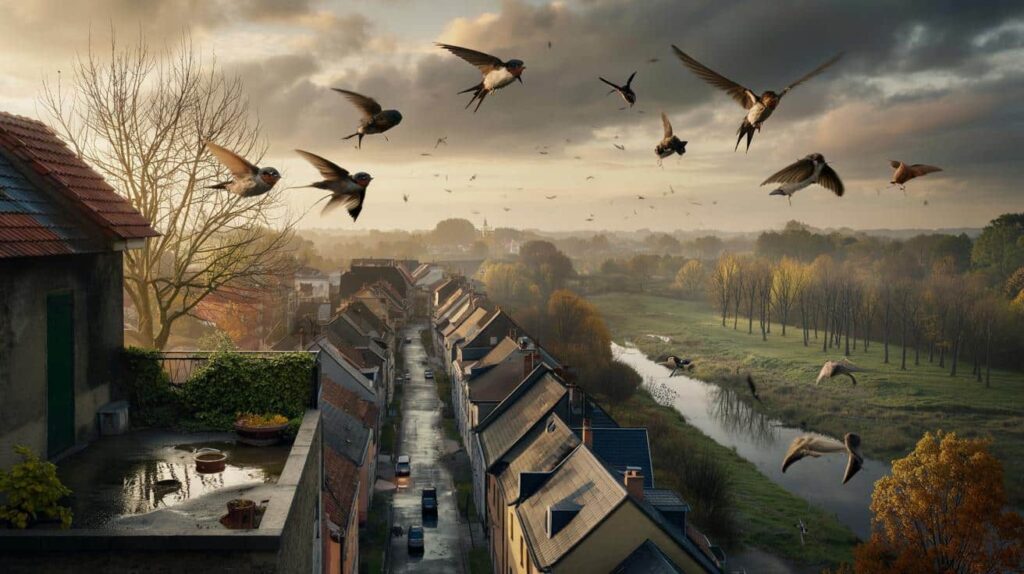
I couldn’t stop looking.
Because beneath those wings was a quiet truth we’ve dodged for years.

When the forecast starts rewriting instinct
For a long time, people thought animals “just knew” what to do. Birds migrate on the same dates, frogs wake up when they’re supposed to, whales follow age‑old routes carved into their genes. Fixed scripts. Reliable calendars.
Now the calendar is on fire.
Heatwaves arrive in spring. Winter storms hit in what should be calm seasons. Nights stay warm when bodies are wired for frost. From city balconies to Arctic cliffs, animals are hesitating, rushing, turning around halfway, or not moving at all. Not because they’ve lost their instincts. Because the cues they evolved to trust no longer match the world outside.
Take one simple example: urban blackbirds in Europe.
For decades, they’ve used day length and temperature to time their breeding. When days get longer and the air warms up, that’s the sign: nesting, egg-laying, frantic dawn singing.
With repeated “false springs” – those weird weeks of 20°C in February, followed by a brutal cold snap – blackbirds are starting earlier. Some are laying eggs when the trees are still confused, their leaves not fully out, insects not yet abundant.
The result? Parents working overtime to feed half-starved chicks while the weather whiplashes from warm to icy rain. A few survive. Many don’t. On paper it looks like a minor shift in dates. On the ground it feels like a constant emergency.
Biologists used to read animal behavior as a neat, predictable response to timeless seasons.
Migration dates were lines on a graph. Hibernation was a block on a calendar. Hatching windows were tidy. That idea is collapsing quietly, piece by piece.
What we’re seeing now is less a “mistake” and more a frantic recalibration. Bodies built over thousands of years to follow temperature, rainfall and light are colliding with a climate that swings between extremes like a faulty metronome.
The misunderstanding was thinking animals simply adapt on the fly. Many can’t. They don’t change their minds overnight. They pay, bodily, for every wrong bet the weather forces them to make.
Signals, misfires and the new survival toolbox
There’s a deceptively simple question behind all this: what triggers an animal to move, breed, hide, or hunt?
For some, it’s temperature. For others, day length. For many, a layered mix: the first heavy rain, a certain soil smell, wind direction, the hum of insects, even the behavior of neighbors. When extremes hit – record heat, sudden floods, smoke-darkened skies – those signals overlap, clash or come in the wrong order.
A sea turtle might crawl ashore to nest on a night that’s far too hot, baking eggs in the sand. A mountain goat might descend early because snow melted fast, only to be trapped by a late blizzard. What looks like “strange behavior” is often survival software encountering corrupted data.
On Australia’s east coast, flying foxes – those large fruit bats that hang like black umbrellas from trees – have become a living thermometer. During extreme heatwaves, thousands have simply dropped from the branches, literally cooked alive.
Researchers watching these events noticed a shift over the years. Bats started changing their routines on hot days: moving deeper into shade, spreading wings to radiate heat, clustering near water. On nights that used to be comfortable, they now pant, restless, like a city that can’t sleep.
What you don’t always see in headlines is the quieter adaptation: colonies shifting roost sites closer to rivers, mothers timing births a little earlier to avoid peak heat, some populations inching toward cooler zones. It’s not a clean success story. It’s messy, full of losses and half-solutions.

Behind every “odd” animal story viral on social media – dolphins in strange bays, garden birds singing at 3 a.m., foxes walking city streets at noon – there’s usually one common denominator: the old rulebook no longer fits the new climate.
We once assumed animals reacted only to averages: the typical winter, the normal rainy season. Reality is they’re wired to react to the edges. The first frost, the last storm, the single hottest afternoon. When those edges become more extreme, behaviors shift from rhythmic to erratic.
*This isn’t animals going crazy; it’s animals obeying rules we forced out of date.*
The plain truth is, many of those rules were never as rigid as we liked to think.
What we can actually do, from a balcony or a policy office
Faced with all this, people often freeze. What do you do, personally, about fruit bats dropping from trees or seabirds skipping breeding seasons?
Start close. Small, unglamorous, hyper-local.
In hotter summers, shallow water dishes in gardens and on balconies can turn into life-support for overheated birds, hedgehogs, even insects. Native shrubs can give shade and emergency food when flowering seasons go off sync. Turning off bright outdoor lights, especially in heatwaves or stormy nights, helps bats, moths and migrating birds that are already disoriented by cloud-covered stars and odd winds.
These don’t feel like grand gestures. They’re not. They’re stitches in a fabric that’s under strain.
Then there’s the human urge to “rescue” every animal that looks out of place. A fox wandering at midday, a seal hauled out on a beach, a heron in a supermarket parking lot after a flood.
Sometimes they truly need help. Sometimes they’re just adjusting, scouting new territory, figuring out fresh water sources after a drought. The hardest part is resisting panic.
Talk to local wildlife rehab centers, follow their guidance, save the emergency numbers on your phone before the next heatwave or storm season. They’ll tell you when to step back, when to bring an animal in, when to simply observe. Let’s be honest: nobody really does this every single day. But the people who do it once, at the right time, often change the outcome for a whole colony or family group.
“We keep calling them ‘resilient’ as if that’s a magic spell,” a coastal ecologist in Portugal told me. “They’re resilient until they’re not. Behavior is their first line of defense, and we’re shredding the conditions that made those behaviors work.”
- Watch the timing, not just the presence
Noticing that swifts arrive later, frogs call earlier, or bees vanish mid-summer tells you more than a one-off sighting. - Support real habitat, not just “green décor”
Lawns that scorch in heatwaves are dead zones. Mixed, messy, native plant corners stay cooler and feed more species. - Push for climate and wildlife policy to talk to each other
Firebreaks, flood defenses, and urban cooling plans can all be designed with animal movement and breeding in mind. - Share local anomalies with scientists
Community science apps, photos, short notes – they build the data that reveals new patterns and tipping points. - Rethink what “normal” looks like
The calendar in your head is based on a climate that’s already gone. Observing, not denying, gives animals a better chance alongside us.
The season that no longer matches the script
We’re living in a strange overlap: memories of old seasons, bodies wired for those seasons, and a climate that keeps jumping the rails. Animals were our first meteorologists, our early warning sirens. Now they’re sending out scrambled messages we struggle to read.
When storks stop migrating in winter because landfills offer easy food, when corals spawn at odd times after marine heatwaves, when bears wake too early into snowless forests, it’s not just “nature being weird”. It’s a live transcript of stress.
Yet inside this chaos, there’s another story: attention. The child who notices that swallows came late this year. The farmer who changes mowing dates after seeing fewer nesting larks. The city resident who can’t unsee bats struggling through a heatwave and starts asking questions about tree shade and water use on their street.
We misunderstood animal behavior as a backdrop, a kind of silent wallpaper to our lives. It was always a language. The weather has twisted the grammar, but the sentences are still there, flying overhead, crawling underfoot, knocking gently on the window of whatever future we choose to build.
| Key point | Detail | Value for the reader |
|---|---|---|
| Shifting animal calendars | Extreme weather disrupts cues like temperature and rainfall, changing migration, breeding and feeding dates | Helps readers interpret “odd” wildlife moments as climate signals, not random freak events |
| Behavior as first line of defense | Animals try to adapt behaviorally before genetic changes, with mixed success under rapid climate swings | Shows where resilience ends and where human support and policy become critical |
| Local actions matter | Water, shade, dark skies, native plants and informed rescue responses all buffer extreme events | Gives practical steps readers can take today, from balconies to community debates |
FAQ:
- Are animals really changing behavior because of extreme weather, or are we just noticing more?
Both. We have more cameras, apps and social media, so we spot more. But long-term studies on birds, insects, mammals and marine life clearly show shifts linked to heatwaves, droughts, storms and floods.- Does this mean animals will simply adapt and be fine?
Not automatically. Some species adjust their timing or move to new areas. Others hit limits: their food doesn’t shift with them, or they can’t move fast enough. Adaptation has costs, and some populations are already crashing.- Why do some animals seem to “benefit” from climate change?
Generalists like pigeons, rats, some jellyfish and invasive insects can thrive in disturbed conditions. They reproduce quickly and use a wide range of resources, so they often gain ground as more sensitive species decline.- Is feeding wildlife during heatwaves or storms a good idea?
Short-term, targeted support – water, temporary food stations, shade – can help, especially for birds and small mammals. Long-term, creating stable habitat and reducing other stresses (pesticides, lights, noise) is far more effective than constant feeding.- How can I tell if an animal needs rescue or should be left alone?
General rule: if it’s obviously injured, unresponsive, or in immediate danger (on a road, in rising water), call a wildlife rehab center. Many have hotlines and online guides with species-specific advice and photos to help you decide.