After 40, many people notice their body feels heavier, puffier and slower to respond, even when the scale barely moves.
The mix of hormonal changes, loss of lean muscle and a busier life can leave traditional gym plans feeling out of reach. Yet specialists now point to a technology-backed workout that helps “deflate” swelling, support strength and fit into tight schedules.
Why the body starts to “swell” after 40
From the fourth decade of life, the body quietly shifts gears. Muscle mass declines, collagen production drops, and fat distribution changes. This combination tends to increase flabbiness and water retention, especially around the abdomen, thighs and ankles.

Less muscle means a slower metabolism. A slower metabolism often means more difficulty managing body fat and fluids. Daily swelling at the end of the day, clothes feeling tight, and a sense of “weight” in the legs become common complaints.
After 40, keeping or rebuilding muscle is not just about aesthetics; it supports mobility, joint protection and circulation.
Specialists still see traditional strength training as the backbone of any long-term plan. Lifting weights or using resistance machines remains the most studied and effective way to maintain bones and muscles. Yet researchers and clinicians have added a second tool to the list: muscular electrostimulation training.
The high-tech ally: what is EMS training?
EMS stands for electrical muscle stimulation, also known in medical contexts as neuromuscular electrical stimulation (NMES). The method uses low-level electrical impulses to make muscles contract while the person performs guided movements.
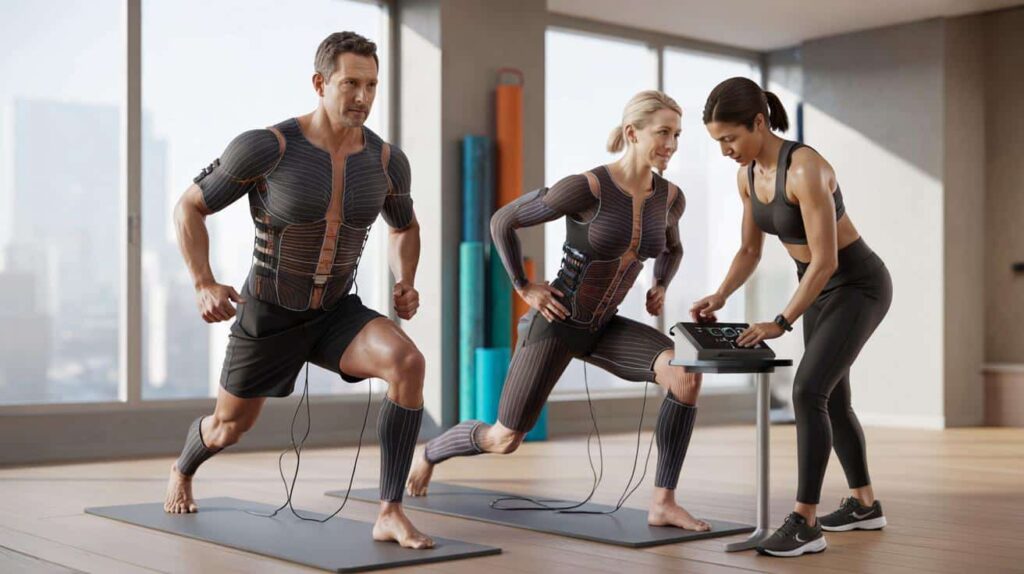
In practice, the participant wears a special vest and straps with built-in electrodes. A professional adjusts the current intensity and leads a sequence of squats, lunges, arm pulls and core exercises. The electrical pulses recruit muscle fibres more broadly than a simple voluntary contraction would.
In a typical session of around 20 minutes, EMS suits can stimulate up to 350 muscles at the same time.
Originally, EMS was developed for rehabilitation after surgery or injury. Physiotherapists used it to prevent muscle atrophy in people who could not move freely. Over the last decade, the technology migrated to sports performance and, more recently, to boutique fitness studios targeting busy adults.
What the science says about EMS and muscle gain
A recent meta-analysis published in the European Journal of Applied Physiology compared resistance training alone with resistance training combined with neuromuscular electrical stimulation. The combined approach produced greater gains in strength and muscle mass than conventional training by itself.
This does not mean that the suit magically replaces effort. Users still need to move, squat, hold planks and stabilise the body. The current acts as an extra layer of stimulation, recruiting additional fibres and increasing the training load during a short timeframe.
For adults over 40, who often juggle work, family and health appointments, the time factor is attractive. Instead of an hour in the gym, they can compress a demanding session into 20 minutes once or twice a week, under supervision.
Why EMS helps with “deflating” and fluid retention
The sensation of “deflating” after EMS sessions is not only about fat loss, which takes time. The electrical contractions stimulate blood flow and venous return, especially in the legs and glutes. This effect supports lymphatic drainage, helping the body move excess fluid out of tissues.
At the same time, improved muscle tone in the core and lower body enhances posture and movement efficiency. Better posture reduces pressure on veins and lymph vessels, which also contributes to less swelling over the course of the day.
Regular EMS sessions can act like a powerful circulation booster, easing the heavy-leg feeling that often follows long hours sitting or standing.
EMS does not replace traditional strength training
Despite the fanfare on social media and celebrity endorsements, specialists stress a key point: EMS is a complement, not a full substitute, for classic strength training in healthy adults.
The intensity of contraction produced by the electrical current is limited by comfort. When current levels rise too much, the stimulation of sensory nerves becomes painful. In practice, many people tolerate between 10% and 60% of their maximal voluntary contraction during EMS.

This means that, for those who can lift weights safely, free weights and machines still provide the highest mechanical load for building strong muscles and bones. EMS works best as an additional stimulus, not the only one.
- Healthy adult, no joint issues: priority on traditional resistance training, EMS as a bonus.
- Very busy schedule: short EMS sessions can maintain or improve conditioning between longer workouts.
- Post-injury or limited mobility: EMS may help preserve muscle under medical guidance.
How a typical EMS session works after 40
A standard EMS studio visit starts with a health questionnaire and a short assessment. The trainer asks about medical history, medications, pain points and training goals: reduce swelling, firm specific areas, improve posture, or simply get back into exercise.
The person then puts on a dampened suit or vest so the current can pass more effectively to the skin. Electrodes line the major muscle groups: chest, back, abdomen, glutes, thighs and arms.
The trainer gradually increases current intensity until the user feels strong, rhythmic contractions without sharp pain. Once the right level is set for each area, the session begins. Movements are usually simple and low impact:
- Bodyweight squats and split squats
- Static lunges and hip hinges
- Arm raises with light weights or no weights
- Core bracing, gentle rotations and balance drills
The session alternates between phases of contraction and rest, lasting about 20 minutes. Afterwards, people often report a deep fatigue similar to that of a longer strength workout.
Who should think twice before using EMS
EMS is not suitable for everyone. People with certain conditions need medical clearance or should avoid it entirely.
| Situation | Typical recommendation |
|---|---|
| Cardiac pacemaker or implanted defibrillator | Usually contraindicated due to interference risk |
| Pregnancy | Avoid abdominal and trunk EMS; many studios exclude EMS altogether |
| Severe neuropathy or uncontrolled diabetes | Needs specialist evaluation before use |
| Recent surgery or blood clots | Medical sign-off required; often postponed |
| Untreated hypertension | Control blood pressure first, then reassess EMS |
Some people also find the sensation unpleasant or intimidating at first. Communication with the trainer is crucial so that intensity stays within a tolerable range and does not cause unnecessary discomfort.
Combining EMS with everyday choices to reduce swelling
For people over 40, EMS works best as part of a broader plan to manage body composition and fluid retention. Small daily choices amplify the effect of the short high-intensity sessions.
Simple strategies can help:
- Alternate sitting and standing during long workdays.
- Walk for five to ten minutes after each meal to support circulation.
- Moderate salt intake and ultra-processed foods, which tend to worsen water retention.
- Drink water regularly across the day instead of large amounts at once.
When these habits combine with EMS and resistance training, the body often responds with better energy, less puffiness and a more stable weight, even without extreme diets.
Understanding key terms: lean mass, collagen and flaccidity
Much of the conversation around EMS after 40 revolves around three concepts: lean mass, collagen and flaccidity. Lean mass refers mostly to muscle tissue, which burns calories, supports joints and keeps posture upright. Losing it accelerates ageing signs and makes daily tasks harder.
Collagen is a structural protein present in skin, tendons and ligaments. Production naturally declines with age, contributing to wrinkles and looser skin. While EMS does not directly rebuild collagen like a cosmetic treatment, firmer muscles under the skin improve contour and reduce the perception of sagging.
Flaccidity describes the visible and tactile looseness of tissues. Strength training and EMS both increase muscle tone, which pulls everything slightly “up” and gives a more compact look. This change alone can make people feel noticeably less swollen, even before large changes on the scales appear.
A realistic scenario: EMS for a busy 45-year-old
Imagine a 45-year-old professional who spends most of the day seated, with little time for the gym and growing discomfort from swollen ankles at night. Traditional exercise plans asking for four or five one-hour sessions per week may feel unrealistic.
In this case, an approach mixing one EMS session a week, one short home strength workout with resistance bands, and daily brisk walks could already shift the needle. Over a few months, leg muscles become more active, circulation improves, and the “end of the day balloon” feeling in feet and calves often reduces.
That kind of gradual, sustainable change tends to stick much longer than intense short-lived resolutions. EMS is not a magic bullet, but, used smartly, it can be a powerful ally for people over 40 trying to feel lighter in their own body again without rewriting their entire schedule.