Walking gets dismissed as just cardio in gym culture where heavy weights & intense workouts take priority. But for adults over 50 this mindset misses something important. The real question is whether daily walking done consistently can build more usable leg strength than many machine workouts. Often the answer is yes. Gym machines guide your movements by stabilizing your body & dictating the motion path while often reducing how much your hips and glutes need to work. Walking is a closed-chain full-body exercise that forces your legs to support & move your entire bodyweight with every step. Walking with correct posture and pace on varied terrain will boost your lower body strength along with coordination & balance and endurance. Studies on walking mechanics and aging show that intentional walking especially uphill & downhill and at varied speeds improves lower-body muscle engagement and joint health and neuromuscular coordination. Eccentric loading during downhill walking and increased hip extension during faster or uphill walking are particularly important for maintaining muscle mass & resilience as we age. With so many different ways to approach walking it can feel overwhelming to start a daily walking practice. We chatted with James Brady who is a certified personal trainer at OriGym. He shares six effective daily walking practices that build leg strength better than gym machines after 50. Brady says that for those over 50 how you walk matters more than how far you walk. Small changes to daily walking can build real leg strength without stepping into a gym. You should walk with a purposeful pace and push the ground away with each step. This strategy engages the glutes and thighs far more than a slow shuffle. Strong walking is active and not passive. In this article we break down Brady’s six recommended daily walking practices that turn an ordinary walk into a powerful leg-strength routine.
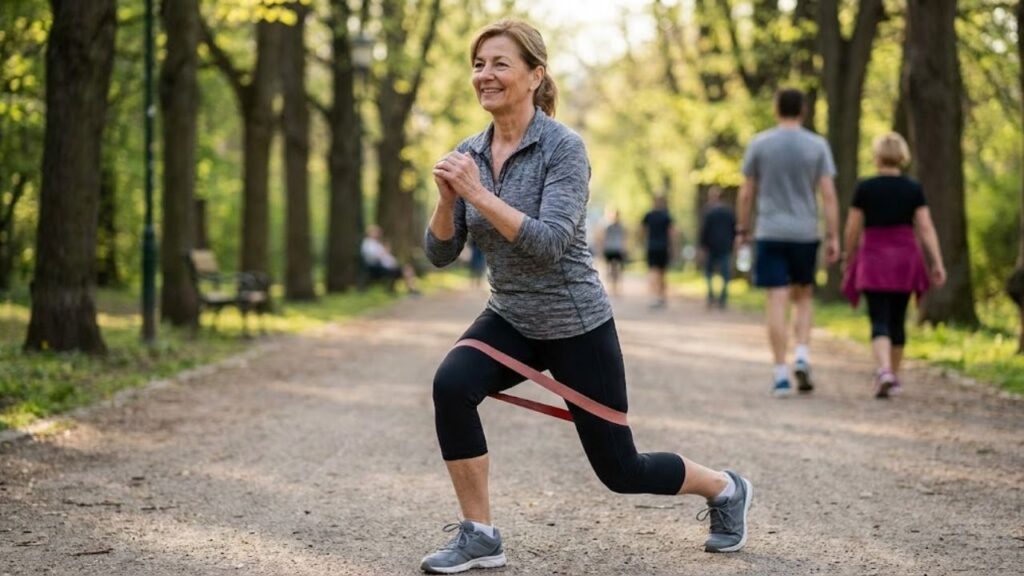
Intentional Pace Walking to Activate Leg Muscles
Most people walk without thinking about it. They shuffle along & let their body move on autopilot. Purposeful pace walking is different because you actively push against the ground with each step. This simple change helps build strength and endurance in your lower body.
Here’s how to do it properly.

Stand up straight with your chest lifted and keep your shoulders loose and relaxed.
Begin walking at a moderate speed that feels intentional but easy to maintain.
With every step you take push the ground away using your back leg.
Squeeze your glutes as your foot lifts off the ground.
Keep breathing naturally & maintain a consistent rhythm without rushing. Walk for 10 to 20 minutes based on how fit you are.
Hill Walking to Build Power and Stability
Uphill Walking for Leg Strength and Cardio Uphill walking is one of the most effective ways to build leg strength and boost your cardio without equipment because it forces your legs to work harder with every step.
How to do it:
Find a hill or incline or sloped path. Even a short one works fine.
Walk uphill at a steady but challenging pace.
Lean slightly forward from your ankles and not from your waist.
Drive through your heels as you step upward.
Keep your strides shorter to maintain control.
Focus on squeezing your glutes as you push off with each step.
Walk uphill for 30 to 90 seconds at a time. Rest for 90 to 120 seconds between walking intervals.
Extended Stride Push-Back Walking for Stronger Legs
This practice changes your focus from stepping forward to pushing backward. This approach strengthens your hips and the muscles along your backside. These areas often become weaker as you get older.
Here is how to do it:
Start by walking on level ground using small steps.
Think about stretching your legs out behind you and pushing the ground back with strength on each step.
Tighten the buttock muscle of the leg that trails behind.
Keep your upper body straight & steady while maintaining good posture.
Continue walking this way for several minutes each time.
Speed Interval Walking to Improve Strength and Endurance
Short bursts of faster walking challenge your legs and cardiovascular system at the same time. This creates strength that helps with your everyday movements.
Here’s how to do it:
Start by walking at a comfortable pace for several minutes.
 Chair-based core routine after 60 rebuilds strength better than planks and eases hip tightness
Then increase your speed for 30 to 60 seconds. Keep your posture good and swing your arms naturally.
Push off the ground with more force as you walk faster.
Keep breathing steadily and maintain a consistent rhythm.
Slow down again to let your body recover.
Repeat this pattern 3 to 6 times during your walk.
Slow Downhill Walking for Control and Balance
Build Strength While You Descend Downhill walking trains your legs in a special way called eccentric training. This happens when your muscles work hard while they stretch out instead of contracting. This kind of exercise is important for making your body more resilient and helping you control your joints better.
How to Do It:
Find a downhill part of your usual walking path and start walking slower than normal.
Stand up straight with your chest lifted & tighten your stomach muscles as you go down.
The main goal is to fight against gravity instead of letting your body lean forward & pick up speed.
Pay attention to each step and make sure you place your foot down with control.
Your thighs and glutes should feel like they are working hard to slow you down as you descend.
Keep using this controlled method for short downhill stretches.
When you finish each downhill part give yourself one to two minutes of rest before you try another one.
This basic approach turns regular downhill walking into a useful strength workout that keeps your joints safe and makes your muscles stronger over time.
Posture-Focused Walking to Finish Strong
Finish Strong with Posture Awareness Ending your walks with good posture helps your body learn correct movement patterns and prevents tiredness from affecting how you move.
How to do it:
Stand taller with a straight back during the last few minutes of your walk.
Tighten your core muscles like you’re pulling up a tight pair of jeans.
Let your arms swing naturally at your sides.
Look straight ahead instead of down at the ground.
Walk with purpose instead of just going through the motions.
Take smooth and confident steps.
End your walk feeling strong instead of hunched over.