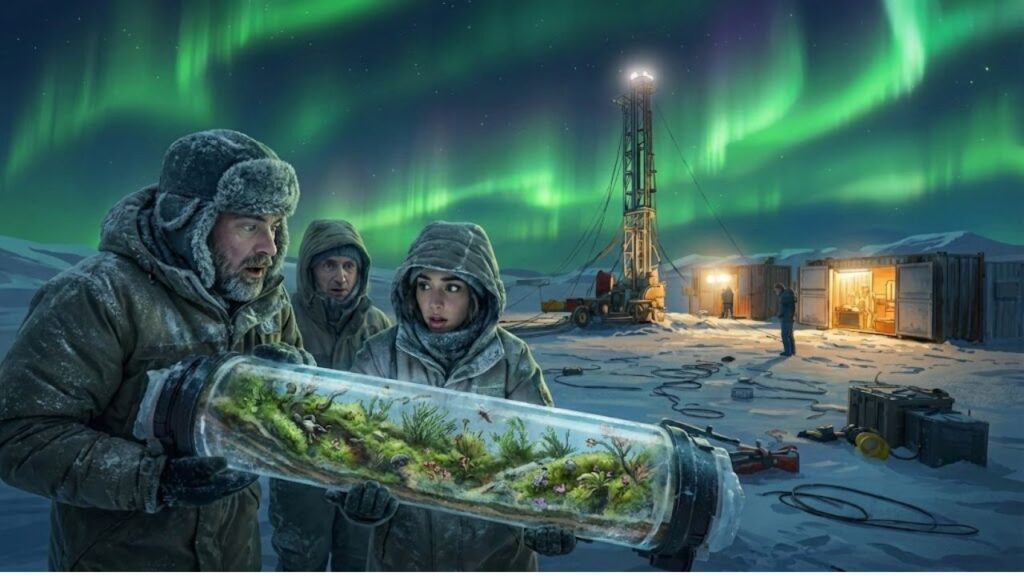
The drilling rig made quiet sounds in the polar night. It stood as a narrow tower of metal and light in a world of blue shadows. Everything around it was motionless. There were no trees or birds. Only a frozen horizon stretched out that had looked the same for millions of years. The wind moved through the camp and made loose cables rattle. A forgotten glove flapped against a fuel drum. Far below where the scientists stood the drill bit was cutting through ancient layers. It had traveled nearly 2 kilometers under the ice. Each meter represented thousands of years being removed. Every core of ice & sediment was a memory being recovered from the past. The first unusual fragments showed up in the tube. They were black against the clean ice. When this happened the talking around the rig stopped completely.
When Antarctica Revealed It Was More Than Frozen Emptiness
The glaciologists working at the site noticed something unusual when they pulled up the ice core. Instead of the standard milky ice they normally saw, this core contained dark streaks and crumbly sections with tiny particles that resembled dirt. When one researcher touched it and saw the dark material mark his glove he realized something significant had happened. They had reached bedrock. More specifically, they had found the ancient surface of a world that had been locked away for 34 million years.
Inside a temporary laboratory container scientists gathered around microscopes under bright lights while generators hummed in the background. They examined the samples and discovered fossilized pollen fragments, pieces of old leaves, and remnants of organisms that had been preserved in sediment far older than human existence. A researcher quickly filled a field notebook with sketches and notes. They recorded temperature measurements, isotope ratios, and grain sizes as they documented their findings. Someone suggested they might be looking at the final record of Antarctica before it became permanently frozen. The comment was met with silence because everyone understood it could be accurate.
The explanation for this ancient world is straightforward. Antarctica today is a frozen wasteland covered by ice that reaches up to 4 kilometers thick in places, but this was not always the case. Approximately 34 million years ago at the end of the Eocene period Earth’s climate underwent a major shift. Carbon dioxide levels dropped, ocean currents changed their patterns, and ice began spreading across the southern continent.
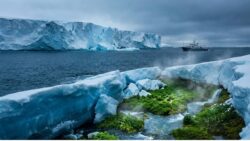
The sediments retrieved from beneath 2 kilometers of ice preserve a moment in time when Antarctica transformed from a green landscape with rivers into the frozen desert it is today. Scientists can study these layers of pollen, minerals, and isotopes to recreate what the living environment looked like in that location. These samples provide direct evidence of how the planet changed during a critical transition period.
Unearthing a Lost World Hidden Beneath Two Kilometres of Ice
Getting to that buried landscape takes time and careful technical work. Drilling through Antarctic ice means working in temperatures that freeze your fingers in seconds and fighting winds strong enough to flip a tent. The team depends on machinery that has to keep running no matter what. Each section of core comes up in thin fragile tubes that look like cold glass bones. The team logs every segment and labels it and photographs it.
They protect the cores from contamination the way surgeons work in an operating room. A stray breath or a fingerprint or a bit of modern dust could damage the story locked inside. What they want is not just interesting fossils but a precise record of how a warm continent turned into ice. Most people think of ice sheets as flat dead slabs. The reality underneath is messier and more active. The bedrock shifts and lakes form & drain. Old river valleys still carve shapes into the buried landscape. Scientists map these hidden features with radar and seismic waves before they start drilling. Only then do they choose the one point on the map that seems right.
They look for a spot likely to hold sediments from the crucial window 34 million years ago. Sometimes you realize the ground under your feet holds a story you never suspected. The plain truth is that this kind of work is slow and often boring. Nobody does this every day with constant excitement. Some days are just endless data sheets and tired eyes and equipment breakdowns & coffee that tastes faintly of diesel. The emotional high of discovery sits on top of months or sometimes years of technical work.
Why Antarctica’s Ancient Past Shapes Our Global Future
The most disturbing aspect of this story is not what Antarctica was like in the past. It is what that hidden world reveals about our possible future. Those 34 million year old sediments show a climate turning point when Earth changed from a warm planet with little ice to one covered by a huge polar ice sheet. Scientists study CO₂ levels and ocean temperatures from that period to understand when ice grows or melts.
This is not just ancient history but a direct warning. We are now increasing CO₂ to levels similar to those that existed when Antarctica had forests. When researchers compare the buried world beneath the ice with current satellite images the difference is stark. That same continent once had beech forests and wetlands with large mammals possibly roaming through cool valleys. Today those valleys sit beneath 2 km of ice that is beginning to thin and crack in certain areas.
This fossil evidence does not give us exact predictions. It shows us how rapidly large ice sheets can form & disappear once certain climate limits are passed. The information in those ice cores is straightforward. The planet can transform much faster than our political systems typically respond. There is another way to think about this. The vanished world of Antarctica existed & disappeared without leaving any written records. No stories or images of its final days remain. It left only pollen and layered sediment that waited millions of years under heavy ice for someone determined enough to search for it.
| Key Insight | What Scientists Found | Why It Matters to Readers |
|---|---|---|
| Hidden ancient landscape | Researchers uncovered 34-million-year-old sediments containing pollen and plant material beneath nearly 2 km of Antarctic ice | Shows how dramatically Earth’s climate and geography can change over deep time |
| Climate tipping-point evidence | Ice cores record Antarctica’s shift from a warm, forested region to a permanent ice sheet | Helps readers understand today’s climate risks by comparing them to a real historical transition |
| How the “lost world” was revealed | Deep ice drilling combined with careful core handling and detailed chemical and microscopic analysis | Makes scientific discovery feel tangible and highlights the persistence behind major breakthroughs |