The road to Gérard’s place runs between two fields and a line of tired poplars. On one side: brown, bare soil, waiting for spring. On the other: a rectangle of wild grass, yellowed by frost, where a handful of beehives stand like small, painted cabins. The land doesn’t grow wheat, or corn, or anything that sounds like profit. It just hums quietly with bees that aren’t even his.
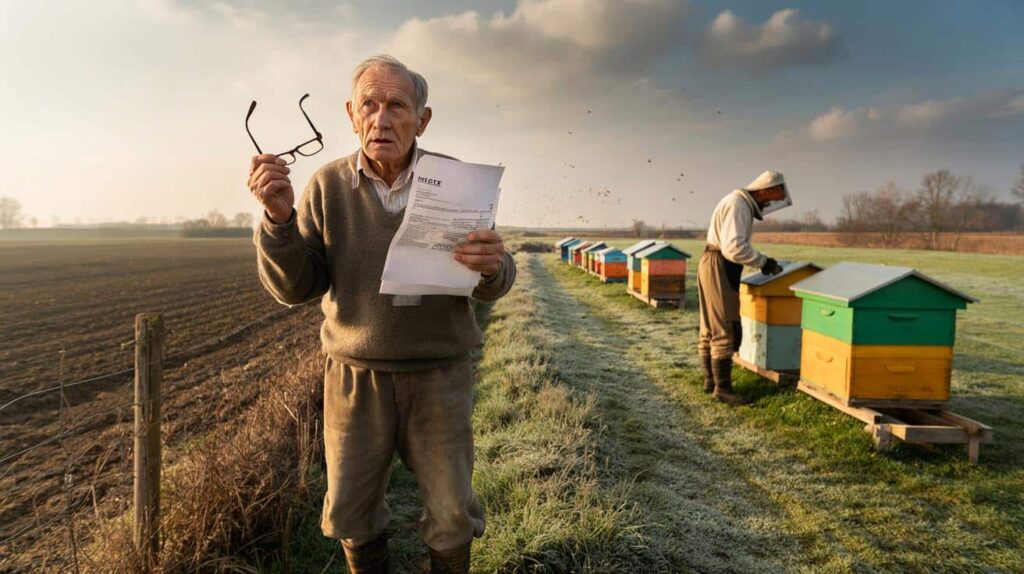
Gérard is 73, retired from the local factory, and used to thinking of this patch of land as “almost nothing.” A favor to a young beekeeper who couldn’t afford a big farm. A way to feel useful, one last time.
Then the letter came from the tax office.

They called his empty field a “farm.”
A favor between neighbors that turned into a tax headache
The morning he opened the brown envelope, Gérard was still in his slippers, coffee growing cold on the kitchen table. “Dear Sir, following a reassessment…” The rest blurred. He had to fetch his glasses, read it three times. The administration had decided that because his land hosted beehives, it counted as agricultural use.
Translation: he had to pay farm taxes.
“I earn nothing from this,” he kept repeating, turning the letter like it might suddenly say something different at the bottom. The beekeeper pays no rent, no lease. Just a few jars of honey at Christmas, as a thank you. Gérard never signed a farm contract in his life. Suddenly, he was treated like a landowner running an agricultural business.
A few months earlier, the scene had seemed almost touching. The young beekeeper, Camille, arrived with a dented van and secondhand hives. She asked politely if she could use Gérard’s unused corner of land. The soil wasn’t good for crops, and the village had been complaining about disappearing pollinators.
Gérard thought of the headlines about bees dying, the summers suddenly quieter without their buzzing. He’d always liked the idea of helping nature, without grand speeches. So he said yes.
No contracts, no lawyers, just a handshake over a wire fence. A photo of the first beehive proudly shared on Facebook. A small act of generosity that fit perfectly with his modest life. Then the tax office discovered the hives in a routine land register update, and the kindness flipped into a “taxable activity” line.
The logic, on paper, is cold. Land used for agricultural production falls into a specific tax category. Bees produce honey. Honey is a product. So the land becomes “agricultural,” even if not a cent passes through the owner’s hands. Officials point to regulations, to equal treatment, to systems that cannot guess a person’s intentions.
But in real life, the gap between the law and the gesture is brutal. Gérard isn’t a farm boss weighing subsidies. He is an old man who thought an unused field could help a younger neighbor start out. The ruling hit a nerve because it sounded like a sanction against generosity, a message that says: if you lend, you pay.
That’s how a few beehives in a forgotten field turned into a national conversation.
When nature, kindness and the tax code collide
Once Gérard’s story hit local radio, lawyers, farmers, and bee lovers crawled out of the woodwork. Everyone had a version of this kind of story. A cousin hosting a shepherd’s flock for a few weeks. A family letting a neighbor stack hay bales on their unused land. City folks allowing an urban gardener to grow tomatoes in a courtyard.
Most of them never thought of calling a notary. These arrangements were born in parking lots, at school gates, outside churches. One person with land they barely use, another with a small project and no space. *It felt like the last quiet place where trust still counted more than paperwork.*
Tariffs and tax codes rarely show up in these conversations. Then one day a bill arrives, and the whole balance tips over. Suddenly everyone starts asking: who is really the farmer here? Who is liable? Who should pay?
The Gérard case crystallized those questions. As his story spread, social networks filled with similar mini-dramas. A retired teacher in the south who lent a field for grazing and got reclassified as agricultural land. A couple who hosted a few hives “to help biodiversity” and received an inspection asking for their farm identification number.
Some people shrugged and said, “Rules are rules.” Others saw something bleaker: a system that punishes initiative and favors only big, officially registered operations. What hurt most was the feeling of being treated like a cheat when you were just trying to be decent.
We’ve all been there, that moment when a good deed suddenly looks naive in the harsh light of bureaucracy. The Gérard affair gave that feeling a very precise face.

If you listen to tax officers, they insist they’re not hunting down retirees with bee jars. They talk about standard categories, about fairness between real farmers who pay taxes and those who might exploit loopholes. They have templates, codes, and forms, not space for every individual story.
On the other side, citizens see something very different. **They see a lonely pensioner who lent a lifeline to a struggling beekeeper, and got treated like he’d opened a secret agribusiness.** They hear that if you share your land, you might get a bill.
That’s the plain-truth sentence hidden in the outrage: people fear that solidarity is quietly becoming a taxable resource. Between the lines, the national debate isn’t only about tax law. It’s about whether small gestures are still allowed to be just that – small, clumsy, generous, and free.
How to help without getting burned: small protections for big hearts
Behind the noise, a simple question emerges: how do you keep saying yes to beekeepers, gardeners, and small farmers without blowing up your finances? The first quiet step is to talk about the land like it matters, even if “it’s just a field.”
Before handing over a key or pointing to a gate, sit down at the kitchen table, two coffees, one sheet of paper. Write, in simple words, who is using the land, for what, and for how long. Mention clearly that you’re lending it for free, that you’re not involved in the activity, that no revenue comes to you. It’s not about distrusting the other person. It’s about creating a trace that says: this is solidarity, not business.
Then, if a letter arrives, you’re not caught empty-handed.
Lawyers say one of the biggest mistakes is pretending “nothing’s happening” on a piece of land. You tell yourself, “It’s too small to matter.” The neighbor tells you, “Don’t worry, no one will ever come check.” Then the administration uses satellite images or local declarations, and the story changes overnight.
A second trap is assuming verbal promises protect you. They rarely do. A simple, dated, signed note can save months of anxiety later. Adding a quick call to your local town hall or tax office to ask how to declare the situation helps, too. Let’s be honest: nobody really does this every single day. Yet thirty minutes of slightly uncomfortable admin can prevent five years of legal fog.
An empathetic approach, on both sides of the fence, starts by naming what’s really going on: you’re not an investor, you’re just trying to help.
“People think generosity is invisible to the system,” says one rural notary who’s been flooded with calls since Gérard’s case. “But as soon as hives, animals, or crops appear, the land takes on a legal life of its own. The trick is not to stop being generous, but to give that generosity a minimum of structure.”
-
- Write a simple loan agreement
One page with names, land description, free use, and no income for the owner. It doesn’t have to be perfect, just clear. - Clarify who is the “farmer”
- Write a simple loan agreement
The beekeeper or grower should register, even as a micro-activity, so the tax role falls where the production income is.
-
- Talk to local authorities early
A short appointment at the town hall or tax office to explain the project can prevent surprise reclassifications later.
-
- Limit duration and renew
Set a term (one year, three years) instead of “forever.” It keeps everyone aware and lets you adjust if rules change. - Keep proof of no payment
- Limit duration and renew
Bank statements, messages, or notes confirming there is no rent or share of the profits protect you in any dispute.
Beyond one field and a few bees: what kind of countryside do we want?
What unsettles people about Gérard’s story is not only the amount on the tax bill. It’s the feeling that something fragile is at stake. Those small, improvised pacts that still hold villages and suburbs together. A corner of land here, a garage lent there, a room offered to store tools or boxes.
When that network of informal help starts to look risky on a tax spreadsheet, many quietly pull back. They say no instead of yes. They leave the field empty instead of letting it buzz with life. The beekeeper buys cheap land far away, or gives up entirely. Nature loses, small producers lose, and the old man staring at his unused field loses a reason to open his gate in the morning.
The national debate sparked by Gérard’s bees goes beyond agriculture. It taps into a more uncomfortable question: can a country survive on rules that only recognize big structures and ignore tiny, human deals? Farmers’ unions ask for clearer thresholds, so that small, non-commercial uses don’t automatically trigger the full machinery of taxation. Environmental groups argue for protective status for land used for biodiversity, even when no one is getting rich from it.
Some propose symbolic income thresholds, others want new legal categories for “solidarity uses of land.” None of these ideas are simple to implement. Yet something is already moving: people are talking, openly, about the price of being kind to your neighbor. That conversation alone changes the way we look at a rusty gate, an empty field, a few painted hives waiting for spring.
| Key point | Detail | Value for the reader |
|---|---|---|
| Clarify the land use | Describe in writing who uses the land, for what, and with no income for you | Reduces the risk of being treated as a hidden farmer |
| Formalize even “small” favors | Use a simple free-loan agreement and keep proof of no payment | Protects your finances without killing generosity |
| Talk to local authorities early | Declare the situation and ask which status applies | Avoids surprise tax reclassifications years later |
FAQ:
- Question 1Can I lend my land for beehives without becoming a “farmer” for tax purposes?
- Question 2What kind of written document is enough to show that I don’t earn money from the land?
- Question 3Does a small project, like three or four hives, really attract the attention of the tax office?
- Question 4Who should pay taxes when a retiree lends land to a young farmer or beekeeper for free?
- Question 5How can I support local agriculture and biodiversity without taking on unexpected legal or tax risks?