These ancient giants, older than any tree and taller than a house, once dotted a rocky landscape covered only by low plants and moss. Nearly two centuries after their discovery, scientists are still arguing about what they really were – and whether they belonged to a completely vanished branch of life.
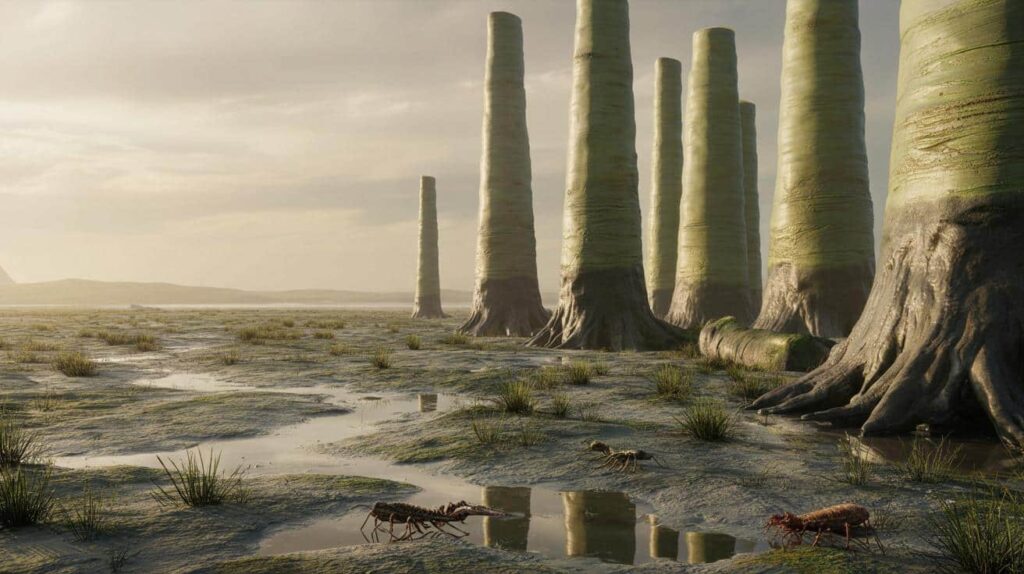
A planet without trees, but not without giants
Travel back around 400 million years, to the Devonian period. Continents were clustered in different shapes, the air carried far more carbon dioxide, and nothing resembling a modern forest yet existed. Most plants hugged the ground: simple mosses, early vascular plants, small shrubs standing no higher than a person’s ankle.
Amid this modest vegetation, something utterly out of scale rose toward the sky: massive vertical columns, some stretching beyond 7.5 metres in height. From a distance, they must have looked like lonely, pale trunks scattered across a barren plain.

These mysterious structures, known as Prototaxites, were the largest living things on land long before the first true trees appeared.
Fossils of Prototaxites were first found in 1843 and puzzled Victorian geologists. By 1859 they had a name – “Prototaxites”, meaning “primitive yew” – because they vaguely resembled tree trunks. Yet almost as soon as that label was applied, doubts emerged. Their inner structure did not match wood. Their growth patterns looked wrong for a plant. And so the arguments began.
Not quite plant, not quite fungus
Over the 20th century, two main ideas fought for dominance. Either Prototaxites was a gigantic fungus, effectively a prehistoric mushroom tower, or it represented a lifeform unlike anything alive today, sitting outside the familiar kingdoms of plants, animals, and fungi.
A recent study in Science Advances has pushed the debate sharply back toward the second, more radical option. Researchers compared Prototaxites fossils with known fossil fungi from the same rock layers and found several crucial differences.
Under the microscope, Prototaxites is built from dense networks of tubes. That might sound fungal at first, since fungi also form webs of narrow filaments called hyphae. But the resemblance fades on closer inspection.
- The tubes in Prototaxites branch in a chaotic way, without the regular organisation seen in fungal tissue.
- The overall pattern is more like tangled cables than a structured network.
- No clear reproductive structures typical of fungi have been identified inside the fossils.
The chemistry deepens the puzzle. Many ancient fungi preserve signs of chitin, a tough compound that forms the walls of fungal cells and the shells of insects and crustaceans.
In rocks where other fossil fungi still carry traces of chitin, Prototaxites appears to lack it entirely, hinting at a fundamentally different biology.
That absence is hard to brush aside. If Prototaxites were simply a bizarre fungus, scientists would expect at least some chemical fingerprint of chitin in well-preserved specimens found alongside confirmed fossil fungi.
A lost branch of life?
Some researchers now argue that Prototaxites could represent a completely separate lineage: a large, complex organism whose relatives have all vanished. In this view, it might sit on a branch of the tree of life that broke off early and never made it into the modern age.
Others take a more cautious line. They suggest Prototaxites might still be a fungus, but one so unusual that it looks alien by comparison with anything alive today. On that reading, it could come from an extinct branch of the fungal kingdom that pushed body size and structure to extraordinary limits.
The fossils themselves only go so far. On the outside, Prototaxites looks like a tapering column, sometimes more than a metre across. Inside, the tissue appears mottled and patchy, with dark and light bands. Some specimens show a kind of growth ring pattern, hinting that the organism grew slowly over years, perhaps decades.
Whatever its true identity, Prototaxites shows that complex, multicellular life on land was experimenting with giant forms long before forests rose.
How did a giant feed in a low, scrubby landscape?
Even if Prototaxites was neither plant nor ordinary fungus, it still had to find energy. Earlier studies have looked at carbon isotopes – chemical fingerprints that can reveal what organisms ate.

The results suggest Prototaxites likely lived as a decomposer, consuming dead organic matter, much like fungi do today. That would fit an ecological role as a recycler in early terrestrial ecosystems.
Yet the scale raises tough questions. How could a 7.5‑metre column support itself nutritionally when the surrounding vegetation barely reached ankle height? Did extensive underground structures spread outwards to absorb resources from a large area? Did it feed on thick mats of algae and early plants that covered damp ground?
So far, no clear fossil evidence of roots or anchoring structures has been identified. Some scientists imagine Prototaxites as a vast, low, sheet-like network underground, with only the column visible above the surface. Others suspect that what we see preserved is only one growth stage among several, leaving much of its lifestyle hidden.
Reconstructing an alien-looking ecosystem
Artists’ reconstructions of the famous Rhynie ecosystem in Scotland, where some of the best early land fossils are found, tend to show Prototaxites towering over a carpet of tiny plants. Picture a rocky floodplain, warm and humid, dotted with small streams. The ground is covered in mossy patches and wiry stems. Rising through this low carpet stand a few pale pillars, silent and unmoving.
To early land animals, such as primitive arthropods resembling millipedes and scorpions, these columns would have formed prominent landmarks. They might have provided shade, windbreaks, or complex microhabitats at their base where moisture and decaying material collected.
| Feature | Typical tree | Prototaxites |
|---|---|---|
| Main kingdom | Plant | Unclear (possibly not plant or fungus) |
| Internal structure | Ordered wood tissue with vessels | Tangled tubes, irregularly branched |
| Key wall material | Cellulose | No clear sign of chitin; composition uncertain |
| Height range | Varies, but includes tall forests | Up to at least 7.5 metres |
| Leaves or branches | Common | No clear evidence |
What this tells us about life’s flexibility
Prototaxites highlights how messy the early history of life on land really was. The familiar kingdoms – animals, plants, fungi – are human attempts to organise a much more complicated reality. In the deep past, boundaries between these groups may have been blurrier, with experimental forms that do not fit modern boxes.
Paleontologists sometimes talk about “stem groups”: extinct organisms that sit along the side branches leading to modern forms. Prototaxites could be part of a stem group for fungi, plants, or something else entirely. Without DNA, researchers rely on shape, microstructure, and chemistry to place it, and those clues are giving mixed messages.
Fossils like Prototaxites remind researchers that today’s living organisms represent only a tiny fraction of all the biological experiments Earth has hosted.
Key terms and ideas worth unpacking
Two scientific ideas often mentioned in discussions of Prototaxites can sound abstract but are central to the debate.
Chitin is a tough, flexible biological material. In modern ecosystems it forms the cell walls of fungi and the exoskeletons of many invertebrates. Its presence in a fossil usually points strongly toward a fungal or arthropod origin. When researchers search for chemical traces of chitin in Prototaxites and come up empty, that weakens the fungal interpretation.
Stable carbon isotopes are different forms of carbon atoms that plants and microbes use in slightly different ways. By measuring the ratios of these isotopes in fossils, scientists can often infer what an organism ate or how it gained energy. Prototaxites shows a wide range of carbon signatures, suggesting it fed on varied organic material rather than making its own food through photosynthesis.
Where future research might lead
New imaging techniques, such as high‑resolution 3D scanning and synchrotron X‑ray analysis, may reveal hidden details inside Prototaxites fossils without destroying them. Researchers hope to spot tiny structures that could be interpreted as reproductive organs, growth zones, or connections to surrounding sediments.
Computer simulations of early Devonian ecosystems are also starting to appear. By modelling how nutrients cycled through these primitive landscapes, scientists can test whether a giant decomposer like Prototaxites could be supported by the available biomass. These models may show whether many tall columns could coexist, or whether only a few scattered individuals could survive in any given area.
For anyone interested in Earth history, Prototaxites offers a useful mental exercise. Next time you walk through a forest, imagine stripping away every tree, leaving only knee‑high plants. Then replace the trunks with silent, unbranching towers whose true nature no one can yet agree on. That unsettling image comes surprisingly close to our best guess of what dry land looked like long before forests took over.