New research suggests that the Sahara Desert is on track for a sharp rise in rainfall this century, reshaping weather patterns across Africa and forcing communities, ecosystems and governments to rethink how they live with water.
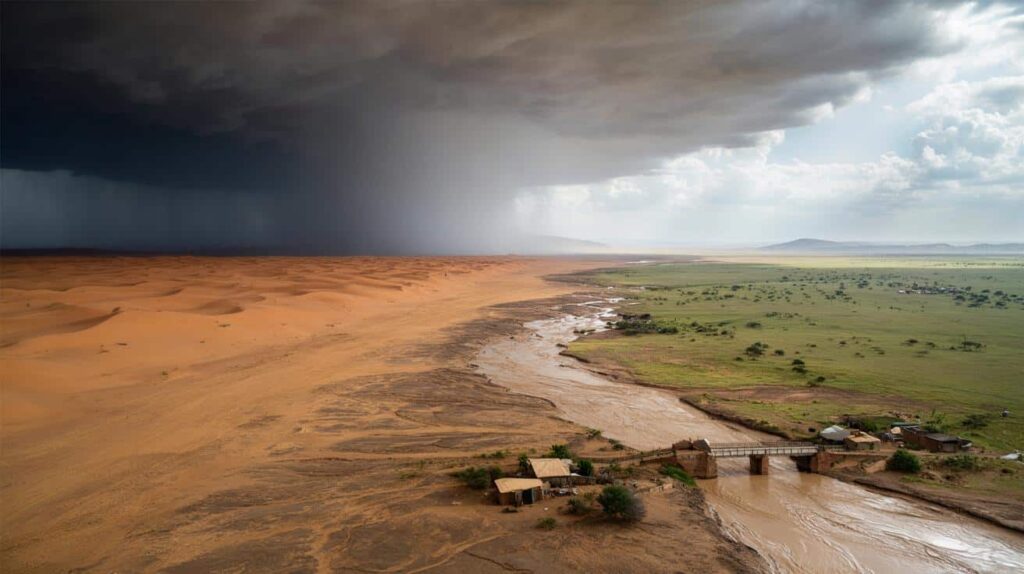
The Sahara’s dry myth is starting to crack
The Sahara has long been shorthand for relentless heat and near-total absence of rain. That view, scientists now argue, is out of date. A study published in 2025 in the journal npj Climate and Atmospheric Science projects that average rainfall over the Sahara could increase by as much as 75% by 2100.
The research team, led by scientists at the University of Illinois Chicago, analysed data from forty global climate models. They looked at past conditions from 1965 to 2014 and then ran simulations out to 2099 under both moderate and high-emissions scenarios, known as SSP2‑4.5 and SSP5‑8.5.

Across all scenarios, the signal is clear: Africa is on course for a much wetter atmosphere, but not in a gentle, predictable way.
Rising temperatures allow the atmosphere to hold more moisture. That extra water vapour is then released through more intense rainfall events. Over the Sahara, the study suggests, this process will be amplified by shifting wind patterns and changes in large-scale circulation in the tropics.
How global warming pumps moisture into the desert
At the heart of the projected shift is a rearrangement of the Hadley cells, the huge loops of rising and sinking air that help steer tropical rainfall. As the planet warms, these cells tend to expand and move poleward.
In the new simulations, that northward shift nudges the core zone of tropical rain further into what is now desert. As moist air is pulled deeper into the Sahara, it rises, cools and condenses into clouds and storms.
Researchers estimate that more than 70% of the “new” Sahara rainfall will come from convective storms – the short, violent downpours associated with thunderclouds.
Such storms are very different from gentle, soaking rain. They arrive quickly, dump large amounts of water in a small area and then vanish. On rock-hard or degraded soils, much of that water runs off instead of seeping into the ground.
Wetter in some places, drier in others
The changes are not limited to the desert itself. The modelling points to a wider reshuffle of Africa’s rainbelt:
- Central and southern Africa could see rainfall increases of roughly 17–25%.
- Some Sahelian regions on the desert’s southern edge might gain more regular pastures.
- The far south-west of the continent could actually lose around 5% of its rainfall.
In other words, a wetter Sahara does not mean more water for everyone. Some areas will be soaked; others risk creeping aridity. The timing of rains also shifts, which can be just as disruptive as changes in quantity.
A “green Sahara” dream with harsh edges
The idea of a greener Sahara captivates imaginations. Geological records show that thousands of years ago, parts of the region did support grasslands, lakes and wildlife. The new findings revive that vision, at least in partial form: researchers talk about semi-arid zones and even temporary savannas emerging along the desert’s margins.
Yet the study is blunt about the downsides. The modern Sahara is not a pristine, ready-to-bloom landscape. Large areas are stripped of vegetation, heavily eroded or crusted with salt. That makes them bad at absorbing sudden downpours.
Excess rain hitting bare, compacted ground is less a blessing than a shock: floods, landslides, and fast erosion rather than quiet regeneration.
Water that cannot infiltrate quickly forms torrents, carving gullies, sweeping away villages and infrastructure, and damaging fragile oases. High temperatures then speed up evaporation, feeding a vicious cycle of brief flooding followed by renewed dryness.
Risk to ecosystems already on the edge
The desert is not empty. Its scattered plants and animals are finely tuned to scarcity. Sudden shifts in water availability can be just as deadly as droughts. Species adapted to long dry spells may struggle with episodic waterlogging, new diseases or invasive plants carried by changing wind and animal patterns.
On the Sahelian fringe, extra rainfall might encourage shrubs and trees, but it could also favour locust outbreaks, crop pests and new competition for pastoral communities. Biodiversity gains in one corner may be offset by losses in another.

Monsoon timing: a few weeks that decide harvests
Far beyond the dunes, the study raises alarms for Africa’s monsoon systems. Across West, Central and East Africa, hundreds of millions of people rely on predictable seasonal rains to plant, graze livestock and refill rivers.
Climate models indicate that the onset and retreat of these monsoon rains may shift by several weeks as the Sahara wets and atmospheric circulation changes.
A small change in the calendar of the rains can mean failed planting, food shortages and forced migration on a vast scale.
If rains come earlier but stop sooner, crops may wilt before maturity. If they arrive later but in heavier bursts, seeds can be washed away and soils compacted. Combined with heat stress on plants and livestock, the margin for error in agriculture narrows.
Who wins and who loses from a wetter Sahara?
Policy makers will be tempted to focus on potential gains: more pasture in the Sahel, new farming opportunities in areas once considered too dry, and extra water for dams and groundwater recharge. Those opportunities are real, but they come with sharp trade-offs.
| Potential benefit | Linked risk |
|---|---|
| Expansion of grazing land in semi-arid zones | Overgrazing, land conflicts and rapid degradation if herds concentrate |
| New areas suitable for rain-fed crops | High exposure to flash floods and year-to-year rainfall swings |
| Higher river flows and fuller reservoirs | Greater flood hazard downstream and stress on ageing dams |
| Chance to restore degraded land with trees and grasses | Wrong species choice could deplete groundwater or disrupt local uses |
The researchers behind the study argue that managing these trade-offs requires planning long before the rain patterns fully shift. Waiting for “proof” on the ground, they warn, could leave governments reacting to disasters instead of shaping outcomes.
Adaptation: from flood control to farming experiments
Across the continent, strategies are already being discussed in climate and development circles. The study’s findings add urgency to several lines of action:
- Strengthening early-warning systems for flash floods and extreme storms.
- Designing roads, bridges and urban drainage to cope with heavier downpours.
- Testing crop varieties that can handle both waterlogging and dry spells.
- Supporting mobile pastoralism so herders can respond to shifting pastures.
- Encouraging reforestation and assisted natural regeneration in zones likely to receive more rain.
Hydrologists are also looking at how new rainfall could recharge deep aquifers under the Sahara. That water might one day support carefully managed irrigation schemes. The risk is that unplanned pumping could quickly outstrip natural refills, repeating mistakes seen from California to the Arabian Peninsula.
What scientists mean by “scenarios” and model uncertainty
The study uses two emissions scenarios, SSP2‑4.5 and SSP5‑8.5. These are not forecasts but storylines that combine assumptions about population, technology, policy and pollution.
SSP2‑4.5 imagines a world that makes some progress on cutting greenhouse gases, while SSP5‑8.5 represents a pathway with high fossil fuel use and little climate policy. Both lead to more Sahara rainfall, though the timing and exact amounts differ.
Climate models still struggle with regional rainfall, especially in areas dominated by convective storms. That means the precise numbers are uncertain. Yet the agreement across dozens of independent models on the direction of change – a wetter Sahara, a more humid African atmosphere – gives scientists confidence that the broad picture is robust.
Every extra drop interacts with heat, land and society
The headline figure of “75% more rain” hides the complex ways water, heat and human activity feed into each other. Higher humidity raises nighttime temperatures, worsening heat stress. Intense storms can strip away topsoil, making land less productive even if annual rainfall totals rise.
At the same time, targeted land restoration can change how rain behaves. Replanting native grasses or shrubs, for instance, helps capture water in the soil, slows runoff and cools local microclimates. In some pilot projects in the Sahel, this has already revived abandoned fields and reduced the impact of heavy showers.
The emerging picture is less a simple “Sahara turning green” and more a continent being pushed into a new, unstable balance. Rain will fall in different places, at different times, with different intensity. How African societies respond — from city planning to village farming — will determine whether this excess water becomes a lifeline or another source of crisis.