The first thing the crew heard was the breathing. Short, forceful blasts at the surface, just off the stern. The kind of sound that makes you look up, even if you’ve been on the water all your life. Orcas, four of them, sliding in behind the small fishing boat off the Pacific Northwest, their black-and-white bodies ghosting through the gray swell like something rehearsed.
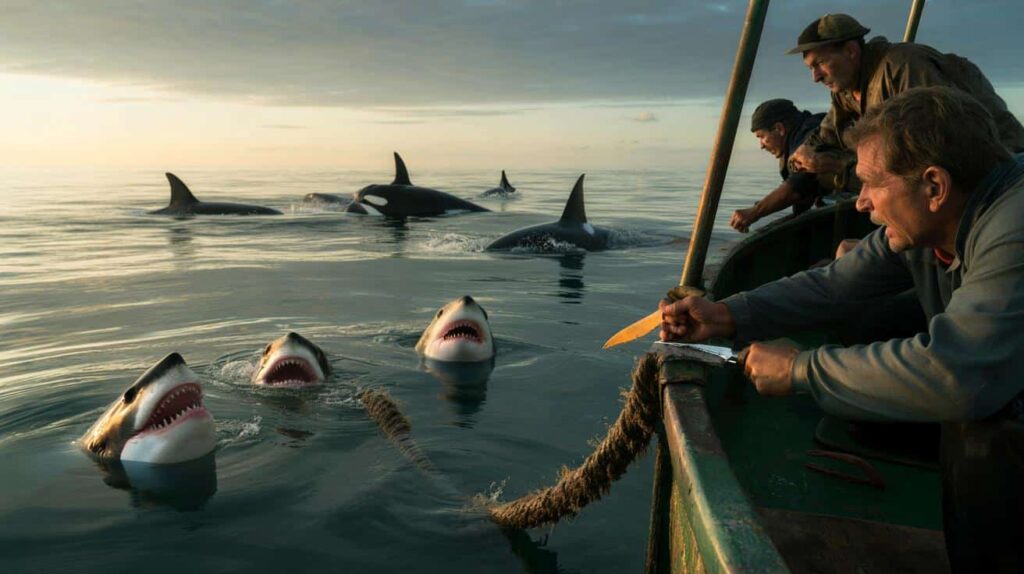
The men killed the engine and drifted, hoping the whales would lose interest. Instead, the orcas drew closer, circling the hull with eerie patience. That’s when the anchor rope snapped tight, then shuddered. One of the crew leaned over and saw the flash of another body below: a shark, jaws clamped on the line, sawing at it like a dog with a bone.
Two apex predators, one aging fishing boat, and a crew suddenly feeling very, very small.

When the sea turns into a power struggle
The fishermen who tell this story don’t bother to dress it up. They were out for halibut, a routine day, until the orcas showed up and turned calm water into something that felt like a contested border. The whales weren’t attacking the boat, but they weren’t leaving either.
The crew watched the dorsal fins cut the surface, perfectly aligned, while their anchor line began to twitch and hum under the tension. They weren’t just stuck. They felt pinned. It’s that odd moment when you realize you’re basically parked in the middle of a standoff between giants, and your only real plan is: don’t make it worse.
Stories like this are surfacing from Alaska to New Zealand. Longliners in the Southern Ocean talk about orcas shadowing them for miles, plucking fish neatly off their hooks. Charter skippers off California describe days when whales follow them like taxis, waiting for the next free meal.
Then there are the sharks. Several crews now say that just after orcas appear, sharks begin darting under the hull, gnawing at anchor ropes or metal fittings. One New Zealand skipper filmed a blue shark chewing his line while a pod of orcas circled 30 meters away. Another Alaska fisherman described his rope “vibrating like a guitar string” before the anchor suddenly vanished into the dark. Those aren’t the sorts of details you forget.
Marine biologists are cautious, but they’re listening. Orcas are known for their problem-solving brains and for teaching each other clever tricks. Sharks are opportunists, reading chemical cues and movement in the water with brutal efficiency. Put those instincts together in a small patch of ocean and you get something that feels like coordinated chaos.
The simplest reading is that orcas and sharks are both homing in on the same distressed signals: hooked fish, spilled bait, engine sounds. The boat becomes a floating buffet, and the anchor rope is just collateral damage. Still, when crews describe sharks biting lines **right after** orcas roll in, it’s hard not to feel there’s some more complex dance going on under the hull.
Staying calm when predators close in
Talk to skippers who’ve been through it and one thing comes up again and again: don’t panic and gun the throttle. That instinct is strong when a black dorsal fin slides past your stern, but sudden movement can tangle lines, damage the prop, or even pull a hook into someone’s hand.

The crews who come home with both their boat and their nerves intact tend to do the same simple things. They reduce speed or cut the engine, secure loose gear, and keep eyes on both the animals and the water around the anchor rope. If the line starts to jerk or shred, they prepare to release it rather than fight it. Losing an anchor hurts the wallet. Losing steering in a swell because the rope wraps the prop is a whole different kind of hurt.
There’s another layer people don’t always talk about: fear has a long tail. After a close encounter, some fishers admit they spend the next few trips flinching at every bump under the hull. That’s natural. We’ve all been there, that moment when your body still thinks it’s in danger long after your brain says you’re safe.
A few skippers now build in small routines for their crews. A quick safety check before heading out. A three-sentence briefing on what to do if an orca or shark comes close. A quiet debrief over coffee back at the dock if something does happen. It sounds formal, but the goal is simple: nobody should feel like they have to “tough it out” alone after watching a shark literally chew through the thing anchoring their world to the seabed.
One veteran Alaskan fisherman put it this way: “The first time an orca popped up next to my transom, I felt honored. The third time, with a shark on my anchor rope, I just felt like the dumbest piece of gear in the water.”
- Slow your reactions
Pause before changing speed or course when large predators appear. That small delay helps avoid tangles, hardware damage, and panicked choices. - Watch the lines, not just the fins
Assign one person to keep eyes on anchor and fishing lines. A fraying rope or strange vibration is your earliest warning sign. - *Prepare to sacrifice gear*
Have a knife or release system ready. An anchor, chain, or section of rope is replaceable; your ability to maneuver out of real trouble is not. - Talk through the adrenaline
After the encounter, let people share what they saw and felt. It’s basic seamanship, not therapy-speak. Bottled fear comes back at the worst times. - Respect the pattern
If orcas or sharks start frequenting a particular area, adjust routes or timing instead of betting they’ll move on. Let’s be honest: nobody really does this every single day, but the crews who do tend to have quieter logbooks.
What these encounters say about a changing ocean
These strange anchor-rope stories sit at the crossroads of folklore and science. On one side, you have old-school fishers swapping wild tales at the harbor bar. On the other, researchers tracking orca pods with drones and tags, mapping shark movements like subway lines. Between them is this uncomfortable truth: the animals are adapting faster than we are.
Some scientists suggest orcas targeting fishing boats are showing a learned behavior, possibly sparked by a few individuals that discovered how easy it was to grab tired fish off longlines. Sharks biting ropes could be confusion, curiosity, or a side effect of the same feeding frenzy. Yet the more reports stack up, the more it looks like something systemic, not random: a sign that the ocean’s big predators already see our boats as built-in features of their hunting grounds.
That might be the real reason these stories resonate so strongly online. Beyond the spectacle of orcas and sharks circling a small boat, there’s a quiet, unsettling shift: humans aren’t just visitors out there anymore, or even the main event. We’re one more moving part in an ecosystem that’s rewriting its own rules in real time. The question is less “What are the whales and sharks doing?” and more “How are we going to fish, work, and travel in a sea where the wild things now read us as clearly as we try to read them?”
| Key point | Detail | Value for the reader |
|---|---|---|
| Predators are adapting to fishing activity | Orcas and sharks increasingly target boats as predictable food sources, sometimes interacting with anchor ropes and gear. | Helps readers grasp why such encounters are becoming more common, not just “freak events”. |
| Calm, simple routines reduce risk | Slowing down, watching lines, and being ready to sacrifice gear protect both crew and vessel during close encounters. | Offers practical takeaways that feel usable, even for occasional boaters or charter guests. |
| Emotional impact matters too | Debriefs, shared stories, and acknowledging fear help crews process high-stress moments at sea. | Validates reader emotions and encourages more open, realistic conversations about ocean risk. |
FAQ:
- Are orcas actually attacking fishing boats?
Most reports describe orcas taking fish off lines or inspecting hulls, not ramming or capsizing boats. In some regions, like parts of the North Atlantic, there have been rare cases of orcas damaging rudders, but outright “attacks” remain unusual.- Why would a shark bite an anchor rope?
Sharks often investigate anything that vibrates, smells like fish, or moves in the water column. A tensioned rope near struggling catch can feel like prey, or just something worth sampling with their teeth.- Could orcas and sharks be working together?
There’s no solid scientific evidence of true cooperation between orcas and sharks. It’s more likely they’re independently drawn to the same food source around fishing boats, creating the impression of coordinated behavior.- What should a small boat do if surrounded by large predators?
Reduce speed or idle, keep hands and gear out of the water, watch all lines, and avoid sudden maneuvers. If an anchor rope is clearly compromised, releasing it is often safer than fighting it.- Are these encounters becoming more frequent?
Many fishers and charter operators say yes, especially in heavily fished areas. As predators learn to associate boats with easy meals, such behavior can spread within pods or local populations over time.