On a cool January morning, the port at Dunkirk looked more like a sci‑fi film set than a slice of northern France. Dock workers craned their necks at a hulking white cylinder, 25 metres long and taller than a two-storey house, slowly inching its way onto a waiting barge. Phones were out, videos rolling. Even the most jaded forklift driver paused for a photo.
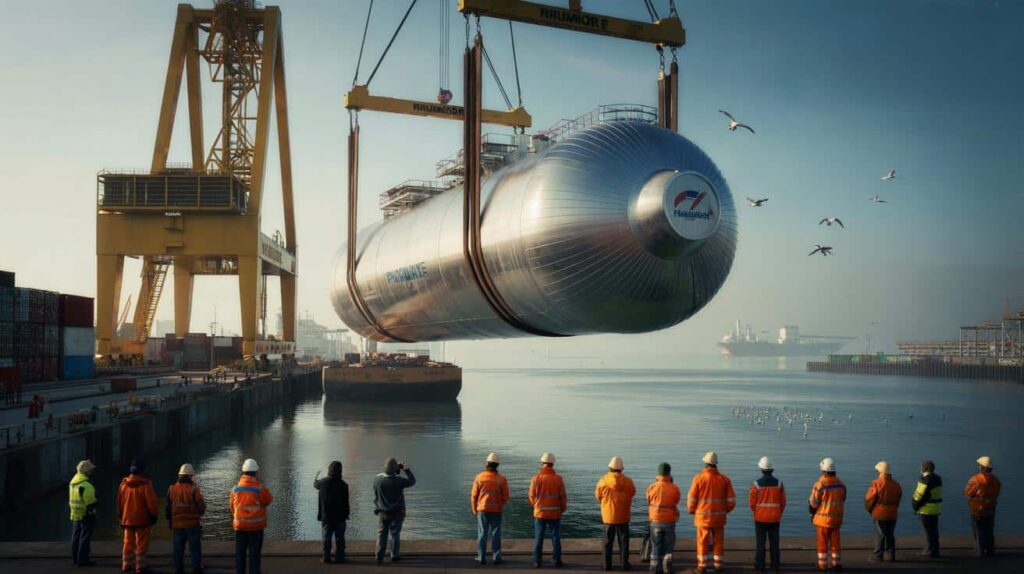
This was no ordinary shipment. It was a 500‑tonne nuclear colossus, built in French steel and welds, on its way to power Britain’s next-generation EPR reactor at Hinkley Point C in Somerset. One piece of metal, carrying decades of political arguments and billions of euros on its back.
Nobody on that dock needed a reminder: this is what the future of European energy actually looks like.

France’s nuclear muscle heads for the English coast
The sheer size of the component is the first thing that hits you. The reactor pressure vessel, forged by Framatome in France, weighs about as much as 80 African elephants and has to be eased onto a specially reinforced barge, centimetre by centimetre. Workers talk in hand signals, not shouts. One wrong move and the timetable of an entire power station would slip.
From Dunkirk, the vessel is due to hug the French and then British coastline, escorted like a head of state. At the end of the journey: Hinkley Point C, the UK’s flagship Generation III reactor project, now visibly transforming a quiet corner of Somerset into one of Europe’s biggest building sites.
For locals along the route, the passage of this steel giant will be both surreal and strangely mundane. In some coastal towns, people may see just a low shape on the horizon, escorted by tugboats and a discreet security cordon. In others, roads will briefly close as police manage traffic near ports and docks. Kids will ask what that “massive thing” is.
It’s easy to forget how long this has been in the making. Hinkley Point C was first announced back in 2010, with a price tag that has since swollen to more than £30 billion. Behind the numbers, French engineers have been quietly machining, polishing and X‑raying steel in Le Creusot and Chalon-sur-Saône to strict nuclear standards. Every weld on this vessel has its own paperwork trail, a sort of metallic passport that will be checked and rechecked for as long as the reactor runs.
What gives this voyage its weight, beyond the metal, is what it symbolises. The UK walked away from coal, dabbles in gas, swears by offshore wind, and still needs something that keeps the lights on when the weather simply doesn’t play ball. That “something” is baseload power, and Generation III reactors like Hinkley’s EPR design are marketed as safer, more efficient and longer-lasting than their predecessors.
France, which already gets about 70% of its electricity from nuclear, is exporting not only hardware, but know-how and political will. The colossus on the barge is a reminder that, for all the talk of batteries and hydrogen, heavy industry still decides how fast the energy transition really moves.
A Franco-British bet on the next nuclear wave
Seen from a practical angle, shipping a 500‑tonne component across the Channel is a kind of choreography. Specialist heavy-lift teams survey every quay, every bollard, every tide table. The barge is ballasted to keep it level under the load, and the route is chosen to dodge shallow waters and high winds whenever possible. It’s slow, methodical and strangely calming to watch.
This is how you move a piece of infrastructure designed to sit in one place for 60 years, maybe more. Once the vessel reaches Somerset, another dance begins: the transfer from river barge to bespoke transporter, then to a reinforced concrete cradle at the heart of the reactor building.
For residents near Hinkley Point C, the arrival of this French-built “heart” of the reactor will be yet another visible sign that the project is crossing from theory into reality. One café owner in nearby Bridgwater told local reporters she’s already seen engineers from France, China and across the UK queueing for bacon sandwiches at 6am. “We used to know everyone’s name,” she laughed. “Now I hear four languages before I’ve poured the first coffee.”
There are jobs in this, and disruption too. Roads have been upgraded, housing squeezed, rents nudged up. Some locals gripe about traffic and noise, others quietly appreciate the full tables and steady work. Big energy projects don’t come without a footprint, and people feel that in the price of a pint or the wait for a GP appointment long before they see a kilowatt on the grid.
 Hepatologist warns of 6 ignored signs of fatty liver disease that many still deny are dangerous
From an energy perspective, the message is blunt: the UK cannot decarbonise on weather-dependent renewables alone, at least not yet. Offshore wind output can drop to a fraction of capacity on calm winter days, just as demand peaks. Gas can plug the gap, but that means emissions and volatile prices. A single EPR unit, once online, can power around six million homes day and night with low-carbon electricity.
France, for its part, is doubling down on its nuclear “brand”, using Hinkley as a shop window for its technology and industrial base. If Hinkley’s reactors finally switch on smoothly in the early 2030s, contracts from other countries weighing their options could follow. If they stumble, the ripples will reach far beyond the Bristol Channel.
What this colossal shipment really changes for you
So what does a 500‑tonne steel cylinder mean for someone just trying to keep their energy bills manageable and their lights on? Start with timing. Hinkley Point C is running years behind schedule, and every delay has a cost that, one way or another, lands back on consumers or taxpayers. The safe delivery and installation of this vessel is a critical step toward locking in the latest target: first power around the start of the next decade.
If and when those reactors run, they’ll feed constant low-carbon electricity into the grid. That steadiness makes it easier to integrate more wind and solar without crashing the system on dark, still days. In plain terms, it’s a long-term play against the kind of price spikes Europe saw after Russia’s invasion of Ukraine.
Many people feel a kind of nagging unease when they hear the word “nuclear”, and that doesn’t vanish just because the component is French and the project British. We’ve all been there, that moment when you read “500 tonnes” and your brain jumps straight to “what if something goes wrong?”. It’s a natural human reaction.
The flip side rarely makes the same emotional splash: nuclear plants, especially modern designs, have one of the lowest death rates per unit of electricity of any major energy source. Wind, solar, nuclear – they’re all part of the same story: replacing fossil fuels that quietly kill through air pollution, year after year. Let’s be honest: nobody really reads the safety reports tucked away on regulators’ websites every single day.
Engineers who work on these reactors like to say: “The best compliment is that nobody thinks about us once the plant is running.” They’re not chasing glory, they’re chasing invisibility – electricity so reliable you forget where it came from.
- New generation reactor design
EPR Generation III technology uses multiple passive and active safety systems, thicker containment and improved efficiency compared to older plants. - Cross-Channel industrial cooperation
France supplies the reactor core hardware and much of the nuclear expertise, while the UK provides the site, labour force and regulatory framework. - Long-term energy security
Once operational, Hinkley Point C is expected to run for around 60 years, delivering predictable low-carbon power less exposed to imported fuel shocks.
A giant cylinder, and a mirror held up to Europe
Seen from the shoreline, the French nuclear colossus on its barge is just a quiet shape sliding across grey water. No drama, no soundtrack, just the steady churn of tugboat engines and the gulls overhead. Yet packed inside that modest scene are all the tensions of our age: climate urgency, energy poverty, national pride, fear of risk, hope for technology.
Some will look at Hinkley Point C and see a monumental bet on the past, a stubborn love affair with big centralised plants in an era of rooftop solar and home batteries. Others see the opposite: a sober acceptance that societies of tens of millions still need heavy-duty machines humming away in the background, day and night, while the rest of the system evolves around them. *Both instincts catch a piece of the truth.*
The barge will dock, the vessel will be lifted into its concrete nest, and the conversation will move on to the next milestone. Yet this moment – France shipping its nuclear heart to an English headland – may linger as a snapshot of the crossroads we’re at. A Europe trying to clean up its act, without turning out the lights.
| Key point | Detail | Value for the reader |
|---|---|---|
| French 500‑tonne reactor vessel | Massive pressure vessel shipped from France to Hinkley Point C to house the nuclear core of a Generation III EPR reactor | Gives a concrete sense of the scale, cost and ambition behind the UK’s new nuclear push |
| Franco‑British energy partnership | EDF and Framatome supply hardware and expertise, while the UK provides the site, labour and regulatory oversight | Shows how cross-border cooperation shapes energy bills, jobs and long-term security |
| Impact on future electricity mix | Once running, Hinkley Point C aims to provide constant low-carbon baseload for about six million homes | Helps readers understand how big nuclear projects fit alongside renewables in cutting emissions and stabilising prices |
FAQ:
- What exactly is the 500‑tonne “nuclear colossus” being shipped?
It’s the reactor pressure vessel for one of Hinkley Point C’s EPR units, a huge steel cylinder that will contain the nuclear fuel and primary coolant. It’s a core safety component, designed to withstand extreme pressures and temperatures over several decades.- Why is France supplying this to the UK?
The Hinkley Point C project is led by EDF, France’s state-backed energy giant, with strong involvement from Framatome and other French nuclear specialists. France has a deep industrial base in nuclear manufacturing, so the UK effectively imports that expertise as part of the deal.- Is transporting such a large nuclear component risky?
The component itself is not radioactive at this stage, so the risk is mainly logistical, not radiological. It’s moved on specialised heavy-lift barges and transporters, under strict engineering and safety procedures, similar to how large turbines or offshore platform parts are moved.- When will Hinkley Point C actually start generating power?
Current projections suggest first power around the early 2030s, after several rounds of delays and cost overruns. The arrival and installation of the reactor vessel is a key step toward locking in that timeline, but large nuclear projects often face schedule pressures right up to commissioning.- How will this affect my energy bills in the long term?
In the short term, consumers help fund the project through an agreed strike price for Hinkley’s electricity. Over the longer term, the aim is to provide stable, low-carbon baseload power that’s less exposed to fossil fuel price spikes, which can help smooth bills compared with a system heavily reliant on gas.