In a blurry phone video from the edge of a rainforest road, people are shouting over each other. Car doors slam, someone drops a plastic bottle, and a shaky voice gasps: “That’s at least fifteen metres, mate!”
The snake on the track looks monstrous, like a dark river of muscle crossing the mud. No one goes closer. They zoom in, zoom out, compare it to the car, the ditch, the trees. Everyone is guessing. Everyone is sure.
Later that night, a biologist watches the same clip and quietly says: “Three metres. Maybe four.”
The snake didn’t grow. The story did.
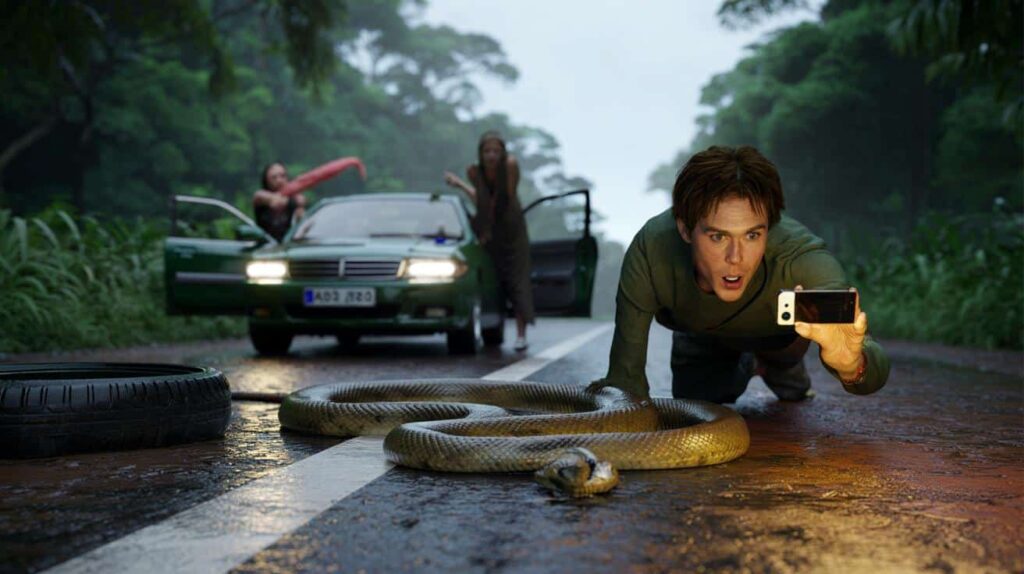
Why giant snake stories keep getting bigger
Ask people about the biggest snake they’ve ever seen, and their hands will go wide before their memory has even caught up. The gap between fingers is always longer than reality.
There’s something about a big snake that scrambles the human measuring system. Our brains are tuned to faces, doors, cars. Not to a living rope that coils and bends and disappears into leaves.
So the story grows. A five-metre python becomes “easily seven, maybe eight”. A hefty boa remembered at the pub ends the night as a legendary monster. And once the tale has been told like that, few are brave enough to shrink it again.
In Brazil, a viral clip of an anaconda dragged behind a digger was shared millions of times. Headlines screamed about a “10-metre giant”, “largest snake ever found”, “prehistoric monster”.
Herpetologists paused the footage, counted the bucket teeth of the excavator, checked standard dimensions. Their estimate: around 6 metres. Still huge. Not a record.
Yet days later, the number in comment sections had climbed to 12, even 15 metres. Every share added an invisible extra metre. Nobody was lying in the classic sense. The scale simply drifted upwards, like a fishing story that keeps adding invisible kilos.

Humans are surprisingly bad at judging size without a reliable anchor. A straight, still object is already difficult. A snake is the opposite: moving, coiling, half-hidden, often seen in panic.
Our brains lean on whatever they can grab: a tyre, a boot, a patch of grass. If those reference points are off, the whole calculation slips. Add fear, adrenaline and a shaky camera, and the “world’s longest snake” is born in seconds.
*We’re built to react first and measure later.* That’s great for survival when something might bite. It’s less great for accuracy when stories hit your feed.
How to see a snake’s real size (without a tape measure)
There’s a simple habit that quietly kills most giant-snake myths: always look for a hard reference. Not a bush, not a vague “road width”, but an object with a known size.
Road lane? Roughly 3 to 3.7 metres in many countries. Standard car? Around 4 to 4.5 metres long. Person standing? Usually between 1.6 and 1.9 metres, unless they’re clearly a child.
If you pause a video and literally put your finger along the snake on the screen, then “copy” that segment against the car or road, you get a basic count. Four “snake segments” along a 4-metre car? You’re around 4 metres of snake, not 9.
When people meet big snakes in real life, panic often shrinks and stretches reality at the same time. One UK keeper told me visitors regularly swear the zoo’s 4-metre python is “over ten feet easy… no, wait, must be fifteen”.
They step closer, stand next to the glass, and the illusion collapses. The snake that filled their whole field of view suddenly fits along a single wall panel.
On a flooded road in Southeast Asia, villagers once filmed a thick python across the tarmac and called it “nearly as long as the road itself”. Later, surveyors checked: that section of road was 6 metres wide. The python? Around 4.5. Still a beast. Not a record-breaker. The drama was real. The number, less so.
What’s happening is a clash between geometry and emotion. Our visual system judges size using context: how much of your view the snake occupies, how it sits among nearby shapes. Without stable references, your brain cheats.
A coiled snake looks shorter than it is. A stretched snake looks longer. One half-hidden in grass can feel endless because your imagination quietly extends the part you can’t see.
So when someone screams “It’s 30 feet long!”, they’re reporting a feeling, not a measurement. **The story captures their fear more accurately than it captures the length.** Once that story hits social media, the feeling spreads faster than any correction.
Spotting the tricks – and enjoying the story anyway
There’s a practical, almost playful way to read giant snake stories online: treat them like puzzles. Before you react, ask three questions.
Where’s the reference point? How far is the camera from the snake? And is the snake straight or curled?
If you can answer those in five seconds, you’re already ahead of most comment sections. You’ll start to notice that any “20-metre snake” mysteriously shrinks when you compare it to a doorframe, a bridge girder or a tyre.
Most of us scroll while half-distracted, thumb twitching, attention blurred. So we rely on drama as a shortcut: “largest ever”, “record-breaking”, “terrifying monster”.
That’s why giant snake myths thrive. They’re not just about reptiles. They’re about us wanting a quick jolt of awe before the next notification.
Soyons honnêtes : personne ne fait vraiment ça tous les jours, s’arrêter sur une vidéo pour mesurer calmement la largeur d’une voie rapide ou la hauteur d’une garde-corps. Yet that tiny pause is all it takes to separate the “whoa” from the wildly wrong.

As one field biologist in the Amazon told me,
“I’ve handled pythons big enough to swallow a dog, and none of them were as long as Facebook says.”
Her rule is simple: enjoy the spectacle, doubt the number.
For readers, a short mental checklist helps keep your curiosity intact without killing the magic:
- Compare the snake to at least one known object (car, boot, person, lane width).
- Notice if the camera is zoomed in or very close to the ground.
- Ask if any part of the snake is hidden or coiled out of sight.
- Be wary when numbers end in “0” or “5” with no source.
- Look for a named expert or institution backing the measurement.
Why this matters far beyond snakes
Once you see how snake stories inflate, you start seeing the same pattern everywhere. Giant waves, “unprecedented” queues, “miles” of traffic that turn out to be a few hundred metres.
Our brains are constantly filling in gaps, stretching and compressing scale depending on how we feel, what we fear, what we want to share.
That doesn’t make us foolish. It makes us human. The trick is to know when your inner storyteller has grabbed the wheel and gently nudge it back.
On a crowded beach, someone points at a dark shape offshore and swears it’s “a shark bigger than the boat”. A kid starts crying. Two swimmers rush back to the sand.
Ten minutes later, the shape drifts closer: a floating log, about two metres long, riding the swell at just the right angle to look huge. Nobody lied. Their eyes simply borrowed drama from the sea.
We live in a world where those first scared shouts now carry globally in seconds. A phone, a caption, a share button – and a log, a snake or a shadow can become a legend before anyone measures a thing.
There’s a quiet satisfaction in being the one person in the group who looks twice. Not the killjoy, but the friend who can say, *“It’s still amazing – just not twenty metres.”*
You don’t have to correct the internet. You don’t have to argue in the comments.
You can simply hold both truths at once: that a 4-metre python is astonishing, and that numbers inflated by fear or headlines don’t make the world more magical. **They just make it harder to see how magical it already is.**
| Point clé | Détail | Intérêt pour le lecteur |
|---|---|---|
| Les références visuelles trompent | Sans objets de taille connue, notre cerveau surestime la longueur des serpents | Comprendre pourquoi les vidéos “record” semblent crédibles au premier regard |
| Le contexte émotionnel amplifie | Peur, surprise et zoom du smartphone gonflent instinctivement les chiffres | Repérer quand votre propre ressenti fausse votre jugement |
| Une simple méthode de comparaison | Utiliser voitures, routes, personnes et segments visuels pour estimer la taille réelle | Garder votre curiosité intacte sans tomber dans le piège des mensonges viraux |
FAQ :
- Are giant snakes of 15–20 metres even possible in nature?Biologists have no verified records of snakes anywhere near that length in modern times. The biggest reliably measured specimens, like large reticulated pythons or green anacondas, sit around 6–8 metres.
- Why do so many “record” snakes turn out to be smaller?Most viral claims rely on eyeballing from shaky footage, with no proper measurement. When scientists revisit the scene or compare with known objects, the numbers usually drop sharply.
- How do professionals measure massive snakes safely?They straighten the animal gently along a tape or marked rope, often with several people supporting its body. Some also use photos with scale bars or known objects and calculate length later.
- Are the famous prehistoric snakes like Titanoboa real?Yes, but they’re extinct. Fossils suggest Titanoboa reached around 13 metres, living some 60 million years ago. Modern snakes don’t reach those sizes.
- What’s the best quick trick to judge a snake in a video?Pause the clip and “measure” the snake in screen-length segments against a car, lane, or person you can see. Count those segments and you’ll often get surprisingly close to the real length.