Around 4:30 p.m., the first fat snowflakes started falling on the supermarket parking lot, drifting sideways in the wind like lazy confetti. A delivery driver yanked his hood up with one hand, phone in the other, scrolling through a weather alert that had just buzzed through: “Heavy snow expected tonight. Travel strongly discouraged.” Inside the automatic doors, the manager was taping up a bright orange sign that read: “We plan to stay open normal hours.”
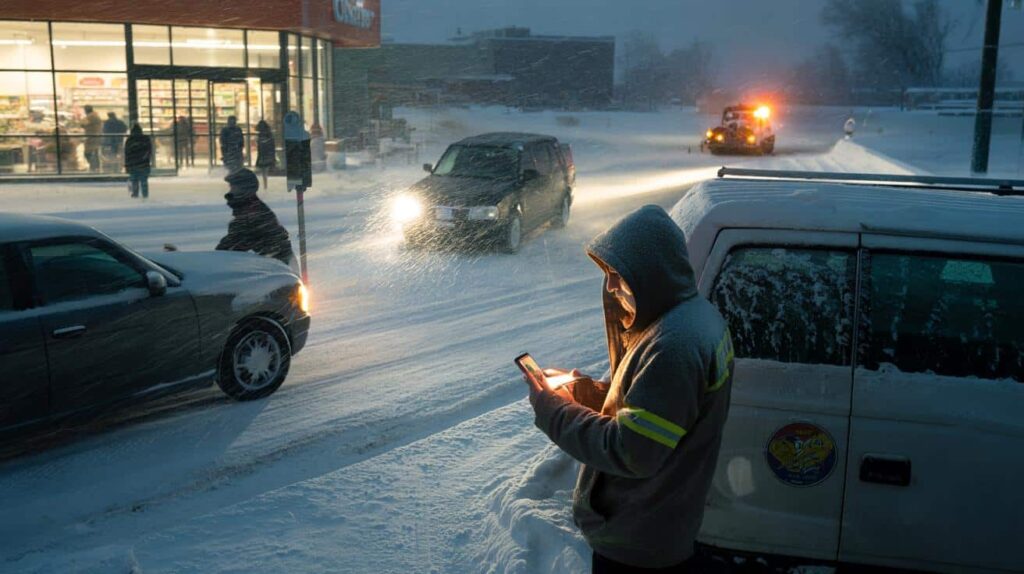
That strange split-screen feeling settled over town. On one side, flashing alerts, urgent press conferences, troopers talking about black ice and stranded cars. On the other, emails from head offices and store chains promising “business as usual,” as if the storm were just a slightly inconvenient meeting. People stood in checkout lines with milk, bread, and frozen pizza, half-listening to the overhead radio, half-wondering if they’d be able to get to work in the morning.
The snow was still gentle then, almost pretty. But the forecast was not.
Authorities hit the brakes as businesses hit the gas
By early evening, the tone from officials had sharpened. Meteorologists were talking about “snowfall rates up to two inches per hour” and “rapid deterioration of driving conditions.” The state police posted a blunt message on social media: “If you don’t absolutely need to be on the road tonight, stay home.” Plows were already staged at highway on-ramps, orange lights pulsing in the gray light like a warning heartbeat.
At almost the exact same time, inboxes lit up with the opposite message. One regional retailer sent a company-wide email saying stores were “committed to maintaining regular operating hours to serve our customers’ needs.” A logistics company pushed out a reminder that “attendance expectations remain unchanged.” For a lot of people, that meant one thing: whatever the weather apps were showing, the alarm was still set for 6 a.m., and the car had better start on the first try.
You could feel the tug-of-war in the small details. A nurse checking the hospital group chat, wondering if sleeping on a cot on the ward was safer than driving back at dawn. A fast-food worker DM’ing their manager a screenshot of the state’s “avoid travel” alert, and getting a thumbs-up emoji in return. The storm itself is simple: snow will fall, roads will ice, visibility will drop. The human layer on top of that is where it gets messy, and where the real risk often hides.
The hidden cost of “business as usual” in a blizzard
We’ve all been there, that moment when the road outside your window looks like a white river and you’re still trying to decide if calling in is worth the awkward conversation. One 28-year-old warehouse worker I spoke to, Mark, described sliding sideways through an intersection last winter because he felt he “couldn’t afford” another absence. “I saw the trooper tweet telling people to stay home,” he said. “Then I saw the text from my supervisor reminding us that late arrivals would be ‘noted.’ I went anyway.”
He wasn’t alone. During a similar snow event two years ago, state officials reported more than 300 weather-related crashes in a single night, many of them involving people commuting to or from late shifts at distribution centers, hospitals, and 24-hour chains. The numbers tend to spike right in that window when snow goes from scenic to dangerous but workplaces are still clinging to routine. It’s a quiet pattern, buried between the bolder headlines about “record totals” and “historic storms.”
This isn’t just about bad bosses or careless drivers. It’s about a system where staying off the road can mean losing a day’s pay, or even risking your job, while getting on the road can mean spinning into a guardrail at 35 mph. Let’s be honest: nobody really reads the employee handbook section about “inclement weather policies” until the flakes are already falling. The result is a kind of societal mixed message, where one authority tells you to stay put and another authority signs your paycheck.
How to navigate conflicting messages without losing your mind—or your safety
There’s no perfect script for these nights, but there are a few small moves that tilt the odds in your favor. Start by getting your information from more than one place. Check the National Weather Service, not just the app that came pre-installed on your phone. Look at radar, not only the temperature. If officials are talking about “whiteout conditions” or “travel only for emergencies,” that’s your cue to start negotiating alternatives with your manager before the worst of the storm hits.

Talk early, not at 5:55 a.m. when you’re already panicking in the dark. Be specific instead of vague: “Here’s the advisory from the state. My commute is 25 miles on an unlit highway. Can we switch my shift, work remote, or arrive late without penalty?” A lot of people assume the answer is always “no,” and sometimes it is, but sometimes it isn’t. *That tiny window for a more humane plan tends to open before the plows get overwhelmed and the phone lines clog with people calling out at the last second.*
On the practical side, this is also when you quietly stack the deck for the nights when you truly have no choice but to go. Keep a basic winter kit in your car:
- Blanket, hat, and gloves in case you get stuck and the engine can’t stay on
- Small shovel and a bag of sand or cat litter for traction
- Portable phone charger and a flashlight with spare batteries
- Non-perishable snacks and a bottle or two of water
- Printed emergency contacts in case your phone dies or loses signal
One traffic sergeant I spoke to summed it up bluntly:
“Every storm, we pull someone out of a ditch who says, ‘My boss said we were still open.’ Your boss isn’t the one sitting upside down in a snowbank. You are.”
For businesses, the plain truth sentence cuts the other way: **no customer is impressed by a store that stayed open while its staff crashed on the way in.** The companies that quietly win loyalty on nights like this are the ones that send staff home a little early, pay them anyway, and post a simple notice saying safety came first.
A storm is never just a weather story
As the evening wears on, the world outside the window slowly changes shape. Streetlights turn into halos. Cars crawl instead of glide. Somewhere across town, a manager is debating whether to hit “send” on an email closing the office for the morning, while a paramedic refuels an ambulance that has already been out three times in the last hour. These are the small, invisible decisions that decide how bad a storm really feels, long after the snow totals melt away from our feeds.
There’s a quiet question running under all of this: who gets to be safe, and at what cost. The knowledge worker with a laptop can shift to the couch without losing a cent. The grocery cashier, the delivery driver, the cleaner on the night shift, they’re often the ones staring at the conflicting alerts and wondering whose warning they can afford to believe. **A blizzard doesn’t care about job titles, but paychecks often do.**
Next time the forecast turns bold red and the notifications start buzzing, it might help to remember that storms are shared, even when decisions feel lonely. Ask your friends how their workplaces are handling it. Ask your own managers what “safety first” really means when the roads glaze over. And if you’ve got a story of the night you stayed home, or the night you went anyway, and what happened next, that’s the kind of story other people quietly search for when the snow starts to fall.
| Key point | Detail | Value for the reader |
|---|---|---|
| Heed official travel advisories | Use National Weather Service alerts and state police updates as your baseline | Reduces the risk of getting caught on the road during peak whiteout conditions |
| Negotiate early with employers | Contact managers before conditions worsen to discuss remote work, shift swaps, or delayed starts | Increases chances of a safer arrangement without last-minute stress |
| Prepare a simple winter car kit | Blanket, shovel, traction aid, snacks, water, and phone power backup | Improves survival and comfort if you become stranded during the storm |
FAQ:
- Question 1What does “avoid non-essential travel” really mean during a snow alert?
- Question 2Can my employer legally require me to come in during a severe snowstorm?
- Question 3What’s the safest way to drive if I absolutely have to go out?
- Question 4How far in advance do meteorologists usually see these heavy snow events coming?
- Question 5What should I do if I get stranded in my car during the storm?