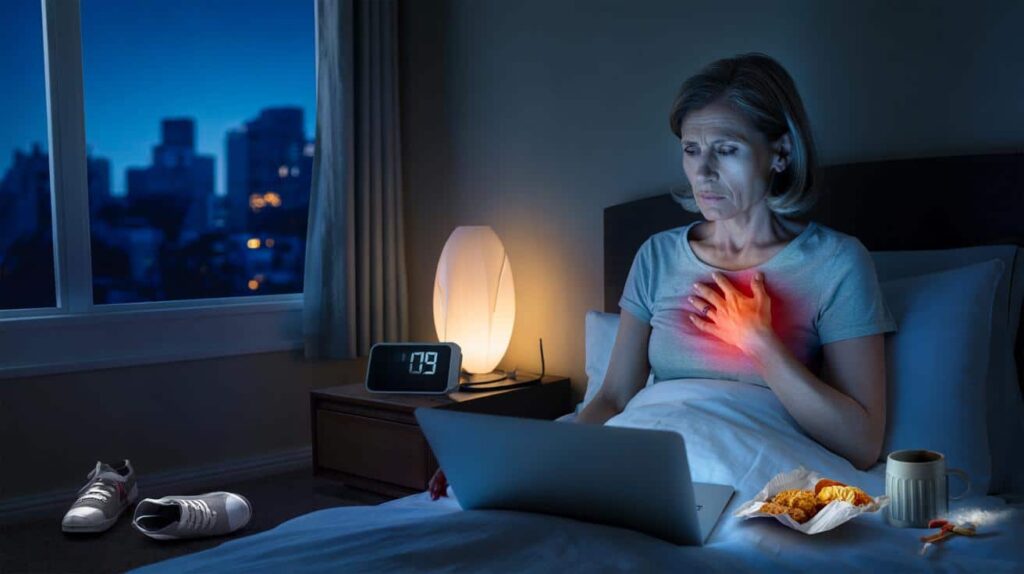
New research from the UK suggests that people who naturally stay up very late are not just tired the next day; they may also carry a significantly higher risk of heart attack and stroke, largely because of the lifestyles that tend to come with a night-owl rhythm.
What the new British study actually found
The findings come from a large study conducted by researchers at the University of Birmingham and published in the Journal of the American Heart Association. They looked at data from more than 300,000 adults, with an average age of 57, and followed them for around 14 years.
Participants were grouped according to their “chronotype” – whether they considered themselves morning types, evening types, or somewhere in between. Around 8% described themselves clearly as “evening people”, with typical bedtimes around 2 a.m.

Compared with people whose sleep habits were more intermediate, clear night owls showed a 16% higher risk of heart attack or stroke over the follow-up period.
That was not the only worrying signal. When researchers looked at an overall score of cardiovascular health – which included factors such as blood pressure, cholesterol, blood sugar, weight, exercise, sleep and smoking – night owls were 79% more likely to fall into the “poor” category.
Is the late bedtime itself dangerous?
The timing of sleep did play a role, but it was far from the whole story. Researchers estimate that about three-quarters of the extra risk in late sleepers can be traced back to lifestyle patterns that cluster in this group.
Compared with early or intermediate sleepers, night owls were more likely to:
- Smoke regularly or have smoked for many years
- Move less during the day and miss recommended activity levels
- Eat a less balanced diet, with fewer whole foods
- Sleep irregular hours or cut sleep short on workdays
- Carry excess weight or have signs of metabolic trouble
The study used a global cardiovascular health score that combined eight factors: smoking, sleep, physical activity, diet, body weight, blood sugar, cholesterol and blood pressure. On average, people who went to bed around 2 a.m. scored worse across several of these markers.
The late clock itself appears to nudge people toward behaviours and schedules that make it harder to protect the heart.
Early birds, women and the risk gap
Not everyone in the study faced the same level of risk. People who reported going to bed earlier, around 9 p.m., tended to have slightly lower cardiovascular risk than those in the middle group.
The gap was especially striking in women. Female night owls showed a more pronounced increase in cardiovascular risk than male night owls. Researchers do not yet fully understand why, but suspect a mix of hormone differences, stress patterns and the double burden of work and family schedules that can hit women harder when sleep is disrupted.
Why lifestyle hits night owls harder
Being a natural evening type is not a moral failing or a simple “bad habit.” Chronotype has a biological basis, influenced by genes and internal body clocks. The problem arises when that inner clock clashes with social reality.
Most workplaces and schools still run on an early schedule. For a night owl, that can mean going to sleep late, waking up early, and constantly running on partial sleep debt. In that situation, people often rely on nicotine, caffeine, quick snacks and fast food to push through the day, and feel too drained for regular exercise.
Chronic mismatch between your body clock and your alarm clock – sometimes called “social jet lag” – gradually strains blood vessels, metabolism and the heart.
What the numbers mean for your own risk
A 16% increase in risk does not mean that every night owl will have a heart attack or stroke. It means that, across a large population, late sleepers experienced more of these events than people with intermediate sleep patterns, when followed over many years.
To give a rough idea, imagine two similar groups of 10,000 middle‑aged adults:
 The ancients knew: this simple pine cone feeds your plants better than fertiliser in winter
| Group | Chronotype | Relative risk of heart attack or stroke |
|---|---|---|
| A | Intermediate sleepers | Baseline (100%) |
| B | Clear night owls | 116% of baseline |
In very simple terms, if 100 people in group A had a cardiovascular event, about 116 people in group B would be expected to have one over a similar period, all else being equal.
How night owls can cut their cardiovascular risk
The study carries a hopeful message. A large chunk of the extra risk linked to a late chronotype seems to come from behaviours that can be changed, even if your natural rhythm stays the same.
Stabilise your sleep, even if it’s later
If you cannot fall asleep at 10 p.m., forcing yourself into bed early is unlikely to work. A more realistic approach is to:
- Keep a regular bedtime and wake time, even on weekends
- Aim for at least seven hours in bed most nights
- Reduce bright screens and stimulating content 60–90 minutes before sleep
- Shift your bedtime slowly, by 15–20 minutes every few days, if you want to move earlier
Consistency helps your internal clock settle, reduces social jet lag and improves sleep quality, even if your lights go out closer to midnight than 10 p.m.
Target the biggest lifestyle levers
Researchers highlighted smoking, inactivity and diet as key drivers of risk in evening types. Small, specific changes can start to tilt the balance back towards protection for your heart and blood vessels.
- Smoking: Quitting, at any age, quickly reduces cardiovascular risk. Nicotine replacement, prescription medications and structured programmes all raise the odds of success.
- Movement: Short bursts of activity – brisk 10‑minute walks, cycling to work, climbing stairs – count towards the recommended 150 minutes a week of moderate exercise.
- Food: Having a simple, balanced “default” evening meal (vegetables, a source of protein, whole grains) limits last‑minute fast‑food decisions made when tired.
A night‑owl body clock does not lock anyone into poor health; changing a handful of daily habits can dramatically reshape future risk.
Why sleep regularity matters as much as sleep length
The study did not just look at what time people went to bed. It also considered how regular their patterns were. Irregular sleepers – those who shifted their bedtimes and wake times by several hours between workdays and weekends – tended to do worse on cardiovascular scores.
Our organs, from the heart to the pancreas, follow daily cycles. Large swings in sleep timing throw off those rhythms. Blood pressure, for instance, normally dips at night and rises in the morning. When sleep shifts constantly, those patterns become messy, and that can damage artery walls over time.
Even for night owls, keeping weekday and weekend schedules relatively aligned reduces that strain. A small difference – say, one extra hour in bed on days off – is far less disruptive than a three‑or‑four‑hour swing.
Key terms that help make sense of your sleep and heart
Health news often uses technical language. A few terms in this research are worth unpacking:
- Chronotype: Your natural tendency to feel more alert in the morning or in the evening. It sits on a spectrum from “lark” to “owl”.
- Cardiovascular event: A major problem involving the heart or blood vessels, such as a heart attack (myocardial infarction) or a stroke.
- Cardiovascular health score: A combined measure based on factors like smoking, sleep, diet, exercise, blood pressure, blood sugar, cholesterol and weight.
- Social jet lag: The gap between the sleep schedule you keep on workdays and the one you fall into on free days.
A realistic scenario for late sleepers
Picture a 45‑year‑old who naturally gets sleepy around 1 a.m., but has to wake at 6 a.m. for work. They rely on strong coffee in the morning, snack on sugary foods, skip exercise because they feel wiped out after work, and unwind with screens until the small hours. Over years, their blood pressure creeps up, weight increases slightly, and blood tests start to show raised cholesterol.
If that same person keeps their late chronotype but makes a few adjustments – setting a hard cut‑off for screens at midnight, aiming for 30 minutes of walking most days, planning simple healthier dinners, and getting support to stop smoking – their measured cardiovascular risk can drop significantly, even if their bedtime remains later than average.
The British data do not suggest that every night owl must become a 9 p.m. sleeper. They point instead to a more nuanced message: your internal clock might be late, but your choices around sleep regularity, movement, food and tobacco still shape how your heart and blood vessels age over the next decade.