At first nobody noticed. The heat shimmered over the parking lot, kids shouted on the playground, office windows glowed in that flat noon light. Then a woman on the café terrace looked up from her phone and squinted at the sky, as if something in the air had shifted. The shadows on the ground grew sharper, like someone had turned up the contrast. Birds fell strangely quiet. Cars kept rolling past, but a hesitation crept in, small and contagious. A barista turned down the music without really knowing why. People stepped outside “just for a second” and didn’t go back in. The blue of the sky deepened to something almost metallic, almost wrong. And then, as the moon slid into perfect alignment with the sun, the bright day folded in on itself.
For 6 long minutes, noon became midnight.
Something in us does not forget that.
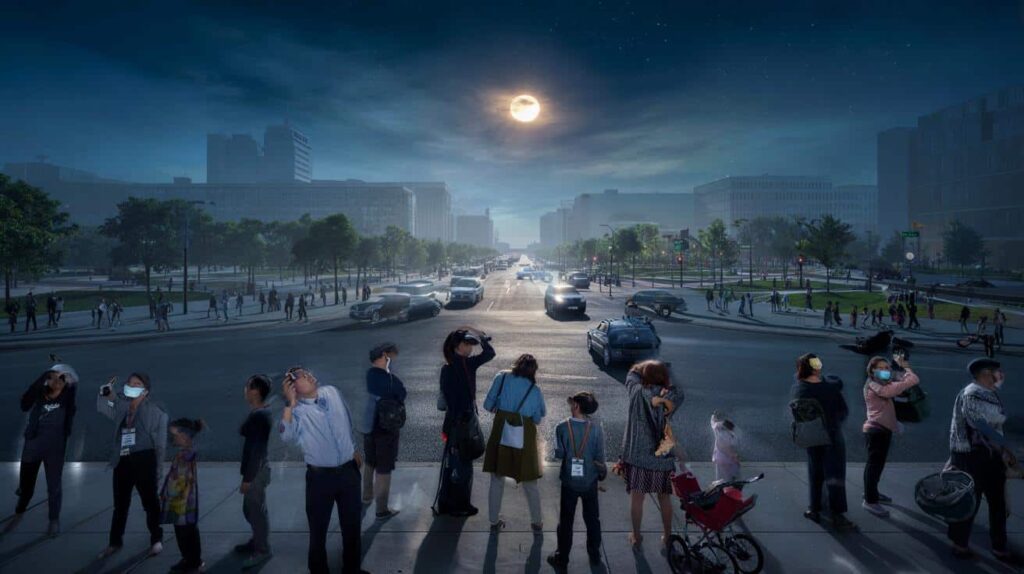
The day the sun blinks — and the world holds its breath
The longest solar eclipse of the century won’t feel like a gentle dimming, it will feel like a planetary shudder. You’ll know it’s starting long before totality arrives. The light goes weird first, turning sidestreets into movie sets and familiar buildings into cut-out silhouettes. People will stop mid-sentence, spoon frozen over their soup, dog leash slack in one hand as they tilt their heads to the sky. Phones will be out everywhere, yet for once, screens won’t be the main attraction. This is daylight itself being slowly dialed down, like some cosmic hand playing with the switch. And under that slow twilight, you’ll feel a strange mix of awe and unease.
Ask anyone who’s stood in the path of totality and they’ll tell you: no photo prepares you for it. During the 2017 eclipse across the United States, traffic on some highways almost stopped as drivers pulled over, leaving cars half-crooked on the shoulder just to step out and stare. Factory workers poured into parking lots, classrooms emptied onto sports fields, and in more than one small town, the main street turned into a spontaneous block party under the shrinking sun. One man in Oregon described the moment totality hit as “like the universe took a deep inhale and forgot to exhale for two minutes.” Now imagine that pause stretching to around 6 astonishing minutes.

What actually happens in those minutes is simple physics but feels like something older and wilder. The moon slides perfectly between Earth and sun, its shadow sweeping across our planet at thousands of kilometers per hour. When that shadow is widest and the alignment just right, totality lasts longer, and this upcoming eclipse pushes that to a rare extreme. The sky darkens as if evening has jumped forward by hours. Streetlights may flicker on, temperatures can drop a few degrees, and animals often react before we do – cows heading to barns, insects chirping like it’s night. Our brains know the science. Our bodies react like it’s an omen. That tension, between knowledge and instinct, is what makes this kind of darkness feel so electric.
How to actually live those 6 minutes, not just film them
If you’re anywhere near the path of totality, planning your eclipse day is less about astrophysics and more about logistics and mood. First thing: location. You want an open sky, low horizon, and as few obstacles as possible — think fields, rooftops, clear beaches, wide plazas. Cities along the path are already mapping official viewing zones, which means crowds, yes, but also a shared “we’re in this together” buzz. Get there early. Roads can clog up hours before first contact, and parking turns into quiet chaos. Bring proper eclipse glasses, not that scratched pair from years ago, and a backup set for the inevitable friend who forgot theirs. Then, once you’re set, allow yourself to do something rare: clear your schedule for a sky event.

There’s a trap a lot of us fall into during spectacular moments: we watch them through our phones. A 6-minute totality is long by astronomical standards but shockingly short by Instagram standards. You’ll be tempted to fiddle with camera settings, swap lenses, try for the perfect corona shot. Let’s be honest: nobody really does this every single day. Most serious eclipse photos you see online come from people with gear, practice, and a plan. If you’re not one of them, give yourself permission to be a spectator, not a content machine. Set your phone for a wide video, prop it somewhere stable, and walk away. Future you will be grateful that present you actually looked up with your own eyes.
During the 2009 total eclipse — the last one that came close to this kind of duration — an astronomer in China told local reporters something surprisingly tender: “For six minutes, we remember we live under the same sun and the same shadow.” That’s the quiet gift of these events. They flatten status, routine, and hurry into one simple, shared act: looking up.
- Arrive early, much earlier than feels reasonable, so the build-up becomes part of the experience.
- Test your eclipse glasses calmly before the big day, not in a rush as the sky starts to dim.
- Plan a tiny ritual: a song to play, a sentence to say, a person to call right after totality.
- Have warm layers and water — the temperature drop and long waiting time can surprise you.
- Decide in advance: will you prioritize feeling the moment, or documenting it? Then stick to that choice.
A brief night at noon — and what we do with it
When the sun’s disk is fully swallowed and the halo of the corona glows like a ghostly crown, a strange calm falls over crowds. People gasp, shout, then go oddly quiet. You might feel a prickling on the back of your neck, that ancient sense that something bigger than your daily worries just walked into the room. *This is one of those rare times when reality feels more like science fiction than the movies do.* For a handful of minutes, the world doesn’t quite look like the place you woke up in that morning. Then, just as your eyes adapt to the darkness, that first bead of returning sunlight bursts out, and the spell breaks. Daylight rushes back, conversations tumble over each other, traffic resumes, notifications buzz.
| Key point | Detail | Value for the reader |
|---|---|---|
| Path of totality matters | Total darkness only happens in a narrow band; outside it, you’ll see a partial eclipse | Helps you decide whether to travel or stay put for the best experience |
| Safety isn’t optional | Direct sun viewing demands certified eclipse glasses until full totality | Protects your eyesight while still letting you enjoy the show |
| Preparation shapes emotion | Choosing your spot, your company, and your “no-phone” rule changes how it feels | Turns 6 minutes of darkness into a memory you’ll actually carry with you |
FAQ:
- Will the eclipse really turn day into night for everyone?Only people in the path of totality will experience full “night-like” darkness; nearby regions will see a noticeable dimming but not a complete transformation.
- Is it safe to look at the sun during the eclipse?It’s only safe to look with the naked eye during the brief phase of totality, when the sun is completely covered. At all other times, you need certified eclipse glasses or an approved viewing method.
- How long will the full darkness last where I am?The maximum totality for this eclipse will be around 6 minutes, but your exact duration depends on how close you are to the center of the path; closer means longer.
- Do animals really act strangely during eclipses?Yes, many do. Birds may roost, chickens may head to their coop, and nocturnal insects can start calling as if evening has fallen suddenly.
- What if the weather is cloudy that day?Thick clouds can block the view of the sun, but you’ll still feel the sudden dimming, temperature drop, and eerie atmosphere as the shadow passes overhead.