At 11:47 p.m., the snow started as a half-hearted flurry against the streetlights, like someone shaking out a dusty pillow above the city. Ten minutes later, the flakes had thickened into slow, heavy tufts, drifting sideways on a wind that suddenly felt more serious than the forecast app made it sound all day. On WhatsApp, the first photos landed in group chats: buried cars, ghostly bus stops, a taxi already skewed across a junction.
On TV, a scrolling red banner screamed “SEVERE WEATHER WARNING” while, under it, a suited official calmly repeated: commuters are expected to travel as normal in the morning.
It’s a strange feeling, watching the world turn white while being told you still have to show up.

Heavy snow confirmed: chaos incoming, but business as usual?
By late tonight, weather services have stopped hedging their bets. The heavy snow is no longer a “risk” or a “developing situation” – it’s locked in, mapped out in angry blue and purple bands sweeping across the country. Forecasters are talking about widespread accumulations, drifting on exposed routes and “significant disruption” on roads and rail from the early commute onward.
At the same time, transport bosses and government spokespeople are on every channel with the same line: the network will be running, people should still travel to work, and disruption will be “managed”. Those two messages do not feel like they live in the same reality.
Scroll through social media tonight and you can already see the gap between official optimism and what’s happening on the ground. A teacher posts a video of an almost vanished motorway, white from barrier to barrier, headlights reduced to blurry fireflies crawling through the dark. A nurse shares a photo of the bus she’s stuck on, tilted at a strange angle on an icy hill, hazard lights blinking like a warning heart monitor.
One delivery driver shows his van completely snowed in, with the joking caption: “But yeah, I’ll ‘travel as normal’ at 6 a.m.” Underneath, hundreds of comments pour in from people who still remember the last big storm, the one that left them sleeping in cars at service stations or walking home for miles in wet socks and office shoes.
This tension isn’t new. Every time the weather turns dangerous, the same script plays out: meteorologists sound the alarm, emergency services brace, and workplaces insist the show must go on. Part of it is culture – that quiet pride in “pushing through”, even when the risks are obvious and the roads look like a frozen river. Part of it is economics: lost days mean lost money, and nobody wants to be the first to say “Stay home” and trigger a domino of closures.
There’s also a blunt truth here: many people simply don’t have the option of staying put. Cleaners, carers, supermarket staff, rail workers – the ones who keep society ticking in a storm – are also the least likely to be able to work from a laptop in the kitchen. They know what’s coming, and they’re going anyway.
Getting to work in a red-warning morning: what people are really doing
If you’re one of the millions expected to travel tomorrow, the rescue plan starts tonight, long before the alarm clock. People are quietly shifting into “storm mode”: setting phones to charge, laying out the thick socks, digging gloves from the back of drawers. The smart ones are checking local community groups, not just national forecasts, because your actual route to work is often decided by one bad hill, one ungritted side road, one frozen train door.
Some are pre-packing a “snow commute kit” by the front door – torch, water, snacks, portable charger, power bank, a blanket tossed into the car almost as an afterthought. It sounds dramatic until you’ve watched time slow to a crawl on a blocked motorway with the fuel gauge sinking.
People who came unstuck in the last big freeze talk differently now. One office worker remembers leaving home in just a thin coat “because the app said light snow”, and spending three hours stranded on a motionless train with no heating. Another describes ditching heels in a bin after sliding twice on the same patch of pavement, hobbling home in tights on slushy concrete.
A rail guard tells friends she now wears base layers under her uniform and keeps a spare pair of socks in her bag, “because once your feet are wet, your brain stops working properly”. A simple change, but you hear that sentence and you know she earned it the hard way.
The logic behind all this small, almost boring preparation is simple: when the margin for error shrinks, the little things become big. Icy roads turn a ten-minute drive into forty minutes of tight shoulders and slow breathing. A delay that would be annoying on a mild day can become dangerous when temperatures plunge and you’re standing on an exposed platform in a thin jacket. Let’s be honest: nobody really does this every single day.

Yet nights like this push people into a quieter kind of resilience. They start texting colleagues to coordinate lift-shares, setting earlier alarms, checking whether buses accept the fact that “running” might just mean “existing somewhere on the timetable”. *The gap between what’s officially advised and what actually works is where people improvise their own rules.*
Staying safe when you “have to” travel: small actions, real impact
If staying home isn’t on the table, then staying smart is your only real leverage. Start with timing: leaving an hour earlier can feel painful, but it usually buys you something priceless – breathing space. You’re less tempted to speed, less likely to take that risky shortcut down the untreated back road that always ices first.
Think in layers, not outfits. Base layer to hold warmth, middle layer for insulation, outer layer as a shield. If you’ll be standing at a bus stop or walking from a distant car park, that extra scarf or hat is suddenly less about style and more about staying sharp enough to make good decisions when the journey goes sideways.
One of the biggest mistakes people admit to after a snow chaos day is pretending it’s “just weather” and trying to commute like any other morning. They don’t eat before leaving, they forget water, they wear shoes with no grip because they look “office appropriate”. Then the delays stack up, the body cools down, and everything starts to feel twice as stressful as it needed to be.
There’s also the pressure piece. We’ve all been there, that moment when your boss hints that “everyone else seems to be getting in” and you feel your judgment wobble. This is where you quietly redraw your own line: you can be committed to your job and still refuse to drive on a sheet of ice in the dark. Those two things are not opposites, no matter how some emails are worded tonight.
“I’m telling my team the same thing I tell my own family,” says one regional emergency planner who’s been watching the models tighten all evening. “If the police are warning of dangerous conditions, I’m not going to argue with the sky. Work can be caught up. Lives can’t.”
- Check multiple sources before you leave: national forecasts, local councils, and live traffic/rail feeds.
- Pack a basic “storm kit”: water, snacks, charger, any medication, and something warm you can sit on or wrap around you.
- Dress for the journey, not the meeting: you can change shoes or lose a layer once you arrive.
- Tell someone your route and expected arrival time, especially if you’re driving in rural or unlit areas.
- Speak up early: if conditions on your street already look unsafe at 6 a.m., send that photo to your manager instead of silently panicking.
Between duty and danger: what tonight’s snow really exposes
The heavy snow rolling in tonight isn’t just about blocked junctions and cancelled trains. It quietly exposes the fault lines in how we work and how we value each other’s safety. On the one hand, you have alerts warning of “danger to life” and emergency services asking people not to travel unless necessary. On the other, you have people refreshing HR portals to see if their workplace will show the same caution – often, it doesn’t.
Some will call in and say they can’t get out. Some will risk it anyway. Some will sleep badly, caught between rent, reputation and a very literal risk of ending up in a ditch.
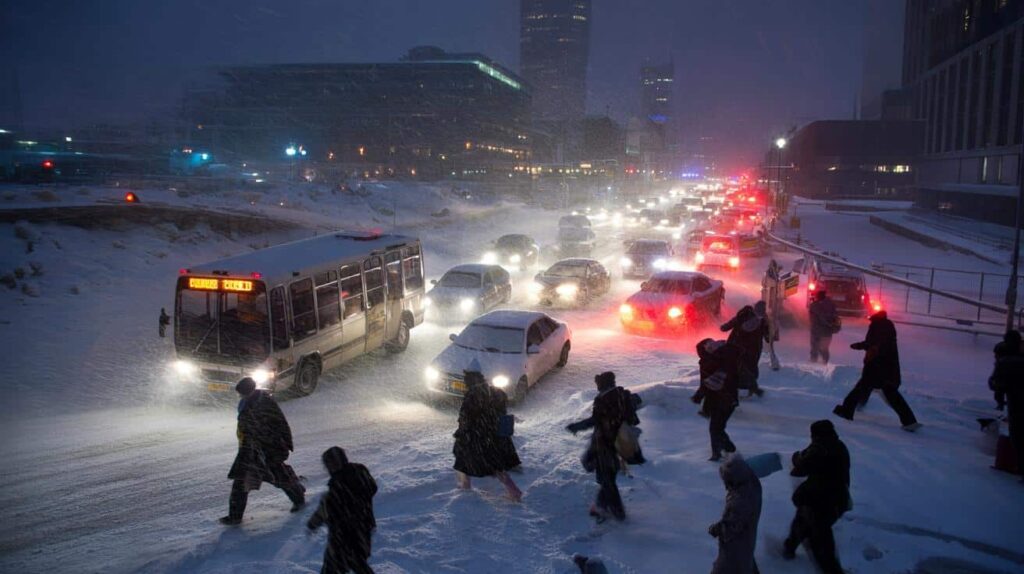
There’s a strange mix of defiance and resignation on nights like this. Neighbours pull together, clearing the shared path with shovels, checking in on older residents, swapping de-icer and stories from the last big freeze. Buses crawl by, lights glowing softly through the snowfall, driven by people who know they’re about to have one of the hardest shifts of the year.
Workplaces that act with empathy tonight – clear, early decisions, flexible arrangements, no guilt-tripping about “dedication” – will quietly earn a loyalty that no shiny team-building day could ever buy. The ones that don’t will be remembered too, just for different reasons.
Tomorrow morning, streets will crunch underfoot, and drivers will inch their way along roads that feel narrower and more unpredictable than they did yesterday. Some will stay home, some will slide their way in, and some will turn back halfway when they realise the risk has tipped too far. The snow doesn’t care about deadlines or calendars. **It simply falls, and forces a choice.**
Between duty and danger, between “business as usual” and “this doesn’t feel safe”, each person will draw their own line in the white. That quiet line, drawn in cold breath and cautious steps, might say more about who we are as a society than any official statement issued tonight.
| Key point | Detail | Value for the reader |
|---|---|---|
| Severe conditions are confirmed | Heavy snow, official alerts, and warnings of major disruption and dangerous travel | Helps you judge the real level of risk behind the headlines and plan your morning |
| Preparation starts the night before | Layered clothing, “storm kit”, route checks, and earlier departure time | Reduces stress and keeps you safer if journeys take far longer than expected |
| You can balance work duty and personal safety | Clear communication with employers, local evidence (photos, alerts), and honest boundaries | Gives you a realistic script for pushing back when conditions cross from difficult to dangerous |
FAQ:
- Question 1Should I still go to work if there’s a severe weather warning but my employer says the office is open?
- Question 2What’s the safest way to drive in heavy snow if I absolutely can’t stay home?
- Question 3How early should I leave in the morning when heavy snow is forecast overnight?
- Question 4What should I pack in a basic “snow commute kit” for car, bus, or train journeys?
- Question 5How do I tell my manager I don’t feel safe travelling without sounding unreliable?