Across a single generation, everyday expectations for children have been rewritten. Many seniors grew up with freedoms, chores and routines that would shock modern parents, yet shaped how they handle life today.
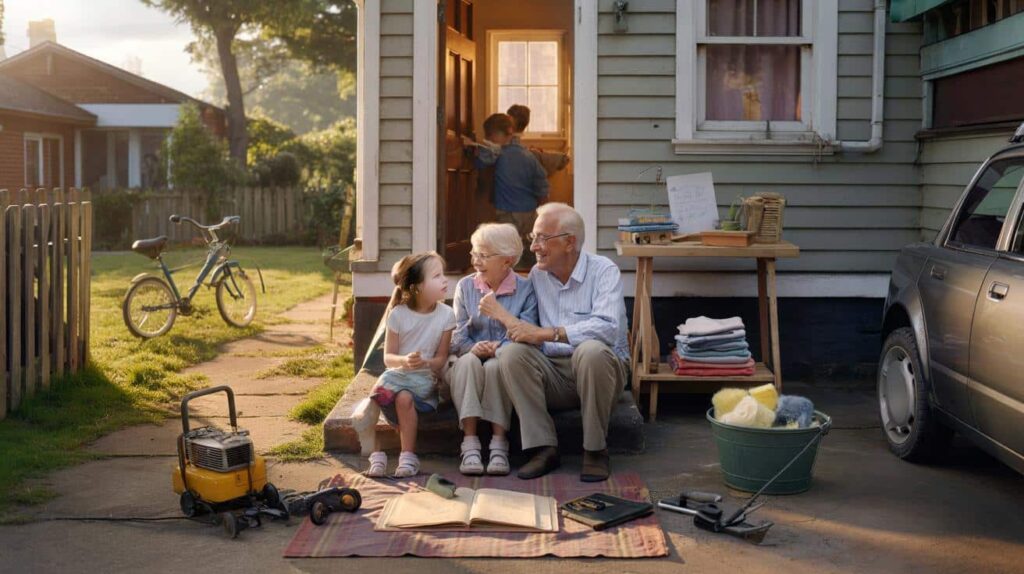
A generation raised with different rules
Ask almost any grandparent and they will tell you: the biggest change is not just smartphones, it is how little we now expect from children in real life.
From walking to school alone to fixing a broken toy, a set of basic skills once taken for granted has faded from family life. That shift brings benefits in safety and comfort, but it also raises a question: what are young people missing out on?

Behind many “old-fashioned” habits lay three quiet lessons: autonomy, patience and a sense of responsibility toward others.
Here are nine things today’s seniors commonly did as children, but rarely pass on as firm expectations to their grandchildren.
1. Walking or cycling to school alone
For many over-60s, that first solo walk or bike ride to school was a milestone. No tracking app. No parent tailing the pavement in a car.
Children navigated streets, judged when to cross the road and learned to read the geography of their neighbourhoods. Getting there on time was their job, not an adult’s logistics problem.
Now, the idea of an eight-year-old heading out alone can trigger anxiety about traffic, strangers or simply “what if”. Parents who were free-range children themselves often drive their own kids door to door.
Researchers increasingly argue that small doses of independence from about five or six help children build confidence and risk awareness, not recklessness.
What this taught seniors
- Time management: leaving early enough to avoid a late mark
- Spatial skills: memorising routes and landmarks
- Self-belief: knowing they could move around the community without constant supervision
2. Earning pocket money through chores
Pocket money used to be closely tied to effort. No chore, no coins.
Children mowed lawns, washed cars, emptied bins or cleaned windows to fund comics, sweets or a new cassette. Work and reward were visibly linked.
Today, many grandparents hand over notes or digital transfers as gifts or “just because”. Generosity is welcome, but the learning that once came with those small earnings easily disappears.
Studies suggest that children who regularly do age-appropriate chores from early childhood tend to show stronger self-control and a more realistic sense of what things cost.
3. Writing handwritten letters and thank-you notes
Before instant messaging, letters were not a special hobby; they were how families and friends kept in touch.
Schools drilled cursive writing, and a birthday gift almost automatically meant a short thank-you card. Even a few lines forced children to pause and think about the other person.
Now, a heart emoji or a quick voice note often replaces that pause.
Handwriting activates different parts of the brain than typing, and is linked to better memory and deeper processing of information.
Reviving occasional handwritten notes could give grandchildren a rare sense of slowness and care in how they communicate.
4. Doing their own laundry
For many seniors, the washing machine was not an off-limits adult domain.
Children sorted colours, measured powder, chose a cycle and lived with the consequences if a jumper shrank. Those mishaps doubled as lessons in planning and taking responsibility for their own belongings.
In households where parents quietly wash and fold everything, teenagers can reach university without knowing how to clean a shirt properly.
A simple laundry “curriculum” for grandkids
| Age | Possible task |
|---|---|
| 6–8 | Sort colours, load machine with help |
| 9–11 | Measure detergent, start machine, hang clothes |
| 12+ | Plan washes, read care labels, handle delicate items |
5. Queuing without complaint or distraction
Streaming, fast delivery and click-and-collect have made waiting feel old-fashioned. Yet many seniors spent much of their childhood in queues: for cinema tickets, bus rides, school supplies or bread from the bakery.
They stood, shuffled forward and waited. No smartphone, no tablet, often not even a book.
That bare-bones boredom trained something rare today: the ability to sit with a delay without constant entertainment.
In queues, children learned social cues too: not pushing in, keeping an eye on younger siblings, chatting with strangers or simply watching the street.
6. Trying to fix things before throwing them away
In countless kitchens and sheds, a broken toaster or radio was an invitation to have a go, not a bin bag moment.

Parents opened casings with a screwdriver, tightened a wire, patched a hole or darned a sock. Children watched, held tools, or were gently trusted to mend their own toys and clothes.
Money pressures played a role, but so did a mindset: objects had value beyond their purchase price.
Repair culture teaches creativity, environmental awareness and problem-solving in one go.
Today’s “replace, don’t repair” reflex costs not only money and resources, but also the tiny rush of pride a child feels when something broken works again under their hands.
7. Wearing hand-me-downs and second-hand clothes
For many seniors, whole wardrobes were inherited rather than bought. An older sister’s dress became a younger cousin’s. A neighbour’s outgrown coat arrived in a carrier bag, gratefully accepted.
Fashion mattered, but so did practicality. Children learned that an item could be loved by more than one person, and that not every outfit needed to be brand new to be “good enough”.
With fast fashion and social media, pressure to wear something new for every occasion can start shockingly early.
Reintroducing second-hand clothes as normal rather than as a sign of lack could quietly push back against that consumer pressure.
8. Quiet time for reading or simply thinking
Many older adults recall “quiet hour” as a fixed part of their week. After Sunday lunch, during a parent’s nap, or on long holiday afternoons, the television was off and noise was discouraged.
Children read, drew, did puzzles or just stared out of the window. Silence was not a punishment; it was an expected rhythm of the day.
In modern households filled with background screens and alerts, shared silence can feel almost awkward.
Regular quiet periods help children build attention span, creativity and a sense of inner calm that no app can deliver.
9. Checking in on neighbours and extended family
Before group chats and video calls, community meant physically showing up.
Children were sent to knock on Mrs Jones’s door to see if she needed anything from the shop, or to take a casserole to a relative who was unwell. Turning up without a prior message was normal, not intrusive.
Neighbours kept an eye on each other’s kids, and a child’s misbehaviour on the next street rarely stayed secret for long.
Through this, seniors learned that care was practical: carrying bags, making tea, sitting with someone who was lonely.
Grandchildren often hear adults talk about “community”, but seeing it in action teaches empathy far more effectively than any speech.
How grandparents can share these habits today
Few families want to rewind entirely to the 1950s, and safety concerns are real. Even so, seniors can pass on pieces of these experiences in small, realistic ways.
- Walk part of the school route with a child, then let them do that short stretch alone.
- Pay grandchildren for specific tasks at your house instead of random cash gifts.
- Write a birthday letter by hand and encourage a handwritten reply.
- Invite them to help fix something minor, even if it takes longer.
- Suggest a “quiet half-hour” when they visit, with books and drawing instead of screens.
Hidden benefits and a few risks to balance
These older expectations brought clear benefits: stronger problem-solving, less fear of everyday risks, and a sense that children were contributors, not just dependants.
There were downsides too. Some children were given heavy responsibilities too early or without support. Modern parenting often tries to correct that, which makes sense.
The challenge now is to find a middle path: keeping children safe without stripping away every chance to learn self-reliance.
Think of these “old” habits less as nostalgia and more as a menu of skills that can be reintroduced, one small piece at a time.
Even a single change — like asking a grandchild to plan their own small purchase through earned pocket money, or to check in on an elderly neighbour with you — can echo far into their adult life.