The persimmon looked perfect in the fruit bowl – smooth orange skin, like a tiny sun on the counter. But the moment the spoon cut in, the taste went from sweet promise to mouth-coating dryness, like chewing on a tea bag and chalk at the same time. A couple of hours later came the cramps, the bloating, that quiet regret: “Was it the persimmon?”
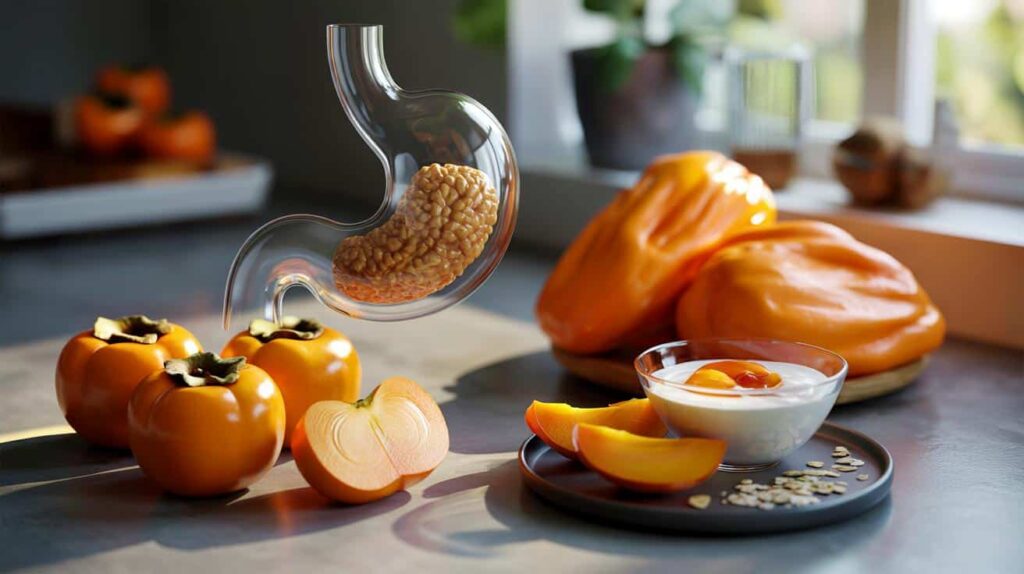
Scroll any health forum and you’ll find the same story: “Persimmons wrecked my stomach.” Yet you’ll also see photos of glowing smoothie bowls and people calling them their favourite winter fruit. Same fruit, radically different experiences.
Somewhere between those two stories, something happens on the tree – and in your gut.

When a beautiful fruit turns on your stomach
There’s a strange disconnect with persimmons. On the shelf they look harmless, almost luxurious, lined up like tiny lanterns in late autumn. People buy them with the enthusiasm we usually save for mango season. Then the messages start: “Why does my mouth feel like paper?” “Is this normal?” “Why am I so bloated?”
Most blame the fruit itself, as if persimmons were the problem. Yet gut specialists quietly point to a much less dramatic culprit: ripeness. A persimmon eaten too early is a completely different beast, chemically and physically, from the same fruit left to soften on the counter for a few days.
To your digestive system, that difference can feel like night and day.
One gastroenterologist I spoke to called persimmons “a perfect example of a misunderstood fruit”. In his clinic notes, the pattern is almost comically clear. A patient comes in with unexplained stomach pain, nausea, or an episode that felt like food poisoning. Scans show a strange, gluey mass in the stomach or intestines. At some point in the conversation, the same phrase appears: “I did eat a lot of persimmons last week.”
In Japan, Korea and parts of Spain, doctors even have a specific term for persimmon-related bezoars – dense clumps of undigested material that can form when you eat a lot of very unripe, astringent persimmons. The condition is rare, but the milder version of this story – gas, cramps, constipation or diarrhoea – is much more common than people realise.
When researchers looked at cases, a shared detail kept returning: the fruit was firm, bright, and eaten straight from the basket, sometimes several in one go.
So what exactly goes on inside that innocent-looking orange globe?
Persimmons, especially astringent varieties like Hachiya, are loaded with plant compounds called tannins when they’re unripe. Those tannins are what make your mouth feel dry and rough, almost furry. In your stomach, they can bind with proteins and form sticky, rubbery complexes. Mix that with fibre and other food, and your digestive tract suddenly has a lot more work to do.
As the fruit ripens, those tannins break down, and the texture turns from crisp or chalky to jelly-soft and silky. The sugars rise, the astringency fades, and your gut receives something much friendlier – more like a dessert, less like a botanical experiment. *Same fruit, different stage, completely different impact.*
This is why so many people swear persimmons “hate” them, while their neighbour eats them happily all winter.
How to eat persimmons without paying for it later
The simplest way to dodge digestive drama is to get almost obsessively picky about ripeness. With astringent persimmons (often the pointy, heart-shaped ones), the rule is blunt: if you can slice it neatly, it’s probably not ready. They need to be almost overripe by supermarket standards – the skin thin, the flesh so soft it feels like a water balloon ready to burst.
Non-astringent varieties (like Fuyu, usually squat and tomato-shaped) are more forgiving. You can eat them while they’re still firm, like an apple. Still, many sensitive guts find them easier once they’ve softened a little, when the flesh gives gently under your thumb. Let them sit on the counter, away from cold, until the colour deepens and any green tinge around the stem has disappeared.
Start small. Half a fruit, with other food, not on a totally empty stomach.

On a practical level, ripeness control starts at the shop. If your digestion is touchy or you’ve had a bad persimmon experience before, skip the rock-hard, glossy ones that feel like cricket balls. Pick fruits with a slight yield, like a ripe peach but without the bruises. At home, leave the firmer ones in a single layer, stem side up. A paper bag with an apple or banana will speed things along by bathing them in ethylene gas, the same natural ripening signal used in orchards.
On social media, it’s trendy to peel and eat three or four persimmons in one sitting. Your gut may not find that trend as cute. Try pairing a small amount with yoghurt, oats or nuts, so the sugars and fibre arrive in your system alongside protein and fat. Soyons honnêtes : personne ne fait vraiment ça tous les jours, mais une petite poignée de réflexes comme celui-là change beaucoup de choses.
If you notice a weird dryness in your mouth with the first bite, that’s your early warning system. Your tongue is telling you what your stomach will confirm later.
One nutritionist I interviewed put it this way:
“Persimmons don’t ‘cause’ digestive issues on their own. We get into trouble when we eat them the way algorithms show them – fast, in excess, and at the wrong stage of ripeness.”
There’s also the emotional layer no one talks about. On a cold evening, that bright orange fruit feels like a tiny act of self-care, a splash of colour against winter fatigue. On a busy workday, grabbing two firm persimmons from your desk instead of a chocolate bar feels virtuous. On a gut level, though, your body doesn’t reward good intentions, it reacts to chemistry.
- Opt for very soft, jelly-like persimmons if you’ve ever had cramps with them.
- Eat them slowly, and not as your first food of the day if your stomach is reactive.
- Drink water across the day, especially if your diet is already high in fibre.
- Talk to a doctor if you have a history of strictures, previous surgery, or known bezoars.
- Keep a tiny food diary for a week if you suspect persimmons are part of a bigger gut pattern.
On a deeper level, this is about learning to read your own signals rather than blindly trusting what looks “healthy” in a feed.
Rethinking “good” and “bad” foods through one orange fruit
On a winter train, I watched a woman carefully pull a persimmon from her bag, wrapped in a napkin like something fragile. She pressed it gently, frowned, and put it back. Next to her, a teenager bit straight into a rock-hard one, made a face, then forced himself to keep going. Same fruit, two completely different instincts about timing and comfort.
We often label foods as heroes or villains – persimmons as “superfood” or “gut-wrecker” – when reality is quieter and more nuanced. Something as simple as three extra days on a windowsill can flip the story your body tells about the very same fruit. That notion can be oddly freeing. You don’t have to ban persimmons for life because of one bad afternoon; you can negotiate with them instead. Watch how your body reacts to ripeness, portion, and pairing.
On a shared table at home, that might even spark conversations: “Try this one tomorrow instead, it’s not ready yet,” said with the same care you’d use for a bottle of wine.
We’ve all had that moment when a “healthy choice” backfires – the salad that left you bloated, the green juice that sent you running to the loo, the persimmon that made your stomach clench. Persimmons are just a particularly visible example of how timing, texture and context can matter as much as nutrients. They remind us that digestion isn’t a simple on/off switch; it’s a relationship between your body and everything you put in it.
Once you know that under-ripe persimmons carry more tannins, act more aggressively in the gut, and can physically behave differently inside you, the choice feels less like superstition and more like informed trial-and-error. You might decide you love them oven-roasted, or only in puddings, or only when they’re so soft they almost collapse in your hand. Or you might decide they’re just not worth the risk right now, and that’s fine too.
Either way, that little orange fruit stops being a mystery and becomes a decision you’re quietly, consciously making – one bite at a time.
| Point clé | Détail | Intérêt pour le lecteur |
|---|---|---|
| Stade de maturité | Les persimmons très mûrs contiennent moins de tannins astringents | Réduit les risques de sécheresse buccale, de crampes et de troubles digestifs |
| Variété du fruit | Les variétés astringentes (Hachiya) exigent une maturité quasi “flasque” | Aide à choisir correctement les fruits au supermarché selon sa sensibilité |
| Quantité et contexte | Petites portions, prises avec d’autres aliments et beaucoup d’eau | Permet de profiter du fruit sans bouleverser l’équilibre du système digestif |
FAQ :
- Do persimmons really cause stomach blockages?In rare cases, very unripe astringent persimmons eaten in large amounts can contribute to bezoars, especially in people with prior digestive issues or surgery.
- How do I know if my persimmon is ripe enough?Astringent types should feel extremely soft, almost jelly-like; non-astringent ones can be eaten firm but are often gentler once slightly softened.
- Can persimmons help digestion rather than harm it?When ripe, they offer fibre and antioxidants that can support gut health, particularly when eaten in moderate quantities with other foods.
- Is it safer to cook persimmons if I have a sensitive stomach?Light cooking or baking can soften the fibres and mellow remaining astringency, making them easier for some people to tolerate.
- Should I avoid persimmons completely if I’ve had problems once?You don’t necessarily have to; many people do well by changing the ripeness, portion size, and how often they eat them, although chronic or severe symptoms warrant medical advice.