The air tastes almost sweet on the edge of the Kubuqi Desert after rain. A decade ago, locals say, there was no such thing as a fresh breeze here, only grit in your teeth and sand in your bed. Now, a faint smell of pine and poplar floats above the dunes, and you hear a sound that used to be rare in this part of Inner Mongolia: leaves rustling instead of sand scraping.
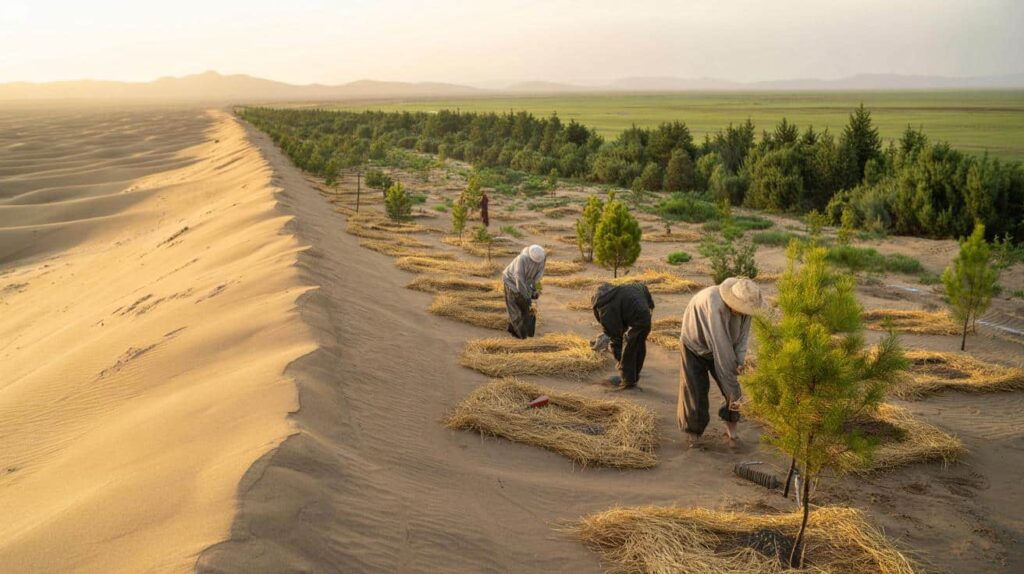
Farmers walk between neat rows of young trees wrapped in straw, checking the moisture, pressing the soil with their heels. Many of them once thought they would have to leave forever. Their land was turning to dust, their homes buried inch by inch.
Today, the dunes look like they’ve been put under a slow, stubborn spell.
Something big has shifted in the sand.

From choking dust storms to living green walls
Ask anyone in northern China over the age of 40 and they will remember the dust storms. The sky turning orange at noon, the taste of metal on your tongue, schoolyards swallowed by a moving wall of grit. Those storms didn’t come from nowhere. They were a symptom of deserts creeping east, swallowing pasture, draining rivers, stripping soil down to bare rock.
When Beijing’s streets vanished under dust in the 1990s, leaders finally saw the desert’s advance as more than just a rural problem. It was a national emergency hiding in plain sight.
Out in the northwest, on the edge of the Tengger Desert, there is a village where people used to tie ropes from their doors to the road so they wouldn’t get lost in the sand. Elder residents remember roofs collapsing under dunes that migrated overnight. Some families dug their way out. Others just left.
Then came the first planting brigades: workers, soldiers, students, anyone the local authorities could gather. They planted saplings in straight, endless lines, using simple tools and almost no shade. Today, satellite images show something extraordinary: patches of green where there used to be nothing but shifting beige.
Behind those pixels of green lies a staggering number: China has planted **over 1 billion trees since the 1990s**, aiming to slow the march of the Gobi and other deserts. Not all those trees survived, and not all the projects worked. Some plantations failed, some species were wrong for the soil, some areas were pushed too hard. *Large-scale restoration is never a clean, linear success story.*
Yet the broad trend is real. Studies from Chinese and international scientists show desert expansion has slowed and, in some regions, even reversed. That isn’t a miracle. It’s a grind of policy, human hands, and roots holding on under impossible sun.
The meticulous craft of stopping a desert
On the ground, the “Great Green Wall” is less a wall and more a patchwork of stubborn experiments. Technicians walk the dunes with GPS devices and notebooks, marking slopes where the wind hits hardest. They lay straw checkerboards on the sand, low and humble, to trap grains and stop them from blowing away. Then they tuck seedlings into the small protected squares, almost like tucking children into bed.
The method is simple: slow the wind, anchor the soil, give fragile roots a fighting chance. Desert control looks heroic from far away; up close, it’s a thousand small, repetitive gestures in the heat.
For locals, the work has changed daily life in quiet but profound ways. In parts of Ningxia and Inner Mongolia, former herders now earn a living tending tree nurseries or patrolling shelterbelts. They talk about fewer days lost to dust storms, fewer hospital visits for children with respiratory problems, and more stable yields from fields that once blew away every spring.
We’ve all been there, that moment when you wonder if your individual effort means anything against a huge, slow-moving crisis. Many villagers felt like that as well. Then they saw the sand stop creeping toward their doorsteps, even by a few meters, and something shifted in how they talked about the future.

Scientists are careful with their wording. They don’t call it victory; they call it mitigation. Desertification in China had many causes: overgrazing, deforestation, drought, poor land policies. Trees alone can’t fix all that. What they can do is buy time and space for new practices to take root: rotational grazing, drip irrigation, better crop choices, paid conservation work.
Let’s be honest: nobody really does this every single day with perfect discipline, from government officials to individual farmers. Policies get bent, shortcuts are taken, survival comes first. Yet the long-term numbers keep moving in the same direction: more restored land, fewer days when cities disappear under dust, more oases holding their ground.
Lessons from a billion trees: what actually works
On the technical side, the quiet revolution has been learning to plant less, but better. Early campaigns focused on sheer numbers. Millions of fast-growing trees were put in the ground with little regard for local water or soil. Too many died. In the last 15 years, engineers and ecologists started favoring native shrubs and hardy species that drink less and bend with the wind.
They plant in clusters, not carpets, leaving gaps where grass can return and wildlife can move. They adjust spacing so rain can reach the ground instead of getting sucked up instantly. It’s less photogenic than a thick forest, yet far more resilient.
For other countries watching China’s experience, there’s a temptation to copy the headline and skip the footnotes. Plant a billion trees, post the satellite images, declare the sand defeated. That’s where the biggest mistakes begin. Tree-planting can become a numbers game that ignores people who actually live on that land.
The more honest Chinese experts say the turning point came when they stopped seeing local communities as a problem and started treating them as long-term partners. That meant compensating farmers for fallowing fields, giving herders alternative income, and accepting that some land should stay grassland, not forest. Respecting that nuance is slower and messier, yet it’s what keeps the roots in the ground once the cameras leave.
“Trees are not soldiers you can just deploy and forget about,” one Beijing-based ecologist told me. “They’re more like neighbors. If you don’t get along with the people next door, the neighborhood won’t last either.”
- Choose **local species** that already survive harsh conditions.
- Mix trees with shrubs and grasses instead of forcing a uniform forest.
- Work with, not against, existing livelihoods like grazing or small-scale farming.
- Track survival rates, not only the number of saplings planted.
- Plan for decades, not election cycles or single budget years.
A greener horizon, and questions still blowing in the wind
Walk through a restored patch on the edge of the Gobi, and the changes feel subtle at first. The sand underfoot is firmer. Insects return. You notice tiny traces of wildlife: a fox print, bird droppings, the glint of a beetle crossing between roots. Then someone shows you an old photo from the same spot: nothing but dunes, a blank, blinding sea.
China’s billion-plus trees won’t save the planet on their own. They won’t erase the emissions from its cities or factories. They do something quieter: they prove that land pushed past its limits can still be coaxed back, if you’re willing to fail, adjust, and keep digging holes in the ground season after season.
There’s a question hanging over all this work: will these new green belts endure as climate change makes droughts harsher and temperatures stranger. Some plantations are already under stress, thirsty and thinning. Others are maturing into more natural, mixed woodlands that might outlive their planter’s grandchildren.
This story isn’t about perfection. It’s about momentum. When people at the edge of a desert can say, “The sand has stopped coming closer,” that sentence carries a kind of quiet power. It invites the rest of us to look at our own landscapes—urban or rural—and ask what might still be turned around, one stubborn root at a time.
| Key point | Detail | Value for the reader |
|---|---|---|
| Scale of planting | Over 1 billion trees planted in China since the 1990s | Shows how sustained effort can shift even massive environmental trends |
| On-the-ground methods | Straw grids, native species, mixed plantings, community jobs | Offers practical inspiration for restoration projects anywhere |
| Limits and lessons | Not all trees survived, and people’s livelihoods had to be part of the plan | Helps avoid common mistakes of one-size-fits-all tree campaigns |
FAQ:
- Question 1Has China really planted more than 1 billion trees to fight desertification?Yes. Since the 1990s, national programs such as the Three-North Shelter Forest Project and “Grain for Green” have led to the planting of more than a billion trees, along with shrubs and grasses, across northern and western China.
- Question 2Did all of those trees survive?No. Survival rates varied widely by region and species. Some early plantations failed due to poor species choice or lack of water. The lesson has been to focus on quality, native species, and long-term care rather than just hitting planting targets.
- Question 3Has desert expansion in China really slowed down?Multiple satellite-based studies suggest that desertification has slowed and, in some areas, reversed since the late 1990s. Dust storm days have decreased in cities like Beijing, and some degraded lands now show stable or recovering vegetation.
- Question 4Is tree-planting alone enough to stop deserts from spreading?No. Trees help anchor soil and reduce wind erosion, but they must be combined with better grazing practices, water management, and support for local communities. Otherwise, pressure on the land just shifts elsewhere.
- Question 5Can other countries copy China’s approach to fight desertification?They can learn from it, but not copy it blindly. What travels well are principles: using local species, involving residents, valuing long-term maintenance, and tracking real ecosystem health, not just the number of saplings in the ground.