The Tesla Cybertruck sat gleaming in the driveway, plugged into the wall like a giant metal pet waiting patiently for its owner to come back. He’d locked the front door, tossed his bags in the taxi, and flown off for a two‑week break, reassured by that comforting green charging icon on his phone. Daily check? Nah. It’s a Tesla. It’ll be fine. That’s the whole point, right?
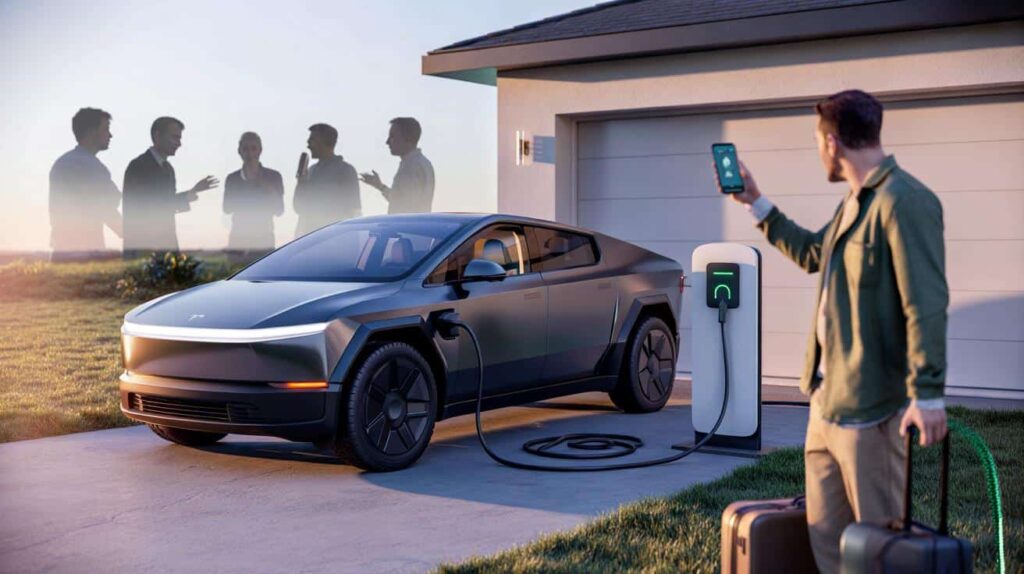
Two weeks later, suitcase in hand, he walked up to his futuristic pickup and pulled on the handle. Nothing. The truck wouldn’t wake up. The app wouldn’t connect. The only sound was the echo of his own disbelief in the empty driveway.
Minutes later, screenshots hit social media. And the real show started in the comments.

When your “smart” truck acts dumb after a holiday
You can almost picture his face scrolling through the Tesla app, waiting for the Cybertruck to ping back online and… silence. Then that creeping doubt: did the power trip? Did the charger stop? Did the truck really just die while being plugged in the whole time? It’s the modern equivalent of coming home to a fridge full of spoiled food because the plug fell out.
Most of us now treat EVs like oversized smartphones on wheels. You plug them in, you forget them, you trust the software. This owner did exactly that, went on holiday with a clean conscience, and still ended up with a six‑figure truck that refused to start.
His story landed on Reddit and X, accompanied by photos of the Cybertruck sitting motionless, like a high‑tech sculpture. He explained he’d left it at home, plugged into a wall charger, expecting a topped‑off battery and a smooth return. Instead, the system had glitched, the truck didn’t charge properly, and the battery drained down so far the vehicle wouldn’t even wake.
Comments exploded. Some owners chimed in with similar tales: cars losing charge due to “vampire drain,” home chargers disconnecting, planned trips ruined. Others posted their charging graphs, proudly showing two weeks away with barely any loss. Same brand, same tech, wildly different experiences.
That gap is where the tension lives.
Then came the split: *who* was to blame? One camp went straight for Tesla. A vehicle this advanced, at this price, should be able to manage its own energy, reconnect to the charger, send a proper warning before going dead. The other camp went for the owner. They argued he should have checked the app during the trip, verified the charge, maybe set a lower charge limit, maybe used Sentry Mode less, maybe disabled extra features.
Plain truth: an EV is both a car and a connected device, and a lot of people still treat it like one or the other, rarely both. That misunderstanding feeds frustration, especially when you’re standing in front of a $100,000 truck that might as well be a brick.
How to avoid coming home to a dead Cybertruck
There’s a quiet little ritual seasoned EV owners do before a long trip: they test everything. They plug in, wait a few minutes, check that the car is actually drawing power, and take a quick screenshot of the charging screen. It takes 30 seconds. That small, almost boring moment can save you from a driveway meltdown.
For a Cybertruck or any Tesla, a safe bet is to leave the battery somewhere between 50% and 80% if the car will stay parked. Set the charge limit, confirm the charger clicks on, and glance at the app. If the connection looks odd or the charge doesn’t start, you have time to fix it before your flight, not after.

Then comes the part nobody loves: checking in during the holiday. We’ve all been there, that moment when you swear you’re going offline, then open three apps without thinking. Sneaking a 10‑second look at your Tesla app once every few days is not the worst compromise.
Let’s be honest: nobody really does this every single day. Life gets busy, the beach is beautiful, the Wi‑Fi is bad. Still, a quick glance mid‑trip can reveal a charger error, a power outage, or a software bug that stopped the charge. Better to discover that on day three when you can call a neighbor than on day fourteen with luggage in your hands.
Some owners say the blame game misses the point. As one Cybertruck driver told me:
“People buy these trucks because they’re supposed to feel like the future. If I have to babysit it like an old laptop, something’s wrong with the promise, not just the owner.”
At the same time, experienced EV drivers quietly follow a few golden rules:
- Always confirm the charge has actually started before leaving for a long trip.
- Leave a healthy buffer: don’t park long‑term at 5% or 100%.
- Limit energy‑hungry features like Sentry Mode if the car will sit for days.
- Ask a neighbor or family member to glance at the car if you’ll be away for weeks.
- Check the app at least once during your trip to catch any silent errors.
This mix of tech expectations and old‑school habits is what really keeps an EV alive while you’re gone.
So… was it the Cybertruck’s fault or the owner’s?
The honest answer is uncomfortable: it was probably a bit of both, and that’s exactly why the story hit such a nerve. On one side, you have a customer who acted the way many of us would: plugged in, trusted the system, left. On the other, you have a machine filled with software, sensors, hidden settings, and plenty of ways for something minor to go wrong without shouting about it.
Some readers will look at this and think, “See? EVs are not ready.” Others will shrug, say the owner should have checked, and move on. Between those two extremes is a quiet group of drivers updating their mental checklist before their next holiday. They’ll test the charger, adjust their charge limit, maybe read the manual section they skipped.
The Cybertruck in that driveway has become a kind of mirror. It reflects what we expect from our cars now: not just power and design, but invisible reliability, constant connection, the feeling that the tech will watch over us without asking for much in return. When that illusion cracks, even once, people start asking harder questions. Not only about Tesla, but about what responsibility we, as owners, are really willing to take on when our vehicles become rolling computers.
| Key point | Detail | Value for the reader |
|---|---|---|
| Check before you leave | Verify that the Cybertruck is actually drawing power and take a screenshot | Reduces the risk of discovering a dead vehicle after a long trip |
| Manage long‑term parking | Park with 50–80% charge and limit energy‑intensive features | Protects battery health and preserves range over days or weeks |
| Use the app wisely | Quickly monitor charge status once or twice during your holiday | Gives time to react to charger failures or software glitches |
FAQ:
- Question 1Can a Tesla Cybertruck really lose its charge while plugged in?
- Question 2How often should I check my EV while I’m away on holiday?
- Question 3Is it safe to leave an EV at 100% for two weeks?
- Question 4What settings should I adjust before long‑term parking?
- Question 5What should I do if I come home and my EV won’t start?