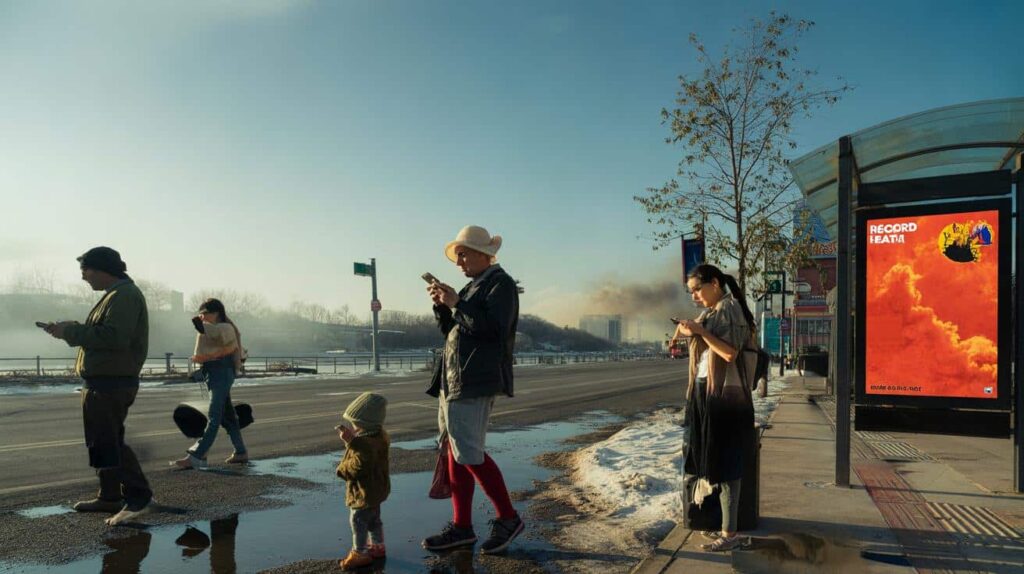
The forecast said “warm for the season,” so you left in a light jacket. By 10 a.m., the air felt like late June, the asphalt giving off that wavy, road‑trip heat. A kid on a bike passed by with a wool hat tied to his handlebars, already useless. Someone joked at the bus stop, “Guess it’s fake winter again,” and everyone laughed, because what else do you do.
Then your phone buzzed. Another alert: “Hottest January day on record.” Again.
Nobody screamed. Nobody marched. People just… adjusted their scarves and went on with their day.
Somewhere between the third “record-breaking” month and the fifth “once‑in‑a‑century” storm, something quietly shifted.
We stopped being shocked.
When disaster starts to feel ordinary
Ask climate scientists what really scares them, and many won’t say hurricanes or wildfires. They’ll say this: that we’ve started treating extremes as normal background noise.
The climate signal that alarms them isn’t just temperature graphs or sea‑level charts. It’s our numbness. Our ability to stand in the middle of a freak weather event, film it for Instagram, and then scroll on.
That quiet shrug is becoming part of the data.
We’ve normalized the abnormal.
And once a society crosses that line, turning back gets much harder than cutting CO₂ on a spreadsheet.
Look at the summer of 2023 across the Northern Hemisphere. Cities from Phoenix to Athens spent weeks above 40°C, nights included. Emergency rooms filled with heatstroke cases. Planes couldn’t take off because the tarmac was literally melting.
Yet the language around it began to sound almost casual. “Another heat dome.” “Another mega‑fire season.” News tickers ran side by side with sports scores, as if they were just different flavors of content.
People started swapping tips on the best portable fans, not on how to push their local representatives for shade trees, cooling centers, or emissions cuts. The crisis turned into a lifestyle challenge.
That shift — from shock to workaround — is exactly what experts are watching with growing unease.

Psychologists have a name for this drift: “shifting baseline syndrome.” Each year, we reset our idea of “normal” to match what we’re living right now. Last summer was brutal, so this summer feels “not that bad,” even if the numbers say otherwise.
Our grandparents’ idea of a cold winter would feel like a sci‑fi movie to many kids today. Yet those kids will grow up thinking their sweltering classrooms and smoky skies are just the way things are.
*That creeping acceptance is a climate feedback loop all by itself.*
Because once extreme feels everyday, the political pressure to act dissolves. And without that pressure, the graphs keep climbing quietly in the background.
How to resist climate numbness in ordinary life
One small, practical move: start keeping your own “climate memory.” Not a perfect spreadsheet. Just a living note on your phone or in a notebook.
Write down the first day you needed the fan this year. The first night you couldn’t sleep from the heat. The time the river near you hit a low that shocked your parents, or a high that flooded the path you walk every Sunday.
Tag big headlines too — “city hit 45°C,” “smoke from fires 1,000 km away.”
This isn’t about being dramatic. It’s about building your own baseline, so you don’t slowly accept what would have once felt unthinkable.
 Emergency declared in Greenland after orcas are spotted dangerously close to rapidly melting ice
Another move is mental, not technical. Watch your own language. When you hear yourself say “crazy weather” for the fifth time that month, pause. Call it by its name: a symptom of a destabilized climate.
That doesn’t mean living in constant panic. Nobody can function like that. It means refusing to treat every new shock as just another quirky plot twist.
We’ve all been there, that moment when you share a flooded subway video with a laughing emoji, even though part of you feels sick.
Let’s be honest: nobody really does this every single day.
Yet carving out even a few minutes a week to connect dots — to talk to a friend, a kid, a colleague about what you’re noticing — keeps your inner alarm from quietly switching off.
Climate researcher Friederike Otto once put it bluntly: “We are not living through ‘bad luck.’ We’re living inside a climate that humans have already changed — and we’re still turning the dial.”
That’s the plain truth behind the weird winters and endless fire seasons.
The weather isn’t just the weather anymore. It’s a message.
- Name what you see
Instead of “crazy storm,” say “this is what a warmer ocean looks like where we live.” It feels small, but the words you choose shape how your brain files the memory. - Connect one feeling to one action
Scared after reading about a heatwave? Sign one petition, donate 5 dollars, email one local official. Small doesn’t mean pointless when it’s repeated. - Protect your attention
Doom‑scrolling endless disaster clips can deaden you. Curate a few trusted sources, then step away. Numbness grows in the endless scroll, not in focused awareness. - Talk to one younger person
Ask what they notice about seasons, air quality, or storms. Listen more than you speak. Their version of “normal” tells you how far the baseline has already shifted. - Create tiny rituals
Maybe it’s checking river levels once a month. Maybe it’s walking the same tree‑lined street each season. These habits keep you tethered to real‑world change, not just headlines.
The line between adaptation and surrender
There’s a tricky balance here. We need to adapt — new building codes, heat plans, flood defenses — without sliding into quiet surrender. Buying better air conditioning while voting for leaders who delay climate policy is a form of doublethink that many societies are learning to live with.
Experts worry less about your individual air‑con and more about a broader social story: that humans are infinitely adaptable, will “figure it out,” and can bend any climate into something comfortable with enough tech and money.
On a wealthy street, that story almost sounds true. On a rooftop in Dhaka during a 45°C heatwave, it falls apart fast.
The danger is that our adaptation comforts can become a kind of sedative, blurring the fact that we’re still actively heating the world.
| Key point | Detail | Value for the reader |
|---|---|---|
| Notice the signal | Use your own memories and simple notes to track how “normal” seasons are changing where you live | Helps you resist numbness and see patterns you might otherwise ignore |
| Shift your language | Replace vague phrases like “crazy weather” with climate‑aware descriptions and context | Builds a clearer mental link between daily life and global warming |
| Link emotion to action | Turn moments of anxiety or shock into one concrete step, however small | Reduces helplessness and reinforces a sense of agency |
FAQ:
- Question 1Isn’t extreme weather just part of natural climate cycles?
- Answer 1Natural cycles exist, but scientists now have strong attribution studies showing that many recent heatwaves, floods, and fires are far more likely — and more intense — because of human‑driven warming. The background climate has shifted, so the “natural” dice are loaded toward extremes.
- Question 2Why is “getting used to it” such a problem?
- Answer 2Adapting emotionally helps us cope day to day, but total numbness kills urgency. When extremes feel routine, voters, institutions, and companies feel less pressure to cut emissions or invest in real resilience. The risk grows while our response slows.
- Question 3What’s the main climate signal experts watch besides temperature?
- Answer 3They watch the frequency and intensity of extremes — heatwaves, heavy rainfall, droughts — and how society responds to them. A world where disasters are normalized, under‑reported, or depoliticized is one where deeper risks can build unchecked.
- Question 4Can individual actions really matter against such a huge problem?
- Answer 4No single lifestyle change “fixes” the climate, but personal choices shape culture, markets, and politics. When millions shift habits, talk differently, and vote with this in mind, it changes what leaders and companies see as possible or necessary.
- Question 5How do I stay informed without burning out?
- Answer 5Pick a small set of trusted sources, set limits on news time, and balance hard facts with stories of solutions and progress. Pair what you read with one simple action. That way, information feeds agency instead of anxiety.