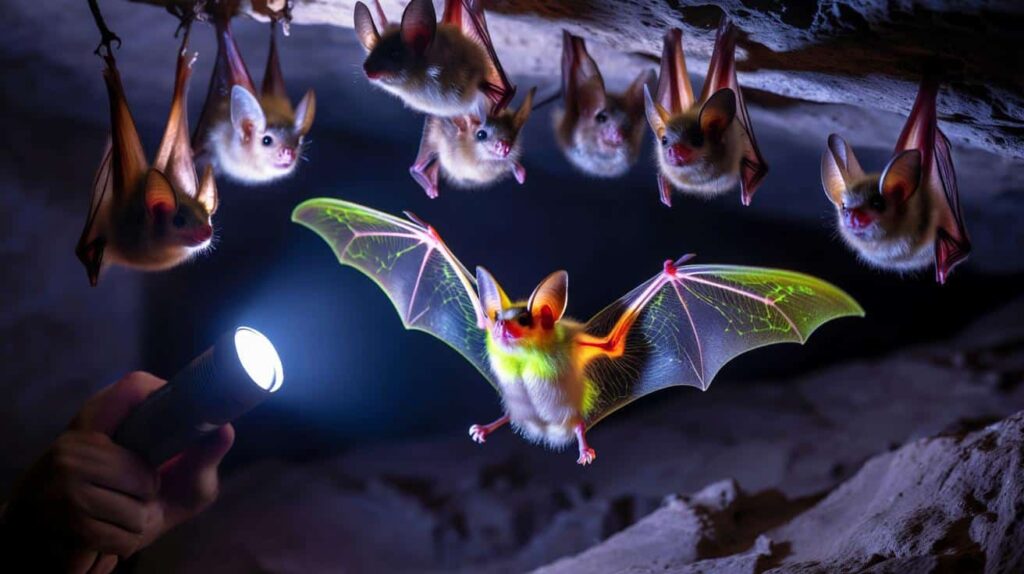
What began as a quirky side experiment has turned into a serious scientific story: bats, long cast as Halloween villains, are revealing secret glowing patterns under ultraviolet light that could reshape what we think we know about mammal vision, communication, and even conservation.
Glowing fur in the dark
From dusty specimen to fluorescent surprise
The first hints did not come from the rainforest, but from museum drawers. Researchers shining UV torches on old bat skins noticed patches of pink, green and orange shining back at them. When they repeated the experiment with live animals in controlled conditions, the result was the same: bats glowed.
Under ultraviolet light, many bats show vivid fluorescent patterns on their wings, fur, and faces that are invisible in ordinary daylight.

This glow is not a Halloween filter. It comes from compounds in bat tissues that absorb invisible ultraviolet radiation and re-emit it as visible light. The effect appears the moment UV is switched on and vanishes just as quickly when the light goes off.
The chemistry behind the glow
The phenomenon is called fluorescence. It differs from bioluminescence, where animals create their own light, like fireflies or some deep-sea fish. Bats do not generate light internally; they simply “re-colour” incoming UV.
Researchers point to a family of molecules called porphyrins as the main culprits. These ring-shaped compounds are found in many mammals and are involved in key processes such as oxygen transport and cell metabolism. Under UV, they shine.
- Flying foxes can show bright green patterns on their thin wing membranes.
- Some weasel bats reveal hot pink tones in their fur.
- Certain related mammals, like springhares, display an orange-red sheen.
- Several insect-eating bats glow in a faint blue-white wash.
The pattern and brightness differ from species to species, and even between individuals. That variation is what excites scientists most, because it hints at potential function, not just a chemical quirk.
How widespread is fluorescent fur in bats?
A trait that crosses continents
Once the first glowing bats were reported, other labs rushed to check their own collections. What looked rare at first is now turning out to be surprisingly common. Fluorescence has been recorded in several bat families and across multiple continents, from tropical fruit bats to tiny insect hunters.
| Bat family | Typical fluorescence colour | Main body area affected |
|---|---|---|
| Pteropodidae (fruit bats) | Green | Wing membranes |
| Vespertilionidae (many insectivorous bats) | Pink to red | Fur, ears |
| Molossidae (free-tailed bats) | Orange | Face and head |
This spread suggests that glowing fur might be an inbuilt aspect of bat biology, not a rare, specialised adaptation. Since porphyrins occur in other mammals as well, similar effects may be waiting to be revealed in species that have simply never been checked under UV.
Fluorescence in bats looks less like a bizarre exception and more like a hidden layer of mammalian colour that humans normally cannot see.
Fluorescence vs bioluminescence: what bats are really doing
Clearing up a common confusion
Glowing animals tend to get lumped together, but the mechanisms differ sharply. In bats:
- Fluorescence needs an external UV source.
- The glow stops immediately when UV is removed.
- No internal chemical “light engine” is involved.
That makes bats quite different from, say, a glow-worm, which shines in complete darkness through chemical reactions in its body. Bats are not lanterns; under normal night skies, their glow is triggered only when some ultraviolet light is around.
How scientists measure the glow
To move beyond pretty pictures, researchers use instruments like spectrophotometers to measure exactly which wavelengths bats absorb and emit. High-resolution cameras sensitive to low light help capture fluorescent patterns without stressing the animals for long periods.
Biochemists then extract and analyse fur samples to identify the fluorescent molecules and how concentrated they are. These methods have revealed a few early patterns.
- Fluorescence can vary with season, hinting at links to breeding or diet.
- Individuals in poor condition sometimes show weaker fluorescence.
- Closely related species often have distinct UV patterns.
UV glow is emerging as a potential snapshot of a bat’s health, reproductive state, and even species identity.
Can bats actually see their own glow?
Bat eyes and ultraviolet vision
This question sits at the heart of the debate. If bats cannot detect UV or the colours produced by fluorescence, the trait may be an accidental side effect. If they can, then glowing fur could play a role in their behaviour.
Many bats rely heavily on echolocation, but they do possess functioning eyes, and some species are active at dusk when UV from the sun is still present. Studies of bat retinas suggest that at least some species show limited sensitivity to UV light, though not as strongly as birds or many insects.
The picture is probably mixed. Certain fruit bats with larger eyes and more diurnal habits might have stronger UV vision than strictly nocturnal insect-hunters. Untangling these differences will take careful behavioural tests under controlled lighting.
Behaviour under UV in the lab
In captivity, bats exposed to UV do not seem alarmed. Tests so far report:

- Little or no avoidance of UV-lit areas in most species studied.
- Normal social interactions, such as grooming and clustering, continuing under UV.
- Unchanged echolocation calls and flight patterns.
- A slight uptick in grooming in some cases, whose meaning is still unclear.
Those reactions suggest that UV is not inherently stressful at the levels used in research. Longer-term impacts remain uncertain, so teams are being cautious about exposure times and intensities.
Why would bats glow at all?
Communication and mating signals
One leading idea is that fluorescence acts as a subtle visual signal layered on top of sound and smell. In a crowded roost under moonlight, a faint glow on the wings or face could help bats tell friend from stranger.
- Species could recognise each other by characteristic patterns.
- Potential mates might assess health via brightness or consistency of the glow.
- Dominant individuals could display more extensive fluorescent areas.
Seasonal changes in glow intensity line up temptingly with breeding periods, hinting that fluorescent fur might function as a low-light dating profile.
Surprising links to camouflage
Another idea runs in the opposite direction: instead of making bats stand out, fluorescence could help them blend in. Under moonlight, which includes some UV, glowing fur might match the reflective background of leaves or rocks, breaking up a bat’s outline.
| Proposed role | Supporting clue | Current evidence level |
|---|---|---|
| Mate attraction | Seasonal shifts in fluorescence strength | Actively tested |
| Species recognition | Different patterns in closely related species | Early but promising |
| Camouflage | Match with UV reflectance of vegetation | Mainly theoretical |
Any predator that lacks UV sensitivity would not notice the difference. That makes fluorescence a potentially “safe” signal, visible mainly to species with the right vision, while remaining hidden from many threats.
New tools for conservation
Glowing bats as health indicators
Bats face pressure from habitat loss, pesticides, wind turbines and emerging diseases such as white-nose syndrome. Conservationists are constantly searching for fast, non-invasive ways to check colony health.
Because fluorescent patterns seem linked to diet, metabolism and immune status, UV images may offer a low-contact health check for wild bats.
By photographing roosting bats with calibrated UV equipment, teams could track changes in colour or brightness across seasons. Shifts might flag:
- Malnutrition or reduced prey availability.
- Infection spreading silently through a colony.
- Chemical contamination affecting metabolism.
- Physiological stress from new construction or lighting nearby.
This sort of monitoring is still experimental, but it has clear appeal in caves or roosts where catching animals is logistically difficult or legally restricted.
Light pollution and hidden side effects
Urban lighting is already known to alter bat behaviour, steering them away from bright roads or towards insect-rich lamps. Artificial UV components in modern LEDs and advertising signs could add a new layer of complexity.
- Stray UV might make bats more conspicuous to predators with UV vision.
- Constant low-level UV could distort natural fluorescent cues used for mating.
- Streetlights near roosts might reshape how and when bats leave shelter.
- Careful design of lighting spectra and shielding could limit disruption.
Some cities are already experimenting with “bat-friendly” streetlamps that cut UV output and reduce skyglow, a step that might matter more than planners realise as we learn how much information bats pack into light we cannot see.
Making sense of the glow: key terms and practical angles
Fluorescence, UV and what humans miss
For anyone trying to follow the science, a few terms help:
- Ultraviolet (UV): Light just beyond the violet end of the spectrum, invisible to humans but detectable by many animals.
- Fluorescence: A material absorbs high-energy light (like UV) and quickly re-emits lower-energy visible light.
- Porphyrins: Pigments found in blood, skin and fur that can fluoresce brightly under UV.
Under normal conditions, bats do not look like glowing toys. Their fluorescent patterns only appear when UV is present, whether from twilight, moonlight, or artificial light sources. Without that trigger, they remain as muted and camouflaged as any other nocturnal mammal.
What this means for people living near bats
For bat workers, UV imaging could become part of routine field kits, used alongside acoustic detectors and thermal cameras. A quick UV scan of a colony might reveal young bats with weaker glow suggesting nutritional stress, guiding where to focus habitat restoration.
For households that host bats in roofs or gardens, the science offers a different kind of reassurance. Glowing fur does not signal radiation or toxicity; it reflects normal biochemistry. The main risks to bats still come from loss of roosts, pesticides reducing insect food, and unmanaged lighting, not from their newfound party-trick under UV.
As research continues, those strange neon outlines seen in the lab hint at a richer sensory landscape than humans experience. Bats, often reduced to horror props each October, turn out to be carrying quietly intricate visual signals, written in colours that only ultraviolet can reveal.