It’s 10:30 on a Tuesday morning and the park is full of good intentions.
There’s the fast walker with the sports watch, the man with the Nordic poles, the woman in perfectly folded yoga pants.
On a nearby bench, 74‑year‑old Denise watches them go by. Her doctor told her she “had to walk 10,000 steps a day”. She tried. Her knees protested, her back flared up, and the pedometer on her phone became a small daily guilt machine.
Next to her, a grandfather scrolls through videos of seniors lifting weights at the gym. He shakes his head. That doesn’t look like his life either.

What if after 70, the key isn’t walking more or training harder, but moving… differently?
Why daily walks and weekly gyms hit a ceiling after 70
Walks are lovely. They help blood circulation, mood, and sleep. But after 70, the body quietly changes its rules.
Muscles melt faster. Reflexes slow down. Balance becomes a fragile thing.
You can hit 8,000 steps and *still* struggle to get up from the sofa without pushing on your thighs.
That’s the hidden trap of the “just walk” advice.
It sounds gentle, realistic, almost comforting. Yet it barely touches the abilities that decide whether you’ll live independently at 80 or need help for the basics.
Take Marcel, 79. He walks every day with a friend, same loop, same pace. Fifteen years of loyal steps, rain or shine.
One morning, he trips on a small curb. The fall seems minor, but the hip fracture is not. Eight weeks of reduced mobility, lost muscle, loss of confidence.
Statistics are brutal: a large share of people over 80 who fall and are hospitalized never fully regain their previous level of autonomy. Not because they didn’t walk. Because their body lacked three protective shields: strength, balance, and the ability to get up from the ground quickly.
The pedometer doesn’t measure those.
The human body is lazy and efficient. Give it the same walk every day and it optimizes for that, then stops adapting.
You become good at your loop… and less prepared for surprises. A dog pulling on the leash. A bus step that’s higher than expected. A suitcase to lift.
The weekly gym session has its own flaw. One big effort, six days of almost nothing. For aging muscles and nerves, this “all at once” model gives less progress than tiny, repeated signals across the week.
The body listens less to the spectacular effort than to the quiet, daily, almost boring ones.

The movement pattern that really upgrades healthspan
The pattern that changes everything after 70 is simple: **mini-doses of strength, balance, and floor work, spread through the day**.
Think “movement snacks” rather than “workout”.
Two minutes while the kettle boils. Three while the news runs. One every time you stand up from a chair.
Here’s the skeleton of this pattern:
Stand up from a chair without using your hands, 5–8 times.
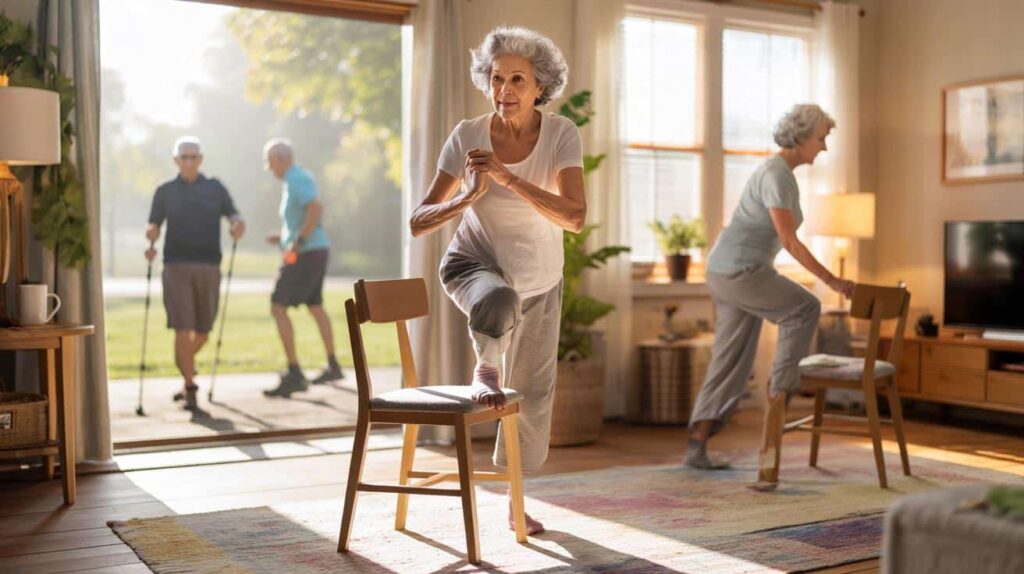
Hold on to the back of that chair and stand on one leg, 10–20 seconds each side.
Gently practice getting down to the ground and back up, even if it’s just once.
Done three or four times a day, this bare-bones routine rewires your body much more than a weekly hour on the treadmill.
Most people imagine “strength training” as barbells and sweat and loud music. Past 70, strength begins with a simple question: can your legs and hips handle your own body weight, in everyday positions?
The main mistake is waiting for the perfect setup: the right shoes, the elastic bands delivered, the class starting next month. Days pass. Then weeks. Then another year goes by and the stairs feel steeper.
There’s another trap: pushing too hard, too fast, out of frustration or fear. Two heroic days, sore muscles, then a long stop.
Let’s be honest: nobody really does this every single day.
Progress lives in the middle ground. Two to five minutes, most days, with no drama. Enough to wake the muscles, not enough to exhaust them. That’s where healthspan quietly grows.
“What saves autonomy after 70 isn’t marathon heroics,” says a geriatric physiotherapist I interviewed. “It’s the ability to get off the floor, stand up without help, and catch yourself when you’re about to fall. Those are trainable skills, not a lottery of good genes.”
- Chair stands
Sit, cross arms over chest, stand up slowly, sit back down. Start with 3–5, aiming toward 10. - Balance holds
Hold a chair with one hand, stand on one leg, then the other. Tiny wobbles are your nervous system learning. - Wall push-ups
Hands on the wall, body tilted slightly. Bend and straighten elbows. Great for arms and chest without hurting joints. - Step practice
Use the lowest stair. Step up and down slowly, lightly holding the banister. - Floor practice
Once or twice a week, rehearse: kneel, sit on the floor, then stand back up using a stable support if needed.
From “exercise session” to a moving life
When older adults adopt this movement pattern, their days subtly rearrange. The bedroom dresser becomes a balance bar. The kitchen table, a place for slow push-ups. The hallway, a mini-walking lab with deliberate steps and turns.
Instead of one big block of effort, life fills with tiny anchors: six chair stands before lunch, a balance pause while the coffee drips, one careful floor descent and rise on Sundays, just to keep the dialogue with gravity alive.
What changes first isn’t strength. It’s confidence. The fear of “what if I fall and can’t get up” softens, replaced by a quiet “I’ve practiced this”. That shift alone rewrites how you go out, travel, or simply shower without constant worry.
| Key point | Detail | Value for the reader |
|---|---|---|
| Shift from steps to skills | Focus on standing up, balance, and getting off the floor | Targets the real abilities that protect independence |
| Use “movement snacks” | Multiple 2–5 minute bouts spread through the day | Makes progress possible without draining energy or willpower |
| Train for unexpected events | Practice turns, small steps, and gentle floor work | Reduces risk of falls and boosts confidence in daily life |
FAQ:
- Question 1Is it too late to start this kind of training after 75 or 80?Not at all. Studies show that even people in their 80s and 90s can gain strength, balance, and walking speed with simple, regular practice. The key is starting gently, being consistent, and adapting to your medical situation with professional advice if needed.
- Question 2What if getting down to the floor feels scary or impossible?Begin by rehearsing only part of the movement: sit on a higher surface, practice kneeling with support, or use a firm bed instead of the bare floor. Over time, even practicing how you’d call for help and roll onto your side can reduce fear and improve real-life safety.
- Question 3How many minutes per day are realistically useful?For most people, 10–20 total minutes, broken into small chunks, already makes a noticeable difference over a few months. Even 5 minutes is infinitely better than none. The goal is repetition across the week, not length on a single day.
- Question 4Should I stop walking if I adopt this pattern?No, walking stays valuable for heart, lungs, and mood. Think of this pattern as the missing layer on top of walking. You keep your strolls, but you add targeted work for strength, balance, and floor skills so your walks remain possible for longer.
- Question 5Do I need equipment or a gym membership?Most of this can be done at home with a chair, a wall, and maybe a staircase. A small elastic band or light weights can be added later, once the habits are in place. The real resource is your willingness to weave movement into your everyday objects and routines.