The first snow of the season was still fresh on the shoulders of the highway barriers when Mark’s gas light came on. He squinted at the dashboard, did a quick mental calculation, and muttered that classic winter phrase: “I can stretch it another 20 miles.” Outside, the temperature on the billboard read 9°F. Inside, the heated seats hummed and the podcast kept playing, like nothing could go wrong.
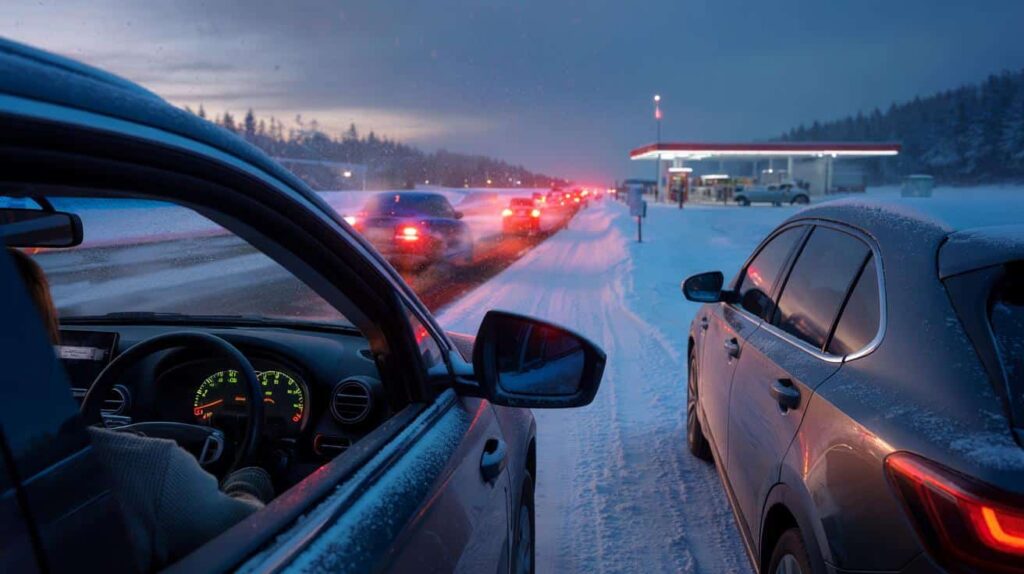
At the next exit, the gas station was packed. Some drivers brimmed their tanks and tapped on their phones. Others just threw in ten bucks and rushed off. Same road, same weather, totally different strategy.
Ask auto technicians about this and you’ll hear two stories. One says you’re wasting money by topping up too much. The other insists a full winter tank can literally save your life.

Both sound convincing.
Why your winter gas tank sparks such strong opinions
Spend ten minutes in a cold garage with seasoned mechanics and the debate starts almost on its own. One will swear that running your tank low is “no big deal” with modern cars. Another will shake their head and talk about frozen lines, stranded families, and cars towed in from the side of lonely highways at 2 a.m.
They’re not arguing to be dramatic. They’re reacting to what they see every winter: very different outcomes for drivers who treat the gas gauge like a suggestion and those who treat it like a safety device.
Take a typical January storm in the Midwest. Traffic slows to a crawl, then barely moves. A 25‑minute commute quietly turns into three hours of idling in a line of red brake lights. People start turning off their engines to “save gas”, then turning them back on when the cold bites through their coats.
By the second hour, some tanks are nearly dry. That’s when the calls start. Tow trucks, state troopers, worried partners. The cars that came in with half a tank keep humming along with steady heat. The ones that rolled in on fumes get cold, fast. The weather doesn’t care how much you saved by skipping that last fill‑up.
Behind the drama there’s real engineering. Low fuel can push the small electric pump in your tank to work hotter, because it losing the cooling effect of the fuel around it. Condensation can build inside a nearly empty tank in freezing temperatures, adding moisture that can sneak into filters and lines. Modern systems are way more tolerant than older ones, but they’re not magic.
So when a tech tells you “fill up often, it protects your car,” they’re not just repeating old rumors. They’re translating a messy mix of physics, weather and human behavior into simple habits.
When topping up is smart — and when it really is overkill
If you talk to winter driving experts, they often repeat one simple rule of thumb: treat half a tank as your new “empty” when it’s truly cold out. Not because your car will explode if you go below that. But because above half a tank, you usually have enough fuel to get stuck in traffic, idle for warmth, and still reach the next open station.
One practical routine many drivers adopt is this: every time the temperature drops below freezing for a few days, they fill up before they reach a quarter tank. No drama, no panic fill‑ups, just a quiet ritual that keeps the gauge in the safer zone.
There’s also a psychological trap here. Gas is expensive, and watching the total climb on the pump screen stings. So lots of people “sip” fuel: ten dollars here, fifteen there, never actually brimming the tank. On a warm summer evening, that’s mostly a budget choice. In a blizzard, it can turn into an emergency.
One Canadian technician told me about a young couple who skated into his lot on pure fumes after a whiteout. Their baby was strapped in the back, pink‑cheeked and silent. They’d been stuck behind an accident for over an hour, engine idling, gas dropping, cell reception spotty. “We only put in twenty bucks last time” turned very quickly into “we almost froze.”

At the same time, some techs roll their eyes at the idea that you must drive around with a full tank all winter long. For many modern vehicles, with well‑sealed tanks and better fuel systems, the old fear of massive condensation turning into a tank of water is greatly reduced. If you live in a dense city, pass six stations on your daily route, and rarely drive into rural areas, constantly topping to the brim can feel like overkill.
Let’s be honest: nobody really does this every single day. So the real question becomes less “full or not full?” and more “do you regularly have enough fuel for when winter throws a curveball?” That’s the line between wasteful and wise.
The simple checklist that can keep you from freezing on the shoulder
One reliable method is to build your gas habit around your life, not around abstract rules. If your longest usual winter drive is 40 miles, think of how that looks in a bad storm: traffic, detours, maybe a road closure. Then double it. Keep enough fuel for that distance plus at least an extra hour of idling with the heater on.
Practically, that often means planning a fill‑up before big trips, not after. Setting a quiet personal rule like, “If I’m going on the highway and I’m under half a tank, I stop first.” Simple, slightly annoying, and surprisingly protective.
There are a few common mistakes that auto technicians see on repeat. Waiting for the low‑fuel light in winter is a big one, almost like a badge of honor. Another is relying on the “miles to empty” estimate as if it were carved in stone. Those numbers swing hard in cold weather, idling, hills and headwinds.
Then there’s the emotional side. We’ve all been there, that moment when payday is still three days away and the tank is low. Guilt, stress, and a quiet hope that the car will “just make it.” An empathetic tech won’t judge you for that. They’ll simply tell you that if money is tight, topping small amounts more often beats running to fumes in January.
“From my tow‑truck window, a ‘waste of money’ is usually a car that saved ten dollars on gas and spent three hundred on a frozen‑night rescue,” says one veteran driver. “Fuel is cheaper than panic.”
- Set your winter “minimum”
Decide on a line — quarter tank, half tank — and treat it as your personal red zone once the temperature drops. - Fill before storms, trips, and late‑night drives
A quick top‑up before you head out can turn a stressful delay into a non‑event. - Keep a small emergency kit
Blanket, phone charger, snack, gloves. Gas isn’t the only thing that keeps you okay when the car stops. - Don’t blindly trust “miles to empty”
Treat that number as a rough hint, not a promise, especially in deep cold. - Balance budget and safety
If money is tight, aim for steady small amounts rather than heroic stretches on nearly empty.
A winter habit that’s more about mindset than the gauge
The whole “fill your tank in winter” debate hides something deeper than gasoline. Underneath the arguments about condensation and fuel pumps is a basic question: how much do you want to depend on luck when the weather turns hostile? Some drivers are comfortable living close to the edge, watching the range tick down like a game. Others sleep better knowing they can idle in a traffic jam for hours without their teeth chattering.
*Neither camp is wrong by definition; they’re just playing different odds.* A city driver with round‑the‑clock gas stations might accept more risk than a nurse driving home on empty country roads at 3 a.m. The same rule on paper looks very different in real life.
That’s why some auto technicians sound alarmist and others shrug. One spends their nights pulling people out of ditches far from town. Another mostly sees small city cars coming in for scheduled service. They’re watching different movies. When you decide what topping up means for you this winter, it’s worth picturing your own version of “worst case”: your roads, your weather, your schedule, your budget.
From there, the habit almost writes itself. A bit more fuel in the tank, a bit less anxiety in the back of your mind. You might still catch yourself rolling past a station and thinking, “I’ll get it next time.” On some days, that will be just fine. On others, that tiny choice could be the reason you come home warm.
| Key point | Detail | Value for the reader |
|---|---|---|
| Winter “minimum” level | Many experts suggest treating a quarter to half a tank as the new empty in cold weather | Gives you a simple rule to avoid being stranded with no heat in traffic or on empty roads |
| Context over one-size-fits-all | City drivers with many stations have different needs than rural or night‑shift drivers | Helps you adapt advice to your own life instead of following rigid, generic rules |
| Small, steady refills | Adding modest amounts more often can be safer than running near empty, even on a tight budget | Reduces breakdown risk without wrecking your finances in one big fill‑up |
FAQ:
- Question 1Do I really need to keep my tank at least half full all winter?
- Question 2Can a low fuel level actually damage my car in cold weather?
- Question 3Is condensation in the tank still a real issue with modern cars?
- Question 4How much gas do I need if I get stuck idling in a traffic jam or snowstorm?
- Question 5What’s a realistic winter fuel habit if I’m on a tight budget?